Uplokkid
During the first lockdown of spring 2020, as we followed our owl around the common, I was thinking a lot – as many people did in those weeks – about solitude, about aloneness, about separation and isolation and the subtle distinctions between those states. I thought about people who have lived in isolation for different reasons in different times. About people in captivity, people incarcerated, people who are housebound. I thought about people who could not be alone, for whom togetherness is enforced. I thought about people who are lonely wherever they are, who carry their aloneness about with them, an invisible force field through which no one can reach. I thought about anchoresses, who had fascinated me during my undergraduate years: religious hermits who took a vow of enclosure. I thought about the choice to live a separated life over a life of company without agency. I thought about the difference between company and companionship, of the presence of others and of togetherness.
I began making single-word ink drawings, visual poems, from words for seclusion and isolation used in Middle English, words anchoresses might have used. It began as a distraction from the pandemic and my inability to focus on writing or reading. It became a daily practice – meditative, joyful – adding colour to those blurry weeks. I worked with inks I already had in the house, and our sweet, soft Lake District water.
The idea came from a tweet, from an account named for Margery Kempe – the mystic or heretic who dictated the story of her life and visions to a scribe in the 1430s. Her book is often described as the first autobiography in English. I chose four words from a list the account shared – uplokkid, reclused, onlihede and solnes – and traced them in water on thick paper before adding ink. I repeated them and repeated them, as though in the repetition some sense would resolve from the seeping colour. How it revealed the structure that was already there, but barely perceptible. How it made something beautiful from it. But the more times I wrote the words out, the more shades of meaning leached from my brushstrokes. The more ambiguous I felt my state of seclusion to be, the more ambiguous I felt about isolation.
Uplokkid means locked up, enclosed – but also implies protection, sanctuary. To be contained is not always to be restricted.
Reclused likewise means shut up, confined, enclosed. To live in a state of retirement from the world, chosen or unchosen. To live in seclusion, apart from society. We carry it forward in the noun ‘recluse’, but we have lost its use as a verb.
Onlihede, onlyhood, is the state of being alone, singular, separate. It means solitude, but also difference from others.
Solnes means solitude, singleness, aloneness, but also holds within it the quality of being a sole being, united and unique, complete in selfhood – the wholeness of being a distinct creature. There is that echo in it, of course, of soulness.
Like many disabled people, I knew at that time I was safer enclosed and contained, in a world in which others are similarly enclosed and contained. Like medieval mystics in their anchorages, my mind was on the long-term rewards of short-term sacrifices. I found myself embracing solitude for a higher purpose: not holiness, but haleness, wholeness. Health. Long-term survival. Our unique and united mortal souls.
In that spring of 2020 I was not alone in my isolation. I was uplokkid with a beloved human and a beloved cat. We were isolated from other humans, but the other humans were also isolated, so although we were apart, we were also together. We were alone, but we were united. We were alone, but we were entire. We were single, but singularly ourselves. We needed unity to have singularity.
But as the writer Damian Barr put it, we were not all in the same boat – we were in very different boats, trapped in the same storm. My boat was chronic illness. The longer the storm went on, the smaller and more fragile my boat seemed, the bigger the waves. Once most people decided the storm was nothing to worry about any more, my boat still felt it, was still at the mercy of it. Still is. They cranked up their engines and the waves cast by their wake crashed over my hull, flooding my engine.
My love and I became increasingly alone, distinct in our separation, in our inability to ignore the risks company posed.
There is the literal, ongoing social isolation of still trying to avoid an airborne illness once most people decide it cannot and should not be avoided. The isolation of not going to parties, not going to dinners, not going to gigs and shows and not going to festivals. Then there is the emotional isolation. I have never felt so alone, so separate from other people, as I have felt in these pandemic years. It has magnified all the aloneness I have felt in my chronic life, all the times I have missed out because I was too ill to go out. I have raged against it and I have let myself sink into it. I have gone to an event, masked, the first I have risked in months, and crumpled under the scrutiny of unmasked peers and their unthinking exclamations. ‘I haven’t seen you in years! Where have you been hiding?’ ‘At home,’ I want to reply. ‘From you. From all of you. From your back-to-normal that does not include me, does not value me.’ But instead I say, ‘Oh, you know, hanging out with the deer and the owls.’ Increasingly, it is easier to spend time with the owls than with people who are living such a different reality from mine. I cannot forget every time they have said they could not bear to live as I live, or that lives like mine are not worth conserving. I cannot forget how quickly they left us stranded in the squall, as soon as they could.
It has been a particular kind of aloneness, a separation from which I sometimes feel my heart will never recover. My heart, my soulness.
I choose the company of owls.
◆ ◆ ◆
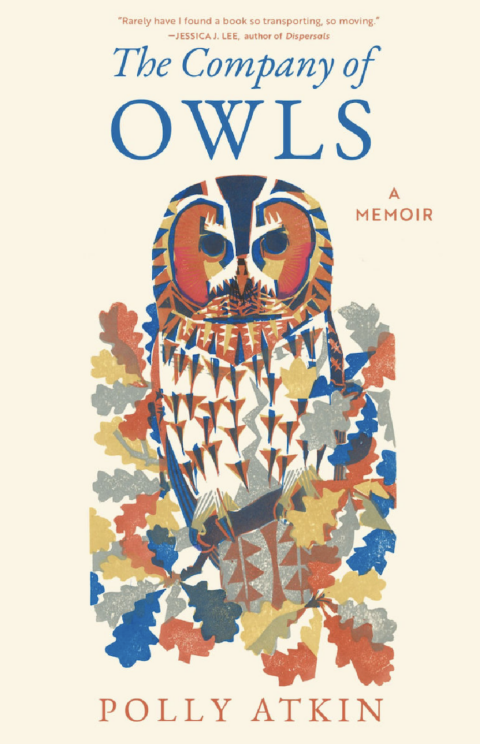 “Uplokkid” is the fifth chapter of Polly Atkin’s memoir The Company of Owls, published by Milkweed Editions on February 3, 2026. You can preorder/acquire a copy of the book directly from the publisher by clicking here.