To Know How to Approach
To know how to approach.
How we see the riddle of distance
from here to where the places we’ve lived thicken.
I summon the islands of heather and ice
the Atlantic dawn
a plane in ascent
hard verses of gulls like fine chains.
Ask for nudity. Farther south
the cliffs open to a broad plain
and the animals are unmoving
a concert shrouds itself:
you thought of their varicolor
finding in some nook of your tongue
sour apples, red berries
the prairie pressed by fog
bogged in its movement.
Look out on the sea
from above, repeat the vertigo
of the plain’s base
in counterweight.
I gazed out and the space was ampler
a parched sundial of capers and lava
stretched across limestone lands, ridges.
Maybe the men lying on the bottom of Europe
watched me. Maybe I ask
are they entwined in the places I saw
in a single brief how to say
what are my meager years
through the clash of South and North.
Every place belongs to others.
I place each with no ancestry.
I offer scent, I receive damp aridness.
They bathe or kill us.
You were at the highest point of the cliff
in the Northern wind, sharp, lunar.
You live in them now. Come closer.
I look out, jump —
from rock to rock over the remains.
/ / /
1980
The district is filled with new houses.
There’s a happiness. You weren’t yet born.
The solid houses of eternal couples.
We thought it had spread on huge cranes
and trees transplanted a ring of tar
that ended at the field, the quiet field
as if before a play. You say
you weren’t yet born, but a shape was there
in worksites and families: the roots pushing,
the tar, the cranes ready, the children born.
one by one a car, and happiness
like a reptile’s nourished skin.
Now among shopping bags and cellophane bulbs
a hot spring cuts you.
It cuts us where I say look at the field, its ruined
pictures, the broken cathode-ray tube.
In the television’s fixed sound
the houses behind crumble on screen:
we pull them out, secure the roof with sheaves.
Without us you age as if we’d never been born —
finished miniature, mineral spirit, an entire
landscape of holograms.
/ / /
Riverbed
The green light of the river, the pink of the mountains
crosses the apartment south to north — a soft strip
of chalk that opens, contains. You try to distinguish
the rising voices from the scales of iridescent water.
How sincere these languages: fragments with few
consonants, closed vowels, black, equatorial, rhythmic
drums through sycamore branches. For each language
a scale of water, thrust from window to mountain
in disarming union. The rock circle amplifies,
the city is a stadium, this house its eardrum, we inside it
pulling out the roots of words like hooks from fish.
What we haven’t learned, what is stronger, unwritten,
a sudden burst in the river, the radium that makes the riverbed
shimmer. Open vowels muddle in the grass, closed
vowels rouse dust and motors. We close our eyes:
here are all the scales, broken sounds, drawn in.
The river returns to its place, the mountain to its place.
If we remain silent we conduct:
words, knotted rings, electricity, people
now on a riverbed strangely illuminated.
/ / /
Dorsoduro
I.
The houses on the water will stand firm
but the eyes around them aren’t human.
Atmosphere to atmosphere everything transforms.
A human sound is inhuman.
II.
Water plants resist. We imagine
they reach us from a nucleus deep within.
The garden is balanced without atmosphere,
its reflection on the water is a summary of light
across a city that, though fish-shaped,
flows with a nature neither animal nor vegetable.
Now Papadopoli makes invisible energy,
balance stretched between atmospheres.
This garden has no nature. It’s not a garden.
Is this balance on water real balance?
III.
Evil is hidden by the fog on the sea.
A hook brings it forward and back.
At night we get lost on this bank,
the lights oscillate above our shoulders.
We’re no longer human but sound
that stitches Dorsoduro to the Ghetto.
The motors write the water densely.
Now a fixed silence in the real delivered.
* * * * *
Sapersi avvicinare
Sapersi avvicinare.
Così vediamo l’enigma della distanza
dal posto in cui si addensano i luoghi che ci hanno abitato.
Inizio chiamando le isole di erica e ghiaccio
l’alba atlantica
un aereo al decollo
versi duri di gabbiani come sottili catene.
Chiedete nudità. Le scogliere si aprono
più a sud in un prato piatto
e gli animali sono immobili
una sinfonia che si avvolge su se stessa:
pensavi alla loro bicromia
trovando in qualche angolo della lingua
mele acide, bacche rosse
la pianura premuta dalla nebbia
che si incastra nei movimenti.
Affacciati, dall’alto sul mare,
ripeti la vertigine
nel basso della pianura
in contrappeso.
Mi sono affacciata ed era spazio più ampio
una meridiana arsa di capperi e lava
tesa a lande calcaree, dorsali.
Gli uomini sdraiati sul fondo dell’Europa
forse mi hanno guardato, e chiedo
sarete intrecciati nei posti che ho visto
in uno solo breve come poter dire
cosa sono i miei anni minuscoli
attraverso lo scontro di sud e nord.
Ogni luogo appartiene ad altri.
Li appoggio senza genealogia,
gli do odore, ricevo umido e arido.
Ci bagnano o uccidono.
Eri nel punto più alto della scogliera
nel vento del nord affilato, lunare.
Voi li abitate adesso. Avvicinatevi.
Mi affaccio, salto —
da roccia a roccia sopra un resto.
/ / /
1980
La provincia si è riempita di case nuove.
C’è una felicità. Non eravate ancora nati.
Le case salde di coppie eternabili.
Pensavamo che si espandesse per gru altissime
e alberi trapiantati l’anello di catrame
che terminava nel campo e il campo sereno
come di fronte a uno spettacolo. Dici
non eravate ancora nati, ma esisteva una forma
su cantieri e famiglie: le radici che forzavano,
il catrame, le gru montate, i figli nati,
uno per uno un’automobile, la felicità
come pelle nutrita di un rettile.
Una primavera calda vi taglia adesso
fra le buste della spesa e i bulbi nel cellofan:
ci taglia dove dico guardate il campo con le rovine
delle immagini, il tubo catodico spezzato.
Nel suono fermo della televisione
le case indietro si sbriciolano nel video:
le tiriamo fuori, allacciamo il tetto con il grano.
Senza noi invecchiate come non fossimo nati —
miniatura finita, acqua ragia, ologrammi
dentro tutto il paesaggio.
/ / /
Fondale
La luce verde del fiume, quella rosa delle montagne
da sud a nord attraverso l’appartamento. È un lembo
sottile di calce, si apre, contiene. Provi a separare
le voci che salgono, le scaglie d’acqua iridescente.
Come queste lingue sono sincere: le frazioni con poche
consonanti e le vocali chiuse, nere, equatoriali, ritmiche
tamburi tra i rami dei platani. Per ogni lingua
una scaglia d’acqua, spinta dalle finestre alle montagne
in un’unione disarmante. Il cerchio della roccia amplifica,
la città è uno stadio, questa casa il suo timpano, noi dentro
tiriamo fuori come aghi da pesca le radici delle parole.
Cosa non abbiamo imparato, cosa non scritto e più forte,
una scarica improvvisa nel fiume, il radio che fa splendere
il fondale. Vocali aperte vanno confuse nell’erba, vocali
chiuse spingono polvere e motori. Chiudiamo gli occhi:
ecco tutte le scaglie, suoni rotti, aspirati.
Il fiume torna al suo posto, la montagna al suo posto.
Se restiamo in silenzio siamo conduzione:
parole, anelli allacciati, elettricità, persone
adesso su un fondale stranamente illuminato.
/ / /
Dorsoduro
I.
Le case sull’acqua avranno solidità
ma gli occhi intorno non sono umani.
Tra atmosfera e atmosfera tutto si trasforma.
Un suono umano è disumano.
II.
Resistono piante d’acqua. Immaginiamo
che ci raggiungano da un nucleo profondo.
Il giardino è in equilibrio senza atmosfera,
si riflette nell’acqua per sintesi di luce
attraverso la città che ha forma di pesce
ma scorre senza natura vegetale o animale.
Allora papadopoli tra atmosfera e atmosfera
fa un’energia invisibile, un equilibrio steso.
Questo giardino non ha natura, non è giardino.
Equilibrio sulle acque è equilibrio?
III.
Il male è nascosto nella nebbia del mare.
Un uncino lo porta avanti e indietro.
Ci siamo persi di notte su questa riva,
le luci oscillano sopra le spalle.
Non siamo più uomini ma suono
che cuce dorsoduro alla giudecca.
I motori scrivevano densamente l’acqua.
Ora un silenzio fitto nel reale portato.
◊ ◊ ◊ ◊ ◊
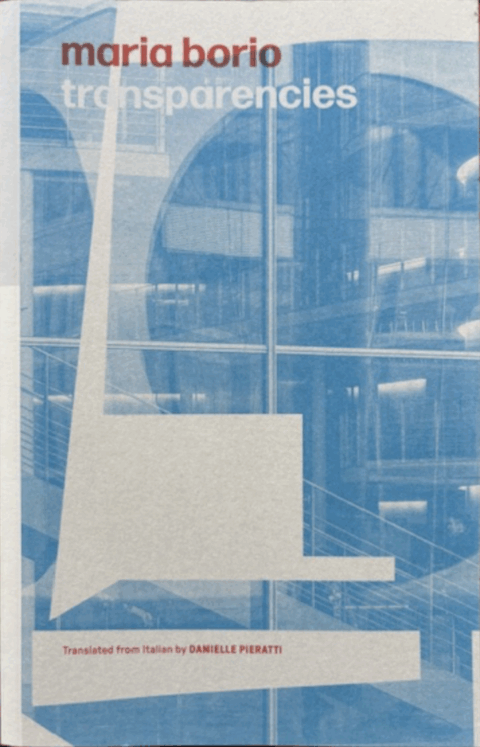 The four poems by Mario Borio appear in the second edition of Transparencies, published by World Poetry. We are grateful to Matvei Yankelevich, editor, for permission to excerpt the poems. To acquire a copy directly from World Poetry, click here.