Translator’s Note
Whenever I’m asked to write a few words to contextualize a poet whose work I’ve translated, I struggle. Do I focus on the author’s biography? Only on their work? How about their standing within Poland’s literary community? All of the above is my first reaction, but I don’t have all day, and the journal or magazine kind enough to publish my work probably doesn’t have to space to include my (elaborate) answers to these and attendant questions.
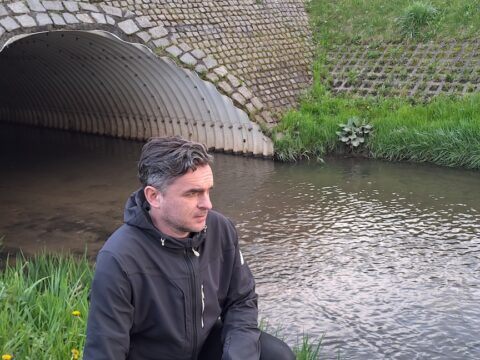 With Maciej Robert, it suffices to say that he is an award-winning poet, essayist, literary and film critic, professor, editor, interviewer, arts administrator, and he also … see what I’m getting at? These identities and activities are integral to who Maciej Robert is, his work, and how he’s perceived by his peers. Born in 1977, he came of age as a writing artist when American poets of a particular stripe, mainly Frank O’Hara and John Ashbery, were translated and read very closely in Poland, but that’s an old story, which is to say, it’s no longer true.
Nevertheless, I think of Maciej Robert as a peregrine writer. In fact, after scores of poetry volumes, he published a book-length essay on rivers (large and small, cherished and forgotten, navigable and buried under feet of concrete), firmly establishing himself as one of Poland’s most exciting essayists and travel writers. But how does one write about water, riverbeds, urbanization, or climate change? Some of these subjects have been written about since time immemorial; others have only recently gained our attention. And the language we use to speak of them, while both old and new, is constantly changing.
This attention to language is at the heart of all of Maciej Robert’s writings, but especially his verse. As a lyric poet, he expresses the thoughts, feelings, and emotions of a single speaker — as one definition of “lyric poetry” would have it — but without forgetting that each one of us is part of a larger whole and thus connected to other human beings and to what’s near and what’s far. It’s a gift, really, to read his work and see the micro and the macro perspectives come into contact, giving rise to a kind of joyous hesitancy on the part of the poet who, thankfully, does not have everything figured out.
— Piotr Florczyk
◆ ◆ ◆ ◆ ◆
Speech Therapy
I
An unfinished house and a ruined house
are two different houses. Delayed, stutterer —
he couldn’t understand it, couldn’t
say it. From under the speech therapist’s hand
he fled for the forest. Looking at a bird
pellet, full of crushed ash-gray
shell, he mumbled under his big nose:
tawny owl feathers, an abandoned nest.
II
As a child, he stuttered
terribly, hid behind others,
spoke indistinctly.
They sent him as expected
first to a speech therapist,
then to a drama club.
He practiced with a piece of an apple.
Thanks to this, his pronunciation
became hyper-correct.
In school plays, he
played mostly idiots,
or priests.
◆ ◆ ◆ ◆ ◆
Two Stars
Two, sometimes three stars,
although mostly just one.
That’s all he can see
through the basement window,
when he goes to take a leak at night,
weaving between the sleepers.
A long journey from things to words.
Two, three, most often one.
In a footnote. Instead of a title.
◆ ◆ ◆ ◆ ◆
Jay
Imitates perfectly
whatever she happens to hear:
the meowing of a cat, the howl of a dog,
and the voices of other birds.
In ancient Greece
she was taught human speech:
she could pronounce
even the names of kings.
She is familiar
with the sounds of civilization:
car alarm, ambulance
siren, hammering.
And while we finish making love
listening to our tunes,
each of us repeats in their thoughts
that short sentence. The jay can.
/ / / / /
Logopedia
I
Dom niewykończony i dom zrujnowany
to dwa różne domy. Opóźniony, jąkała,
nie mógł tego zrozumieć, nie mógł
wypowiedzieć. Spod dłoni logopedy
uciekał do lasu. Patrząc na ptasią
wypluwkę, pełną pokruszonej popielatej
skorupki, mamrotał pod wielkim nosem:
pierze puszczyka, porzucone gniazdo.
II
W dzieciństwie przeraźliwie
się jąkał, chował za innymi,
mówił niewyraźnie.
Wysłali go, gdzie trzeba –
najpierw do logopedy,
potem na kółko teatralne.
Ćwiczył z cząstką jabłka.
Dzięki temu jego wymowa
stała się hiperpoprawna.
W szkolnych przedstawieniach
grał przede wszystkim idiotów,
ewentualnie księży.
/ / /
Dwie Gwiazdy
Dwie gwiazdy, czasem trzy,
chociaż najczęściej jedna.
Tyle może dostrzec
przez piwniczne okno,
kiedy w nocy idzie się odlać,
lawirując między śpiącymi.
Długa podróż od rzeczy do słów.
Dwie, trzy, najczęściej jedna.
W przypisie. Zamiast tytułu.
/ / /
Sójka
Bezbłędnie naśladuje,
co tylko wpadnie jej w ucho:
miauczenie kota, psi skowyt
i głosy innych ptaków.
W starożytnej Grecji
uczono ją ludzkiej mowy:
umiała wypowiadać
nawet imiona królów.
Nie są jej także obce
odgłosy cywilizacji:
alarm samochodu, syrena
ambulansu albo stukanie młotka.
I gdy kończymy się kochać,
wsłuchani w to, co nam gra,
każde z nas w myślach powtarza
tamto krótkie zdanie. Sójka potrafi.