Some Thoughts Prompted by David Brooks’ Turin: Approaching Animals
Why is there so much denial and disavowal in your hearts?
— Friedrich Nietzsche
I saw the laboratory animals: throat-bandaged dogs cowering in cages still obsessed with the pitiful
Love that dogs feel, longing to lick the hand of their devil; and the sick monkeys, dying rats, all sacrificed
To human inquisitiveness, pedantry and vanity, or at best the hope
Of helping hopeless invalids live long and hopelessly.
— Robinson Jeffers, “Memoir”
Before reading David Brooks’ Turin: Approaching Animals, I’d already been thinking about cruelty, specifically, how the intersection between cruelty and curiosity or, to use Jeffers’ phrase, “human inquisitiveness,” is a recurrent one.
As a child and young adult, I committed and witnessed acts towards animals that I now consider callous in the extreme: cutting open a lizard’s egg and watching as the tiny red blob that was its heart pulsed, pulsed … then died. Catching butterflies and spiders, which I chloroformed and pinned for my collection. Helping to trap and skin rabbits on the sheep station where we stayed each year in summer. Standing, fascinated, as the farmer gutted a sheep (“grolicking” is the much more visceral term used by the so-called “Pearl poet” in Sir Gawain and the Green Knight) then fed the entrails to the dogs.
Recently, I read two books, both by naturalists, that reminded me that such behaviour hasn’t been at all unusual. Charles Barrett, in The Platypus, describes incidents of catching and penning these semi-aquatic monotremes with one “specimen,” Splash, being taken into captivity when he was just three or four months old. At the beginning of his time in the so-called “platypussary” that was constructed for him, he nearly starved after refusing food for eleven days. He died when he was just four years old having spent his whole life, after being “tamed and trained,” performing for audiences. In his chapter “Enemies of the Platypus,” Barrett writes, with no trace of irony, about how, ’in the bad old days, trappers and furriers had a free hand’[i] and so, to his mind, were the greatest threat to these extraordinary creatures.
In Rambles in Britain’s Birdland, Oliver G. Pike records the following:
“The most wonderful ejecting performance that I ever watched took place in the nest of a reed-warbler. When I reached the nest on the morning of the third day I found that the young cuckoo had forestalled me and the three baby warblers were lying dead on the marshy ground beneath. As I wanted a cinema film with plenty of movement in it, there was no object in placing these back in the nest. I therefore searched around for another nest containing young birds, and the only one I could find was a sedge-warbler’s nest containing three half-fledged youngsters.”[ii]
Doubting the interloper will be able to eject one of these large birds from the nest in which he places it, Pike watches as the cuckoo levers itself up with the sedge-warbler on its back. Swinging itself upwards to the edge then bends quickly forwards and flings the sedge-warbler over the side.
Cruelty also arises out of fear and the failure to be curious. Recently, I repeatedly turned the hose on the wasps who are trying to build their nest under a ledge on our rooftop garden. It took all too long before I decided to find out what kind of creature they actually are. Paper wasps are harmless unless threatened, in which case they can deliver a painful sting. I check each day to see how the construction of the cells, made from wood fragments and saliva, is going. Slowly, it seems, but at least they can now do this in peace.
And cruelty comes about because of the arguments we make about necessity and pleasure: biologically, we are built to eat meat and we know animal protein is good for our health; we like the taste of steak, lamb chops, sausages, and so can’t imagine giving them up.
* * *
Some of us never awaken, or never fully awaken, to the truth about our mistreatment of the many creatures with whom we share this damaged world. We never take what Brooks, in an earlier book titled Derrida’s Breakfast, describes as “a leap of compassion, let’s say, a leap of heart, and something — people have called it a peeling of the eye — that is harder and less common still, perhaps almost like revelation.”[iii]
* * *
In Turin, a slimmer volume less laden with footnotes and dedicated ‘to the angels of Animal Liberation’, Brooks returns once again to our relationship with animals. He takes as his starting point Nietzsche’s breakdown, which was, it’s believed, occasioned by seeing a horse being flogged on a street in Turin.
The front cover of this volume shows a white horse with a charming flick of fringe facing the camera front on, ears attentively pricked. Five strands of barbed wire bisect the monochrome photograph. The barbed wire forms a barrier between me and the horse and that its gentle muzzle appears too close to the top strand causes a flicker of concern.
This is an unsettling image, one that’s difficult to interpret, especially because I’m uncertain what the look in the horse’s eye communicates: curiosity? Wariness? But in the section called “The Gaze,” the author opens the space of ambiguity by asking, of the stare of a buck kangaroo, “is it, as I think we can be confident it is with most non-human animals who fix their eyes upon us, to track and appraise our movements, assess the dangers we represent? Is it to ward us off? Or is it because he finds us interesting, a creature he wants to look at? Surely it’s a possibility it’s all of these things?”[iv]
Once I began reading, I couldn’t escape the deep discomfort I felt because, as someone who is not vegan — I eat eggs, cheese, honey, fish, and, sometimes, I wear leather shoes and carry leather bags — I’m obviously not fully committed to preventing animal suffering.
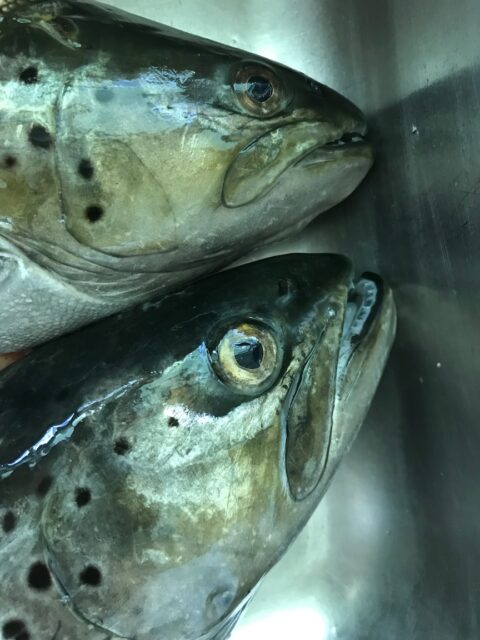
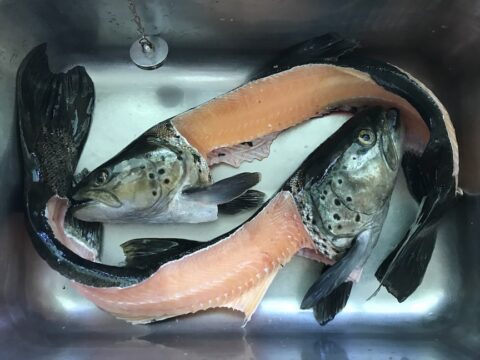
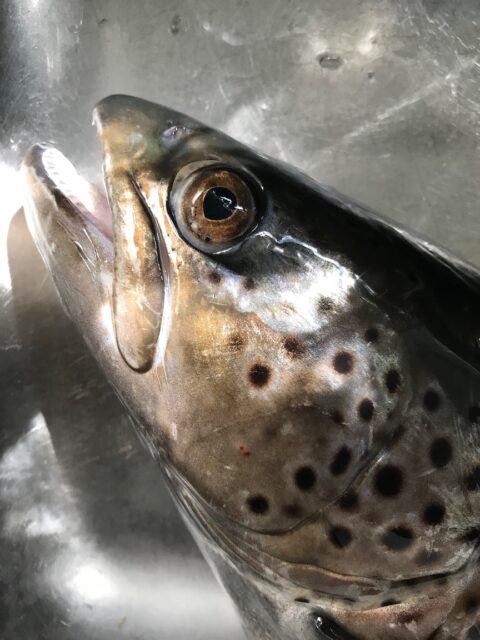
Like many people, I’m a mass of contradictions: I don’t buy products tested on animals but no doubt benefit, unwittingly, from experiments carried out on them; I rescue spiders, but continue to kill mosquitoes and cockroaches; I won’t touch squid or octopuses, or consume anything cooked in squid ink, but I excitedly take photographs of trout corpses once the animals have been filleted.
I understand that where I see exquisite patterns, colours, textures, shapes, and the shiny silver surface of the old kitchen sink rhyming with the shiny silver scales of the fish, others might see only agony in the glassy eyes and open mouths, or be repelled by the all-but-imperceptible dab of blood on a cheek; however, when I arrange the “frames,” as they are called, and focus the camera, the act is one of honouring these animals, which nourish me nutritionally and also aesthetically. Not simply food (for their remains will be turned into stock and the meat picked from their bones), in the afternoon light they become numinous.
* * *
While perception is everything, in Turin Brooks does acknowledge how difficult seeing otherwise can be: ‘At the bottom of a long stretch of boredom (but is it truly boredom if motivated by curiosity, desire to know?), self-imposed, watching sheep, forcing oneself to do so, to stay there, in the middle of the paddock, below the water-tank, resisting the pressure to get on with one’s active, understood, human-animal life — it’s a kind of meditation, yes, although even to think of it thus is to distract — there’s the possibility of seeing, noticing something that one has not noticed before.’[v]
Not averse to provocation, Brooks reminds us of ideas he’s discussed in previous works, including “the troublesome paradox that, if one saves a human life, then one is potentially, if the person one saves is not vegan, ensuring the death of a large number of other, non-human animals”[vi], and “the contentiousness of likening the situation of non-human animals, both within the industrial farming system and otherwise, to the Holocaust or Shoah, as if it is somehow deeply inappropriate to compare the suffering of human and non-human animals, as if it’s not possible that non-human animals can suffer as much as human animals, and as if the comparison was not first made, and has not been frequently supported, by victim-survivors of the Holocaust themselves.”[vii]
He refutes aspects of the philosophy of Martin Heidegger, whose saying that “animals are poor in the world” Brooks decides only holds true “because we have impacted upon, damaged, deprived them of much of their World, in effect, stolen it from them.”[viii] He also finds Peter Singer’s utilitarian argument about comparative sentience, which demands “proof of sensibility” if we are to not eat certain non-human animals, spurious. As Brooks explains, for Singer the cutting-off point lies at the oyster, because “beyond that level […] the creatures one eats cannot feel that that is happening to them, are unable to experience what we understand as suffering.”[ix] And I find this a decidedly Walrus-and-the-Carpenter attitude.
But in case this reduces Brooks’ work by making it sound only depressing or disputatious, it’s important to mention his gentle insistence on affective relations, particularly in the more autobiographically inflected passages about the life he shares with T. , their dog, and the sheep they’ve given refuge to: Henry, Jason, Jonathan, and Orpheus. He sees “my wife’s spirits rise — visible, palpable thing — as she goes down to the sheep, just as I see their spirits rise as she approaches”[x] and describes what he imagines might be these animals’ sheep dreams.
In ‘The Shared Body’, the author writes:
“The other day I fell, at the door of the writing room, was pushed off balance, unintentionally, by one of the sheep coming out of that room (a visit) and within a second was face down on the soil outside, with them grazing about me. The vast human world, all its culture and intellect, understanding, is a mere bubble. Its skin is so thin it can burst at any moment and you are there, face-down, in the soil, unable to get up. One learns — hopefully one learns! — a respect for it, the soil, as a far more abiding thing.”
Possessing the power of parable this anecdote is designed, one presumes, to be a thread that’s later picked up in “Collateral” where Brooks is, once again, at soil level, this time weeding. He disturbs a spider who ‘”leaves the weed forest — to her it must seem just that, a tall protective forest — and clambers up a hill nearby, in a suddenly-devastated landscape, which is to say makes her way up a small ridge of soil, six or seven centimetres high, at the edge of the area I’ve just cleared.”[xi] Here the subtle shift in perspective from that of spider to human animal conveys Brooks’ compassionate regard for the dislodged arachnid, reminding us of an earlier section where he speaks about the bridge that is “often crossed in the absence of conscious thought — between observation and empathy, or, if it does not go down that far, at least recognition of something in the creature’s activity, a sense in which we seem to know what he/she is doing.”[xii]
This is one of the great strengths of Turin, how each loop in the Laocoön of Brooks’ complexly interwoven sections (there are forty-two in all) holds me ever tighter as I turn the pages. I’m forced to recognise in myself the cognitive dissonance he identifies between my dietary choices and my knowledge and understanding of animal exploitation.[xiii] I’m compelled to think about the consequences of my interventions, most recently the day I “rescued” a cicada from the brick wall where I thought it was vulnerable to predation from the resident butcher bird by placing it on the leafy vine growing on our balcony only to see that very bird swoop in and carry it away; one result of “the hubris in thinking there is some superior morality in our perception.”[xiv] I’m called on to recognise that I’ve often deluded myself into thinking that I’ve been conscious of the well-being of non-human animals in the decisions I make about how to conduct myself, what I buy, what I put in my mouth, but, in fact, this is far from the case and I’m left asking myself, at Brooks’ prompting: “Do we really feel that non-human animals are our equals?”[xv] I thought I did, but now realise I don’t, otherwise I’d live differently in an effort to reduce that inequality.
By the time I’d finished, I understood that prior to reading Turin my eyes weren’t peeled. Blinkered, blinded, I’ve been stumbling along oblivious to the harm and hurt I’ve occasioned. But this is a book that wounds us, stabs us, as it rightly should, because the pain will cause us to open our eyes. Wide.
[i] Barrett, Charles, The Platypus, Melbourne: Robertson and Mullins, 1911, p. 57
[ii] Pike, Oliver G., Rambles in Britain’s Birdland, London: Herbert Jenkins Ltd., 1930, pp.42-3
[iii] Brooks, David, Derrida’s Breakfast, Blackheath: Brandl and Schlesinger, 2016, p. 33
[iv] Brooks, Turin: Approaching Animals, Blackheath: Brandl and Schlesinger, 2021 pp. 35-6
[v] Brooks, pp. 108-9
[vi] Brooks, p. 60
[vii] Brooks, pp. 60-1
[viii] Brooks, p. 18
[ix] Brooks, p. 24
[x] Brooks, p. 56
[xi] Brooks, p. 71
[xii] Brooks, p. 28
[xiii] Brooks, p. 76
[xiv] Brooks, p. 99
[xv] Brooks, p. 111