Gabrielle Calvocoressi’s The New Economy is a luminous and unflinchingly tender book that remakes the terms by which we understand grief, embodiment, desire, and witness. These poems contend with the starkest conditions — suicidal ideation, non-binary embodiment, disability, material longing, global violence — yet they narrate these experiences from a posture of radical empathy and imaginative abundance. At the start of the collection, the speaker describes the day they don’t want to die as “extraordinary,” a declaration that immediately reframes survival not as a default state but as a form of astonishment. Across the book, Calvocoressi invents what I would call the elode — a portmanteau of elegy and ode — to describe poems that mourn and praise in the same breath. Elodes do not heal grief; they inhabit it, sing through it, honor its persistence. This doubleness — lament braided with exuberance, suffering braided with awe — structures the emotional, formal, and ethical terrain of the collection.
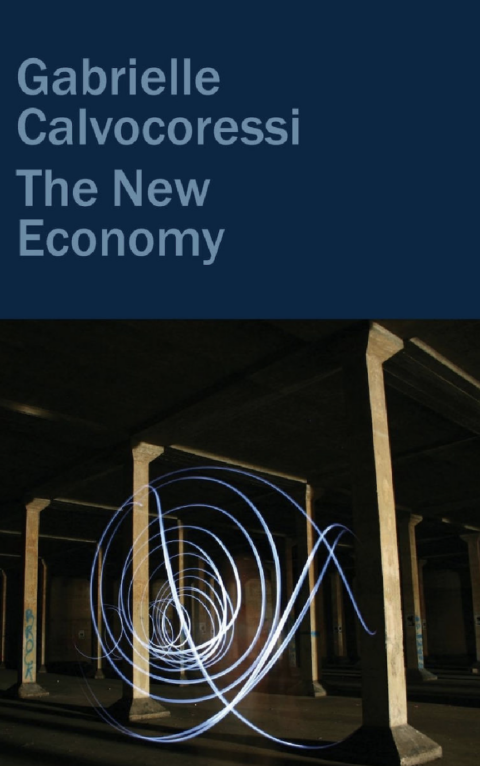 Much of the book unfolds within the architecture of the cistern, a recurring metaphor that becomes a site of resonance and transformation. A cistern is, in its literal form, an underground chamber built to collect and store water, a dark and echo-rich cavity where sound reverberates long after its source disappears. Calvocoressi draws on both dimensions: the cistern as a vessel that holds what is essential but hidden, and as a resonant interior where sound — language, grief, thought — amplifies and distorts. For the speaker, the cistern becomes an inner instrument, a chamber of consciousness they descend into when the world becomes unendurable; it is where the self fragments, reforms, and sometimes refuses coherence. In one poem, the speaker recalls, “what I remember is how my light body got stolen,” marking a central tension of the book: the distinction between the light body, which is agile, spiritual, unburdened, and the literal body, heavy and obstinate, described variously as a “skin sack.” This tension, fundamental to the speaker’s experience as a non-binary person with a disability, informs the book’s ethical and aesthetic stakes. Calvocoressi writes with exquisite sensitivity toward the limits of perception — blurred vision, muffled hearing, physical exhaustion — and yet the poems insist that beauty and attention remain possible within those constraints.
Two poems in particular illustrate how the elode becomes the book’s governing form. “Reawakening Cistern: Recovering the Golden Thread” is a long piece that charts the speaker’s return to language through immersion in what they call “the golden cistern,” a “lush cavity of the burl” where they sometimes get “so deep inside the music, / I can’t get myself out.” What a teacher names “fantasizing” becomes, for the speaker, a disciplined descent — a mode of listening in which interiority resonates back into coherence. Against the belief that poetry must address the immediate present, the speaker insists, “In the present I am writing a poem where / I go back into my light body,” signaling a refusal of linear lyric time and a reclaiming of a self unburdened by pain.
The poem moves between domestic failure — “I made a supper so disgusting I can’t / even face throwing it out today” — and visionary reunion as the speaker imagines the “golden / thread rebraiding between me and my / planet.” This oscillation mirrors the poem’s deeper reckoning with judgment: “For years, people told / me, I couldn’t write a poem worth reading … / couldn’t feed the dog right … / couldn’t make a body like the other beings / made a body.” These stacked negations enact the internalized weight of normative expectations. The decisive turn arrives with the declaration: “One day, I walked away from / the empire of the expertise of others,” a renunciation that names and resists the structures that presume authority over non-normative bodies.
This renunciation is seismic. It marks the moment the speaker claims authority over their own body, their own modes of knowing, their own grammar of being. The poem mourns the years of estrangement from body and voice, but it also praises the fierce return to self. Where “Reawakening Cistern” explores internal restitution, “Miss You. Would Like to Take a Walk with You” turns outward, embodying the relational dimensions of the elode. The poem begins in a register of startling intimacy and irreverence: “Do not care if you arrive in just your skeleton. / Would love to take a walk with you. Miss you.” The repetition of both address and desire establishes elegy not as lament but as ongoing conversation, a refusal to relinquish the dead to silence. What follows is a catalogue of revived domestic rituals — “Would love to make you shrimp saganaki. / Like you used to make me when you were alive. / Love to feed you. Sit over steaming / bowls of pilaf. Little roasted tomatoes/ covered in pepper and nutmeg” — each line staging nourishment as a form of devotion. The beloved is not abstract but vividly embodied in memory: their cooking, their gestures, their presence at a table where the living still sets places.
 This devotion extends beyond the domestic into the landscape of shared routines: “Would love to walk to the post office with you. / Bring the ghost dog. We’ll walk past the waterfall / and you can tell me about the after.” The ghost dog, the waterfall, the “after” — the things collapse metaphysical and ordinary geographies, suggesting that grief is not merely a psychic condition but a spatial one. The desire to be instructed about “the after” underscores the poem’s blend of humor and metaphysical inquiry; the speaker wants the dead to return not to offer solace but to explain what remains unsayable. Recognition here is detached from physical form: “Don’t even need to bring your skin sack. I’ll know / you.” The “skin sack,” a term that recurs across the collection as the speaker navigates dysphoria and bodily distress, is cast off entirely. Knowledge exceeds the literal body; the relationship lives in another register. Yet the speaker’s self-consciousness about change persists: “I know you will know me even though. I’m / bigger now. Grayer. I’ll show you my garden.” Even grief contains the desire to be seen anew, to be recognized beyond the body’s transformations. The poem oscillates between longing and gentle reproach, between the wish to be haunted and the wish that the living self might finally be known. It is an ode to the beloved’s ongoing presence and an elegy for their irrevocable absence. It is, in every sense, an elode — full of longing, full of praise, full of the ache of unfinished conversations. And because Calvocoressi is one of the most empathetic literary citizens in American poetics, this grief is never self-indulgent; it is relational, outward-looking, a testament to love’s ongoing labor.
Other poems extend the book’s exploration of sensory fragmentation and desire and the uneasy ethics of wanting. In “Muffled Chime,” the speaker begins, “If it’s not one thing, it’s / another. If it’s not the / bleeding, it’s the bother of / my ear not working.” From the onset, the poem positions the body as a site of constant interruption, a body whose impairments accumulate rather than resolve. The speaker hears “only half the wind chime,” and even their conflicts become partial: “I only / half hear when I argue / with my neighbor. Not so much argue as discuss. I half discuss and feel my heart pound harder.” The repetition of “half” becomes an acoustic and epistemological condition — an aural world structured by incompleteness. Yet this sensory partiality intensifies, rather than diminishes desire. The speaker admits wanting their “half of the driveway,” before correcting themselves: “How/ ridiculous. I want it fully.” In a world they can hear only in fragments, wanting appears embarrassingly intact, even excessive.
The poem stages this tension directly: “Can’t hear much of what / he’s saying, but I feel all of / my hunger.” This is one of the book’s clearest articulations of disability poetics: perceptions falters, but longing remains whole. Life becomes, as the speaker names it, “half wind / chime and then all that / wanting.” The accumulation of desires — “A driveway, / a house, a car, a _______,/ a ________. One after another I / add them up” — exposes the shame of needing what the world deems ordinary. Wanting becomes an existential exposure.
Midway through the poem, the metaphor expands: “Cistern that / never reaches the lip of itself. / Just gets deeper and deeper.” Here the cistern — elsewhere a site of resonance, memory, and inner music — becomes a metaphor for desire itself: bottomless, unfillable, and echoing. The sensory incompletions of the poem (half the wind chime, half the neighbor, half the bird song, half the hawk flying overhead) are countered by scenes of animal hunger, first in the speaker’s own interiority and then in the world around them. Hunger becomes the link between bodies — human and animal, impaired and nimble, partial and whole. The speaker cannot hear the squirrel but they can inhabit its need: the squirrel “looking for all the acorns it / hid way back in autumn” mirrors the speaker tallying wants, searching through the season of self for what might sustain them. The poem becomes a meditation on shame and longing, on the embarrassment of wanting what one needs in a world that treats necessity as excess. The muffled chime stands in for the partiality of perception: half-heard world, fully felt hunger.
 Counterbalancing the book’s grief and difficulty are moments of domestic joy and queer futurity. “No Poems Today” opens with a gesture that rejects the demand for productivity in favor of presence. The title simultaneously serves as the first line of the poem, following by “Because you’re here.” What unfolds is a catalogue of shared pleasures: “there’s warm / bread to be eaten, with cheese and jam. Small shops to walk into and look around” — activities that seem deliberately unrushed, rooted in the simple fact of companionship. The poem lingers in this ordinary intimacy, allowing it to expand into imagination: “We spend hours with the seed / catalogue, imagining a place bigger / than ours.” When the speaker admits, “I buy more seeds than / we’ll ever be able to use,” it is not frivolity but hope — a queer, domestic futurity made material through overabundance. Even the seeds themselves carry distance and wonder: “Opening a package of seeds / in three weeks (they come all the way from Canada!)” a line that turns something as small as a seed packet into a vessel of possibility. The poem’s tenderness is inseparable from its reckoning with disability. The speaker acknowledges, “And yes, I know / I can’t drive at night,” yet this limitation does not constrict the imagined life. Instead, the poem reframes access through relation: “But who needs / to go anywhere in the future? Maybe / friends will come over.” Disability is not posed as tragedy but as a boundary that reshapes, rather than diminishes, the sphere of living. The lines — “I can / still imagine years of possibility / ahead of us. A place with just a little / more space for us to stretch out” — extend this relational vision outward, situating hope not in escape but in the expansion of shared life.
When the speaker imagines “a new economy,” toward the end of the poem, the phrase becomes a pivot: a vision of value organized not around scarcity, labor, or bodily capacity, but around tenderness, reciprocity, and the ethics of staying put. The poem closes with a gesture toward a sensory world remade: “Imagine how / nice to hear nothing but the stars.” Here the absence of noise — of cars, obligations, movement — is not deprivation but a form of abundance. This the poem reframes domesticity as a site of imaginative and ethical possibility. It enacts a new economy of attention in which presence supersedes productivity, and a quiet, shared life becomes not a small life but a capacious one.
The New Economy proposes a radical revaluation of what constitutes worth, wealth, and survival. The title signals a shift from capitalist notions of productivity and scarcity toward an economy rooted in care, interdependence, bodily honesty, and imaginative possibility. In this new economy, one’s value is not determined by efficiency or success but by the capacity to witness, to grieve, to love, to stay alive, to pay attention even when attention is painful. Calvocoressi’s speaker navigates a world of violence, yet chooses also to look at a redbud about to bloom. That act of witness is not escapism; it is a refusal of the numbness that violence demands, a way of keeping the sensorium from hardening. A way to stay alive.
Calvocoressi, one of our most generous poets, has written a book that models how to live ethically in a broken world. The New Economy is a work of astonishing vulnerability and visionary depth — a book that remakes sorrow into song, body into light, memory into a place we can walk through together. It is an extraordinary achievement and a profound testament to the human capacity for resilience and love.
[Published by Copper Canyon Press on October 14, 2025, 128 pages, $24.00 hardcover]