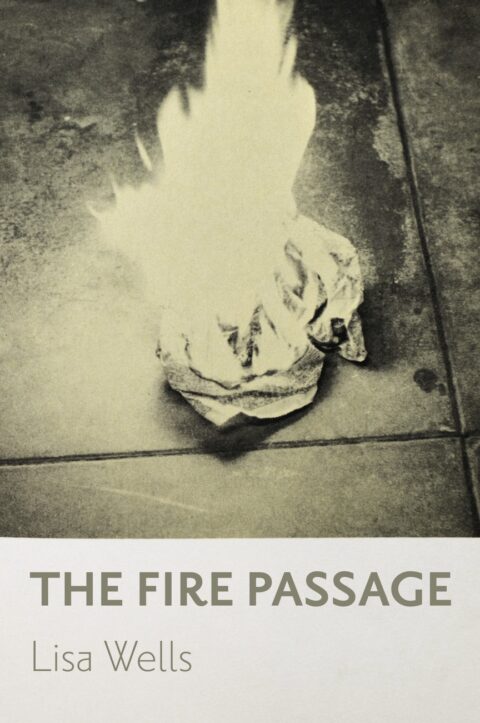
What is this disorder, and how to find wellness? The reader of Lisa Wells’ second collection of poetry, The Fire Passage, hears the question and opens to a variety of answers while being swept up in the construction of her epic: “I am as Gilgamesh among cedars! Armed only with my chisel set / for the trepanation.” The trajectory towards health follows the ancient hero’s path, but also leans into a connection with more contemporary poems, such as Sylvia Plath’s “Fever 103.” Wells’ book resonates with a similar need to burn through distress to reach purification: “There is only going through / We must go through it.”
The speaker inhabits an elemental, alchemical world of suffering. From the start, Wells states:
They prefer I speak plainly. No tricks. I can sympathize.
I was sick, plainly.
I had my symptoms.
From that moment on, the reader travels largely through sound, whether strict rhyme, direct repetition, or partial repetition ( “tricks / sick,” “plainly / plainly,” “sympathize / symptoms”).
 Wells’ musing on her condition marries the philosophical and psychological with the physical, so we’re never entirely certain of the root of her sickness: “As if the wound were in my mind. / And it was. But it was elsewhere too.” In later conversation with the “they” (physician, listener) of the opening poem, she picks up a Chorus: “So the wound is a window?” To whom Wells answers hesitantly but truthfully: “Yes / and no.” Despite the equivocation, one anticipates and enjoys being directed by her intuitive music: “Things go surpassingly well / behind the locked gate of the leprosarium.”
The Fire Passage follows Wells’s debut poetry collection, The Fix (2018), and her nonfiction book, Believers: Making a Life at the End of the World (2021). This new book is one long poem — divided into three sections: “The Floods,” “The Fire Passage,” and “Spells for Ascending” — that begins with the pressure of the unnamed sickness, from which the speaker moves forward in search of healing. The series of poems also simultaneously grapples with a longing which holds an equal power of destruction or restoration: “I lived in terror and I loved the world. / A fire meanwhile rising.”
In this journey, a pilgrim straddles ancient and contemporary worlds (poetically and physically). Wells often invokes not only classic texts of a hero’s progress, but very frequently turns to the Old and New Testament of the Bible to make sense of the reality she finds herself in:
On the seventh day I saw the concrete breached,
the river returned to its original vein, and pulsing there
slick and muscular multitudes
of coho winding north to spawn.
It was so.
I understood intuitively, if the salmon are to return
I must maim the developer’s trademark.
The action undertaken must be similar to Noah’s flood, wiping the world clean of the growing garbage of humanity (with its encroaching development and its mountain top removal); she must be god-like but is at the mercy of something else — her own struggle and rebirth.
In this, the poems recall the torment of Plath’s Ariel (both the reclamation of the patriarchal Western canon by a woman, and the similar grappling with internal demons and external modern weight bring Plath to mind). There are also occasional echoes of the self-conscious playfulness of John Berryman’s Dream Songs (coupled in this example with a supplicatory ring from Louise Glück’s “at the end of my suffering / there was a door” in The Wild Iris):
At the end of my shaking
I diapered my groin and sang
over arid clay. My song goes
soaring about the shrill
notes of the tweak pipe
and its ravaged player.
Who twists out a paste
of redneck cocaine with his pestle.
Whose jittering song will lead
the children into the sea.
Whose throne is draped in a train of entrail
made vague by heat and duration.
Yikes.
I’d like to come back to life
but don’t yet know the way.
 Here in the land of the drug-addicted Pied Piper / Moses, Wells’ voice holds the kindred sad, hopeful, and tongue-in-cheek sound of Berryman’s Henry. A Dream Song-like jackknifing intonation appears in other places: “First, I had a jackal in my genus. / Then I moved among branches, nimbly.” Throughout Wells’ collection, there are people, encounters, those met in passing, but the movement of the music is all. In her wish for phoenix-like resurrection, she always admits a profound uncertainty, yet the underlying song is her compass.
Here and elsewhere, Wells is watching, accounting, questioning, and questing in the register of a desperado: while able to be deceived, and ever on the lookout to resist, she is also not the deceiver. There are stories of a reimagined Genesis, with only the cold companionship of her Maker: “Through pressure and momentum — / Like clay turned on a wheel — my Lord forms me” …
And she is often in conversation with that Maker who may also be herself:
Please permit no more
fear into my temple
I should have been a better friend to myself.
The speaker in The Fire Passage is buffeted by forces both within and without, and she only has herself to rely upon. Wells’ poem winds a path through creation, despair, and renewal (through flood, fire, spells of ascendance — think burnt offering), all with a speaker on the cusp of redemption, of living again. For those who are waiting for resurrection, there is the rapture, of sorts:
And we fear the troubled hours
of Earth. To be ridden by that
famous tide of rapturous woe.
But this is just the gap between
The platform and the door. The dead are
at this very moment speeding back.
But Wells is, above all, a singer — a descendent of an oral tradition. At times, there is a religiousness of sound, even in one (here in full) that feels at once scientific and primeval. It rides on its own unfolding:
Slow seas drove one continent against another,
then the crags shelved upward.
Where taiga heaved towards tundra
a panicked swimmer turns
and overturns in its wake.
The sea lion, alone, in her cave
is barking
As the ice sheets retreat from the latitudes.
The final cycle begun.
I melt.
I freeze again.
I am the shell the chill caresses;
A glittering crust collapsed
by the slightest tap of sun.
What leaks into the breech
unmakes me, makes me new.
We think the transformation beautiful
but it’s loud inside the chrysalis.
What to do with this baroque assemblage
of glass, shale, and oyster
but speak the names?
See the dry bones leap together.
the wild seed has entered the waters
the wild lichen has masked the asphalt
the green fur has smothered the sheetrock
the green creeper has strangled the steel
Wild seeds wild wind dispersed
released from the holds
of warring birds—
It is so.
In this section, as the long poem winds down, Wells leaps farther from the conceit of a hero on a quest, or the maker and made, to a moment with no human interaction, no footprint, comprised only of impetus and accounting. Sound and surrender. As in so many epic tales, she seems to hit on the question that is in fact an answer, and her own call to action:
What to do with this baroque assemblage
of glass, shale, and oyster
but speak the names?
[Published by Four Way Books on March 15, 2025, 72 pages, $17.95US paperback]