One beauty of a reading life is at a certain stage a reader develops an interest in a specific sort of book, and when they find a new book of that sort, they are its ideal reader. Cory Stockwell’s translation The City in the Distance from the French of Jean-Luc Nancy is one such book for me. The book interests me because it’s about cities, in particular, about Los Angeles, where I went to graduate school. And it’s from a French perspective, which is interesting to me as well. While at UCLA, I attended talks by Alain Badiou, Jacques Rancière, and Mladen Dolar (albeit the last not French in nationality, if a post-structuralist in disposition). Jacques Derrida taught at UC-Irvine, not far away, which has, more than UCLA, served as a home away from home for French philosophers, critical theorists, and thinkers. And French books on Los Angeles are many, including Jean Baudrillard’s multi-volume Cool Memories, translated by Chris Turner, and Laure Murat’s Ceci n’est pas une ville [This is Not a City] (2016), which is not yet translated.
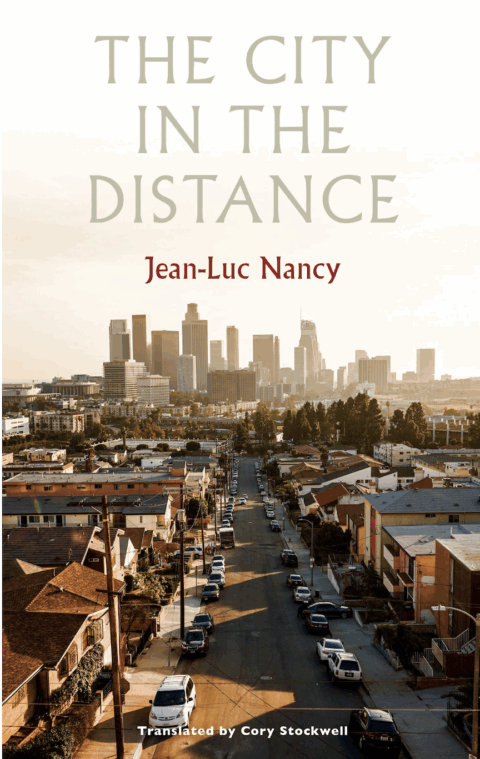 But I also enjoy the genre-bending history of French writing, and while Nancy is usually described as a philosopher or exponent of French critical theory, The City in the Distance may nevertheless surprise the reader because of its distance from the philosophy of centuries past and for its approach to, or encroachment onto, the literary. For me, it brings to mind in fact not first and foremost one of Nancy’s better-known texts, but Langue apocryphe/Apocryphal Language (VVV Editions, 2014), Michael Bishop’s little-known translation of two essays on language philosophy, which the publisher describes as an “elegant and penetrating prose poem.”[1]
Jean-Luc Nancy died in 2021, and since then, Cory Stockwell has translated two works. First, in 2021, The Fragile Skin of the World. Now this book. Stockwell has also contributed scholarly articles on Nancy to venues such as Critical Inquiry. Born in 1940, the same year as Jacques Rancière, and ten years after Jacques Derrida, Nancy had a different intellectual trajectory than these other philosophers, in part due to his absence from the limelight for essentially a decade due to health problems: first a heart transplant, and then a cancer diagnosis. In some respects, it’s fitting that part of his oeuvre would become known only in retrospect, posthumously, because Nancy had a peripheral reception during his lifetime in the French and Anglophone academia.
The City in the Distance is a compilation of essays written over three decades, and what poses as a long poem. While Fordham University Press presents the book as presenting “nothing less than the philosophy of the city,” this statement is more a facet of promotional rhetoric than true. At the very least, it would require us to understand what philosophy is, today, how it is written, and how the city could be a universal, especially in the unfortunate tradition where the West assumes the rest of the world is exactly like it. A philosophy of the city, were such a thing possible, might well need to start in Lagos, Seoul, or Delhi. Instead, Nancy articulates one vision of Los Angeles, which is and is not a typical city for North America. It is, instead, a confederation of towns that grew together, which is part of its beauty (its internal diversity) and its inefficiency (battling municipalities). But this partially organic growth, this unplanned dimension, is important in Nancy’s concept of the city, described by the operative metaphor of the work, or construction, site.
The French book of the same title, La ville au loin, was published in 1999 and contained only the first two sections. Then, the compilation here was published with a new publisher in 2011. Seven sections make up this book: a two-part sequence bearing the same title as the book, written in 1987 and 1999, respectively; “Images of the City” published in 2004; “Traffic/Click” published in 2004; “The Two Futures of the City” published in 2005; “An Art of the City” published in 2010; “Rumoration” published in 2001; then the envoi, “Moments of the City,” published in 2010. If the book’s reiterative focus on the city, with Los Angeles somehow always in mind, might lead a distracted reader to critique its singularity of object of contemplation, this focus is not without variation or surprise: ferreting around in the city will always bring us to some facet that wasn’t at first apparent, some new neighborhood written off as uninteresting that proves to be the opposite when explored.
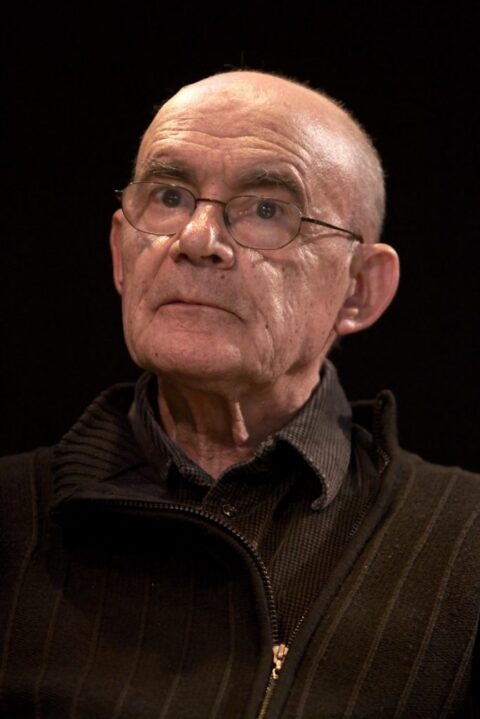 [left — Jean-Luc Nancy] These essays might better be thought of as literary than philosophical because there is not one communicative end, not one point to prove, and the use the language is as much the point as the “point” to be “proven.” These essays are speculations, girded to a philosophical base, and with a root in language, as Nancy frequently explains French words associated with urban living by ushering us back to their Latin derivations, suggesting that his understanding of the Western city owes much to the iterations of Rome. From the perspective of fiction, then, we could say that the city is the main character, and yet this book is not a teleological hero quest (a récit, in Fredric Jameson’s sense), but a roman, full of affective life. It’s not a philosophy of the city but an affective reportage that gives us a sense of the historical rise of the city, and what it feels like to observe the shapeshifting, incomplete, and forever suspended meaning of what it means to be a city. The city is in the distance in the sense that it exists just inside the horizon, visible, but not at all clearly limned. It’s a mirage as much as a definite thing.
At times, the Anglophone reader may have difficulty in appreciating how many words there are in French for urban spaces, and how interconnected many of these words are. Yet, some sense is transmissible, through cognates and through Stockwell’s judicious notes. For instance, “Images of the City” is broken into subsections that define aspects of the city: Imagines Urbis; Villa; Neighbors [Les voisins]; Quarters; Places, Squares, Monuments; Burg; Panoramic Map [Plan cavalier], The Big City, Babylon, Urban Zone: Slowing Down in an Agglomeration. Nancy concentrates on a mythology of the city as image in two chapters, “Traffic/Click,” where he writes about the conjunction of photography and the city, and “An Art of the City,” where the city is itself an “art.”
One striking passage delves into the work site, which is how Stockwell translates le chantier. This is the genius/genesis of the city. Since it represents the complexity of the city’s almost organic growth. [2] Well-laid plans by urban planners gain life when articulated in the chaos of construction. Explaining the relevant philology, Nancy starts with the late Latin term cantherius, which meant a gelding (a castrated male horse), effectively, a horse meant for labor. This then morphed into inanimate extensions, including the sawhorse, and then, in general, for processes “of piling up material and of work that is in progress or underway, that has begun, that is in operation.” The work site has the duality of the plan’s “ideal,” and the actuality (the present-ness) of putting that plan into motion, which can look like a “chaotic melee.” The city-as-work site exists through the tension of these poles: “between chaos and order, between the plurality of operations and the unity of the initiative, between the loading and the eventual foundation.” The work site contains the city, contorts the city, and it is both reason for rapture (how clever we humans are) and for distress, due to its indefiniteness. The work site-as-city “worries the person” because it’s not representable, containable, capturable through “a lens.” It is “unfigurable,” because of its shapeshifting, monstrous quality. Nancy concludes, “The work site is a monster.” And yet, this is the city.
 Thinking of the work site as a principal venue of the city is, at one level, obvious. The city grows from nothing, and it grows through an infinite number of work sites, laid on the ground over years. The strata of society that are brought together at a city work site are also remarkable: the bourgeois planners, engineers and architects; the poor manual laborers; and then, potentially, the elites who inhabit the rendered structures. The work site becomes a symbolic image of the city, which exists as a locale for an imbricated multi-tiered, multi-ethnic society, separated by capital. It’s fair to say the modern city is a capitalist city, while Nancy writes, “It’s difficult to separate the bourg from the bourgeoisie, and also from the burg, the seat of power.”
Some experience with Nancy’s idiosyncratic thinking is probably in order for anyone hoping to translate this philosopher. To be sure, the book is as eclectic, regenerative, and rambling as you might imagine a compilation of Nancy’s essays, published posthumously, to be: the book veers from these formal elements of abstract French writing, to Heideggerian or Agamben-like philological explications, to staggering lists of nouns, to poetic incursions. Stockwell’s experience as a veteran reader of Nancy proves invaluable, and that value is not made clear simply in the scholarly notes where Stockwell explains choices but also in knowing how to negotiate the static elements of formal French essay writing (the impersonal expressions, the expletive “it’s” and “there’s”). To unify these essays without forcing coherence is a feat, and Stockwell puts the emphasis on the thinking, easing there reader in English through impersonal expressions and formal conjunctions that the French reader accepts as easily as they breathe air, but that could bore the more tactile Anglophone reader — though of course, one of Nancy’s lasting contributions is to qualify knowledge as embodied.[3]
Stockwell treats one characteristic French grammatical point with consistency, which emphasizes the reflexivity of the city, a habitus for looking and being looked at. While Murat has said that she likes Los Angeles because it doesn’t have European-style monuments, in “Images of the City,” Nancy writes that monuments and their like exemplify the self-reflexivity of the city: “This is why the city seeks to present itself to itself in buildings, monuments, works of art.” This is an odd locution in English: to present itself to itself. In French, the express is curiously doubled, as well: se présenter à elle-même. There is a doubling, twice. The French reflexive verb allows the subject to be both the subject and the indirect object: for one to present something to oneself. Yet, in this case, the adverbial emphasis “to itself” seems excessive. The gist is that the city represents itself to an audience composed of one: itself. If a simpler phrase like “represents itself” might convey that basic meaning, the excessiveness of the wording that Stockwell chooses does work toward providing the image of the city that Nancy means to convey. Inherently, it is excessive. It is a place of excessive self-regard.
As city dwellers, many of us are at odds with where we live, dreaming of escape to the countryside, and then, once we have escaped, dreaming of a quick return to the city. The city, in Nancy’s eyes, is changeable in its nature. That should come as no surprise to us. We know about its “monstrous” extensions, diffusions, and adumbrations — the agglomeration turned into suburbs and exurbs drifting piecemeal into the countryside (itself a construction, or reconstruction, from an image held of an ideal). Nancy’s reflections are a useful reference point as we continue to contemplate these spaces that define our lives with or without our consent and ultimate commitment.
[1] https://www.fabula.org/actualites/67263/jean-luc-nancy-langue-apocryphe-aprocryphal-language.html
[2] “Almost” does a lot of work in this characterization of Nancy’s take on the city. Later, he makes clear it’s not organic, per se: “The city is a composition whose “com,” whose regime of assembling, is neither synthetic nor organic.” For Nancy, it’s the tension between the two poles that makes the city what it is.
[3] See Nancy’s Corpus ([1992] 2008), translated by Richard A. Rand and Jacques Derrida’s Jean-Luc Nancy, On Touching ([1998] 2005), translated by Christine Irizarry.
[Published by Fordham University Press on October 21, 2024, 126 pages, $25.00 paperback]