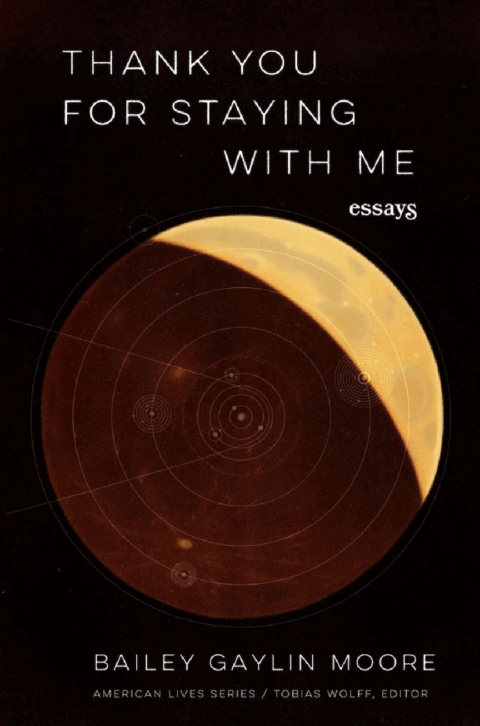
It’s not hard to imagine the feedback Bailey Gaylin Moore might receive in a creative writing workshop: comments like Tone it down or Less is more. “Mostly My Mother’s Daughter,” the second essay in her debut collection, Thank You for Staying with Me, begins with a sentence that could easily be dismissed as flowery: “An April Easter, just late enough for the gummy Ozarks’ air to cause my ivory tights to stick to babyweighted thighs.” Then there’s form: many of her essays take unexpected shapes. The shortest, “Overkill,” clocking in at 25 words, is essentially a footnote; the six “Step” essays (“Step One: How to Be a Daughter,” “Step Two: How to Hold a Baby,” and so on) interspersed throughout the book take the form of instructions; and “Twitter’s Hot Takes on Women in Politics” comprises a conglomeration of tweets and hashtags. Whether vignettes, snapshots, collages, or something else entirely, essays they are not.
But to write off Moore’s prose as overwrought or critique her genre-bending style would discount the virtues of Thank You for Staying with Me, a collection that begins as personal reflection and ends as feminist manifesto. Her engagement with subjects both timeless and timely in our current political era — motherhood, mental illness, sexual desire and shame, whiteness — and the radical honesty of her voice defiantly push back against the idea that women should have to apologize for simply existing in a world where they face constant judgment.
 Apologizing is a recurring theme for Moore. I first encountered her writing when I had the opportunity to interview her and her partner, Donald Quist, about their co-written essay in AGNI 92, “How to Speak to a Police Officer” (Moore’s half of the essay appears with a slightly different title in the collection). The two describe their experience getting pulled over in Missouri, and Moore’s subsequent arrest for displaying her license plate on the dashboard, from their perspectives as a white woman and Black man. Although neither person directly wrongs the other, both react to the incident by saying sorry. When I read Thank You for Staying with Me, then, I was particularly attuned to moments when Moore apologizes of her own volition — or is made to apologize by others — but even readers who aren’t looking for them will notice their frequency.
Many of her apologies are implicit in the way Moore carries herself or worries about what others think. “Mostly My Mother’s Daughter” ends with her confessing: “… my shame grew along with my cup size. I’d try to press myself down with layered sports bras and tight tank tops to make me look flatter. In middle school, I’d play the role of a jock, hiding underneath loose T-shirts.” The awareness that her female body — and others’ perceptions of it — is humiliating follows Moore as she gets older, prompting explicit apologies, too. In “Second Molars,” for instance, a second-person account of her rape at 14 years old, Moore describes her brother finding out: “Later, your brother will come into your room. He will not know what to do with his hands, frantic in the dormant air. You will watch him from your bed. You will tell him, I’m sorry.”
Moore’s impulse to blame herself for an assault perpetrated by a man parallels her community’s response when she becomes pregnant as a teenager. After making her write a letter to fellow churchgoers, her pastor manipulated her message before reading it publicly. “I wasn’t there for my own testimony,” Moore writes. “I couldn’t stand to hear those words spoken by a pastor who, days prior, had edited my version to look like a call for forgiveness, a lesson of obedience and chastity.” Notably, the pastor “didn’t ask for [Moore’s] son’s father to write an apology, despite him being three years older than [her] and a member of the same congregation.” This reproach confirms the shame Moore has felt since young, and the fear of stigma only increases as her son Beck grows up. Recalling another mother looking disapprovingly at a preteen Beck on his phone at a restaurant, Moore notes:
“She frowns, and I feel like I’m doing something wrong again. I wonder if she is judging me for Beck being on his phone or for the simple fact that it is only the two of us. I wonder if she tried to gauge my age, a question which has followed me to every restaurant we go to.”
 Dogged by the conviction that she is “wrong,” Moore, who studied philosophy as an undergraduate, examines this feeling through an ontological lens, finding meaning in sources as disparate as Heidegger, Lakota myth, and Modest Mouse lyrics. Even a casual conversation during a late-night study session at Waffle House prompts a series of musings that penetrate the layers of her experience. Responding to a question about what kind of galaxy she identifies as, Moore explores different options — elliptical galaxy, spiraled galaxy, etc. — applying each one to her life. While the cosmos supplies a slew of handy metaphors, she can’t decide on just one: “It took me a few seconds, a million years, just to come up with I don’t know.” Knowing isn’t the point, after all; in plumbing her emotional depths, she’s seeking to better understand who she is, which means surrendering to uncertainty rather than settling on an answer.
Moore’s philosophical meditations also frame her project. In “Hegel Exercises” — which takes on body image and relationships in addition to Hegelian dialectics with a striking blend of humor and vulnerability, earning its punny title — she remembers a professor explaining, “Hegel doesn’t want to reject or forget the past … We’re only capable of growth if we know what we are growing from.” This idea encapsulates the collection: writing about her past isn’t about forgetting or even letting go, but opening herself to the possibility that her life is not shameful. In “Reclaiming Voices Like Needles in Haystacks,” she discusses how sharing her story has allowed her to view it from a new perspective:
“When I wrote about being assaulted at fourteen, I imagined it was more uncomfortable for the reader because of my inclination toward impassivity. Or: I thought it was more uncomfortable for the reader until an essay about my rape was published. The overwhelming accessibility of what happened to me at fourteen forced me to tear down a partition I constructed between myself and the world, as well as the wall I built between myself and self.”
If her realization sounds like a neat resolution, don’t be fooled — the essays in Thank You for Staying with Me demonstrate that growth is less an instant transformation than a gradual process. In Moore’s case, that means continuing to apologize, but not necessarily in the way readers will have come to anticipate. “When Natalie Walks into the Snow” centers on a young widow mourning her husband, who died by suicide days before. The essay incorporates Moore’s reflections on her own history of depression and suicidal ideation, often triggered by current events, as well as her concern that Beck will face the same struggles. When, in the essay’s final sentence, Moore describes how she and others who have experienced mental illness “will cry with [Natalie], and we will say sorry over and over again,” the sentiment goes beyond sympathy. She apologizes not just for Natalie’s loss, but for the pain we inherit from genetics and society. The ending of “D Explains How to Speak to a Police Officer” that caught my attention years ago uses nearly identical language to describe Moore and Quist’s ride home from the corrections facility: “I look over at D and say I’m sorry again and again, the words spilling out as we drive past city hall, past the spaces that allowed me to assume and to forget.” Her apology is expansive, encompassing not only guilt about having caused a situation in which her Black partner feared for his life, but anger toward a country wracked by structural oppression. Unlike more self-conscious apologies earlier in the collection, those in “When Natalie Walks into the Snow” and “D Explains How to Speak to a Police Officer” also reflect recognition of the circumstances that lead people to feel “wrong.” Moore isn’t exactly forgiving herself — or letting herself off the hook for systemic ills in which she, as a white person, is implicated — but distinguishing between blame and accountability is a step forward.
Speaking of steps, considering the ups and downs presented in the collection, organizing it around the six “How to ” essays would feel incongruous had Moore not explained this choice in her “Author’s Note” at the beginning: “For a long time, I wished I had possessed some kind of step-by-step how-to guide for Being and navigating this world, but I guess the point of all this existential dogshit is to make our own blueprints. This is what writing these essays did for me.” Although the desire to impose order on a series of events and experiences that were hard to navigate is understandable, readers may find themselves wishing that Moore had resisted. Her writing shines most brightly when she embraces the unpredictable and unconventional. Returning to the opening sentence of “Mostly My Mother’s Daughter,” for instance, the extravagant description — “gummy Ozarks’ air,” “ivory tights,” “babyweighted thighs” — establishes her as intensely observant, distinguishing her voice as one belonging to someone immersed in the too-muchness of the world. A sparer style wouldn’t be as effective at drawing us into a mind that’s constantly evaluating herself and others’ reactions to her.
Moore’s inclination toward introspection and second-guessing makes moments of joy in Thank You for Staying with Me all the more powerful. When, in “Galaxy Identification,” she describes the impulse to hug someone, she uses negative space to convey an overflow of emotion, describing her arms:
Spread out
wide,
my whole being found in the length of two outstretched arms
Taking over the page — as she does in several other essays, especially “Twitter’s Hot Takes on Women in Politics,” which might be best categorized as a visual poem — and introducing lineation to an essay otherwise formatted as readers expect is a bold claiming of space. Given how often Moore feels that she must shrink to fit established norms, readers can’t help but delight in seeing her forge her own path.
[Published by University of Nebraska Press on March 1, 2025, 226 pages, $21.95 paperback]