Genre-bending literature has become a prominent literary discussion topic, and for many readers, its innovative appeal is undeniable. However, a more nuanced phenomenon may be emerging: a distinct bending within the genre-bending itself. If such a development is indeed underway, debut author Kim de L’Horizon appears to be at its forefront. The author writes, “I exist in a foreign language. Perhaps that’s one reason for this writing, for this carved-up, crumbling writing. For the fact that my hands produce only shards, their edges so splintered I can’t build from them a beautiful, smooth, compelling, polished story. Perhaps writing is the search for a foreign language in the words we have available to us. The attempt to carve a tongue-sized hideout in what already exists, in what we’ve inherited, one that’s large enough to dance in.”
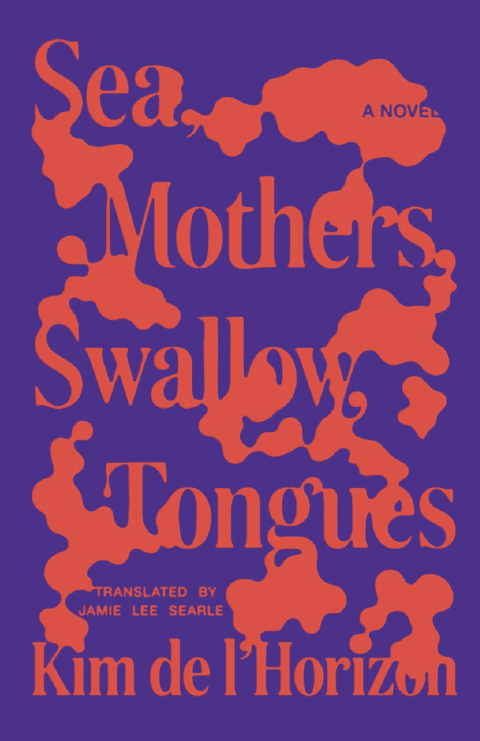 In Sea, Mothers, Swallow, Tongues, translated by Jamie Lee Searle from the German original titled Blutbuch, a nameless (until section 4) and gender-nonconforming narrator embarks on a determined quest into their lineage, spurred by their grandmother’s descent into dementia. As the grandmother loses her grip on memory, the narrator desperately tries to piece together the past, particularly the origins of their own profound physical unease. This investigation reveals a tangled web of family secrets: whispers of incest, the grandmother’s strange conflation of herself with her dead sister, and the lingering mystery of a vanished great-aunt. The family’s steadfast refusal to discuss these matters only deepens the protagonist’s resolve. Excavating these truths proves arduous due to the family’s secrecy. This emotional journey ultimately confronts the narrator with the fundamental question of self-determination: how does one truly exist when your own body is a perpetual negotiation rather than an intrinsic given? They say, “But here, in this islandlessness, in this always-in-the-midst-ness, in the binary-fascism of body languages, my limbs speak a mishmash, a masticated elvish, a kaput Denglisch, an urgent in-betweenness that reels back and forth in confusion.”
Through its mélange-like narrative — part novel, part essay, autofiction, and poetry — the book explores the invisible burdens of inherited trauma, gender, and identity, seeking out alternative, empowering forms of knowledge through linguistic deconstruction. The narrator says, “In the language I’ve inherited from you, Bernese German, my mother tongue, ‘mother’ is meer. It means both ‘mother’ and ‘the sea,”’sneak-tweaked from the French; la mer and la mère. For ‘father,”’we say peer. For ‘grandmother,’ grossmeer. For ‘great-grandmother,’ urgrossmeer. The women of my childhood are an element, an ocean.”
Structured in five distinct parts, the narrative spirals inward, each section mirroring the narrator’s evolving self-discovery and their ongoing effort to reconcile family history with their own identity. Each part presents its own thematic and narrative focus and form ranging from fiction, nonfiction, poetry, and freely associated prose.
At its core, the book is a deeply personal exploration of transgenerational trauma, gender identity, and the search for self-expression in a rigidly gendered world. The narrator glides along the spiral of their family’s history — language and body weaving together memories, myths, footnotes, and reflections. The narrative is anchored by the copper beech tree in the narrator’s childhood garden — a symbol of inheritance, bloodlines, and the weight of familial legacy. As a native German reader, I noted that the original title, Blutbuch, which literally translates to “Blood Book,” holds a double meaning and plays into the linguistic playfulness of the Sea, Mothers, Swallow, Tongues. It directly alludes to the narrator’s personal search for their bloodlines, which culminates in them writing this very book. Additionally, the title subtly connects to the beech tree through its German translation, “Buche.”
 In part 1, “The Search for Flotsdam,” a section of fragmented memories and reflections, the narrator often refers to themselves as “the child” and explores their relationship with their grandmother, Grossmeer, and their family roots. Through the lens of “the child” — a gender-neutral label reflecting a quest for self-expression — the narrator challenges the concept of memory as they explore their curiosities about their complex family dynamics and the struggle to articulate who they are, “Because I remember these things, I know there was once a child there, but this child doesn’t feel like me. I don’t know whether these things I’ve listed are my childhood memories or whether someone told me about them […]” and “I remember how you continually protected me after Grandfather’s death, so you wouldn’t have to confront the loss. No, wait — that’s not me remembering. That’s Mother’s memory.”
In part 2, “The Search for Childhood,” the reader experiences the narrator’s early life and their struggle with identity, the oppressive binary system, and the impact of family expectations and societal pressures on their relationship with their own body. Coalescing memories, dreams, lullabies and surrealism, the child explores the body, a central preoccupation, throughout the narrative, “The child wonders. When is it time to decide? Whether to become a man or a woman? It often poses in front of the mirror. But never for too long. It’s afraid. That the mirror too will remember its body. The child knows: it can’t become a man.,” and “The child runs to the beech tree. The child’s voice hangs out of its mouth. Far too loud. It pulls out the pocketknife and cuts off its voice. The voice entwines with the beech foliage. A skinned eel. It has no eyes. But it has seen everything. The beech leaves tremble. The rustling beech has a voice like a thousand whispers. The child spills over, crying watercolor tears. They mingle on its face. The face a muddled palette. All the colors trickling down its chin. It wants to stuff the voice back inside. But the colors have dried. Its mouth has dried shut. Where its mouth used to be, now there are colorful stripes. Far too colorful.”
In part 3, “The Search for the Mother Blood Beech,” the narrator investigates the history of the blood beech tree in their family garden, connecting it to broader cultural and historical contexts. This exploration weaves together themes of personal and collective history, nationalism, and the search for belonging, as the blood beech becomes a potent metaphor for inheritance, identity, and the narrator’s attempt to reconcile their past. The subsequent part, “The Search for Rosmarie” emerges as a blend of fictionalized family history unearthing the burden of inherited trauma, the silences within families, and the narrator’s attempt to break free from the cycle of repression. Despite occasional pacing challenges, it compellingly examines the role of women in history and the erasure of their stories. Floating between stream-of-consciousness and erudite registers, the narrator ruminates on linguistics, literature, and translation, offering crucial insights into living genderfluid within an inherently binary world and its linguistic structures, “Literature is — apart from being a bourgeois branch of art — one of the few capitalist games where my hypersensitivity and fear are useful. Whoever denies the socioeconomic aspects of writing (however precarious they may be), whoever says literature is purely about the aesthetic expression of unspeakable depths is a rich kid that I wanna punch. What I want to say: I use you in order to swim out of the muddy class where I was born into, to swim to the shore. A shore.”
 Sea, Mothers, Swallow, Tongues stands as a masterclass in translation, with translator Jamie Lee Searle navigating this immense challenge with exceptional skill. “Coming Full Spiral,” the concluding part of the narrative, is rendered in English in the original Blutbuch and marks a pivotal continuation of de l’Horizon’s linguistic journey. As Searle remarks in the “Translator Notes,” this choice reflects the narrator’s confidence and sense of freedom in English, particularly as it is a language their grandmothers don’t speak, enabling a form of self-revelation that won’t be fully “heard” by them. This posed a challenge for the translator: how to convey the original’s feeling of difference or liberation when the preceding parts in the translated version are also in English. Ultimately, Searle chose to preserve de l’Horizon’s original English text, allowing readers to experience the author’s voice, if only briefly. The subtle differences between their “Englishes,” she believed, would convey the additional voice and agency the author sought. Searle writes, “I decided to trust that the reader would perceive the difference and sense there was a reason for it.”
The book ends on a sinuous and introspective note, leading to the narrator’s broader philosophical musings on liberation and fluidity, “If we have a generational task, I think it is this: to start looking under the obvious wounds at the hidden ones, inherited ones (as so many of my friends do). And to let the traumata of our families finally gush out, a mixed-up flood of puke and poo and jizz and blood and squirt and tears. To cut the bloodline and not pass this shit on any longer.” It underscores the narrator’s attempt to reconcile their identity with their family’s legacy, emphasizing the interconnectedness of all things and their journey toward self-acceptance and healing, “Because I have loads of life, I have streams of life around my here-ness that are unscarred, unscared, untamed, and hyperfabulous, I have gushes of life that fucking love it here, I love this stupid species, I love this weird planet, love this absurd body, I love all of this crap with all of the wicked woods of all of my hearts.”
For a book critic, Sea, Mothers, Swallow, Tongues is a gift, challenging and rewarding at once, a genre-fluid narrative that resists categorization within the genre-bending classification, dismantling our assumptions about language, identity, and the very act of storytelling. Indeed, it feels like a disservice to attempt to capture all the extraordinary facets, intricate nuances, raw brilliance, captivating beauty, and audacious courage this book so boldly embodies.
[Published on August 26, 2025 by Farrar, Straus & Giroux, 336 pages, $29.00 US hardcover]