The films of Ingmar Bergman are synonymous with Swedish cinema, looming so large in the global consciousness that his legacy often seems to overshadow the broader artistic reputation of his homeland. A case could be made that the unrelated actress Ingrid Bergman or the pop icons ABBA are more popular or beloved around the world, but the majority of their work, and certainly their most well-known work, was done in English, not Swedish. Bergman, by contrast, worked outside of Sweden only on a single occasion, for the 1977 flop The Serpent’s Egg. The remainder of his more than four dozen feature films — several of which are generally regarded as among the greatest of all time — were made in Sweden by largely Swedish crews starring mainly Swedish actors who were speaking Swedish. And Bergman’s influence can still be felt today in Scandinavian noir, arguably Sweden’s most popular contribution to the 21st-century global arts scene. The literary genre, which originated in Sweden in the 1960s, frequently has themes and settings that could be classified as Bergmanesque, an eponymous adjective officially added to the Oxford English Dictionary in 2018 and one that Merriam-Webster succinctly — if simplistically — sums up as “deep, dark, depressing.” Henning Mankell, whose work helped kick off the current Scandi-noir craze, was even married to Bergman’s daughter Eva.
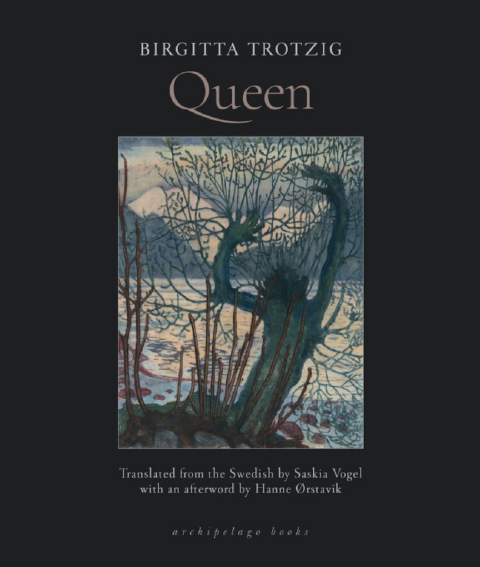
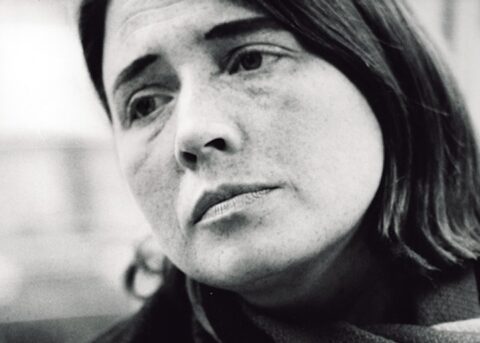 Another Swedish author whose work might be aptly described as Bergmanesque is Birgitta Trotzig, a name likely unknown to most Americans given that her writing has never been translated into English until now. Born in the Swedish coastal city of Gothenburg in 1929, Trotzig published her first novel in 1951, making her a contemporary of Bergman and meaning it is just as possible that she influenced him as that he influenced her. Trotzig and her husband moved to Paris in the mid-1950s and remained there for 15 years, a period during which she published several books, including Levande och döda, or Living and dead, in 1964. One of the three lengthy stories included in that volume is Drottningen, or Queen, as it is titled in Saskia Vogel’s transfixing new English language translation. The novella is the first of a trio of Trotzig works slated to be translated by Vogel, an award-winning translator who has turned out more than 20 titles over the past decade, including Linnea Axelsson’s novel-in-verse Aednan, which was a finalist for the National Book Award for Translated Literature, and Johanne Lykke Holm’s Strega, an otherworldly fable set in an isolated Alpine hotel.
Queen spans about 50 years straddling the turn of the 20th century and is set mainly on an isolated farm in Bäck, a blip of a village along the eastern coast of Skäne, Sweden’s southernmost county, which droops down into the Baltic Sea alongside the Danish island of Zealand. The territory will be familiar both to readers of Mankell’s Kurt Wallander novels, as the detective’s hometown of Ystad sits on Skäne’s southern coast, and to fans of Bergman’s films, eight of which, including The Seventh Seal and Smiles of a Summer Night, were shot in Skäne. The novella tells the story of the Lindgren siblings Judit, Albert, and Viktor, whose familial bonds are strained by their parents and ultimately snapped by violence and distrust, leaving them to fend for themselves, even when they are living under the same roof: “Alone were they, each and every one unto themself, like cast stones scattered in the empty water-dawn.” The boys react to their situation in wildly different ways: Viktor by fighting, drinking, and sleeping around, and Albert by merely withdrawing further into his own head. Judit, however, copes by seeking control, a compulsion that lands her the titular nickname of Queen when she is still a child. The result is a gently told tale about incredibly harsh happenings, most of which are nothing more uncommon than everyday life during the hardscrabble years of economic depression on either side of the First World War.
Judit is nine years old, Albert a year younger, when Viktor is born. Their mother never fully recovers psychologically from what is a traumatic birth and feels “an aversion toward the little one — a flinch at least (as when meeting a snake).” With her mother’s ambivalence, Judit takes on the role of raising Viktor. But the girl also must fill the vacuum left by her father, Johan, who checks out of his children’s lives long before he dies decades later. Overwhelmed by the upkeep of the farm and the deterioration of his wife, Johan takes out his frustrations and feelings of inadequacy by beating the young Viktor, only changing his ways when he has a spiritual awakening. (Trotzig converted to Catholicism while she was in Paris, and faith plays a prominent role in much of her work.)
Johan comes to see God in the “face of the poor” and opens the farm’s doors to whomever is in need, “vagabonds, casual laborers, ordinary beggar men and beggar women, not to mention the parish’s every elder, widows and biddies who supported themselves by helping out with odd jobs for the day in exchange for food and something to take home in their basket.” The experience instills in Judit a visceral distaste for poverty that motivates her for the rest of her life. At 16, she works harder than “all the others put together,” her personal way of rebelling against what she sees as her father’s shortcomings. And while she proves able to meet any challenge presented to her, she also has no guardrails: “There was always something in the Queen that leaned toward ‘too much,’ she couldn’t put a limit on things, it ended up being too much and it ended in destruction.”
 Words and phrases are repeated throughout the novel, sometimes in the next sentence, sometimes a paragraph or two later, a stylistic decision made textual early on when we are told that there are “few words in this rough land’s laconic language.” Sometimes these echoes change a word’s meaning or reference point, as with the description of a woman’s arrival to the farm: “She was tall and dark. Her face was white. Her hunger was dark. Death was dark. The snow was white.” In the following paragraph, the imagery is rearranged: “Dark is death, dark is hunger, the white white drift. Such is death’s bitter empty field, death’s splendid garden. She was tall and dark.”
Trotzig’s writing can also be grandly cinematic in its scope, never more so than when she is writing about the landscape of Skäne, passages where Vogel’s translation soars. She doesn’t try to iron out the compound structure that presumably derives from some Swedish words, as in “Without pause the lighthouse beam swept across ever-new light-unstruck never-seen waves.” And she varies the lengths of sentences, carrying readers along for nearly an entire page then stopping them every few words. The passage when Johan finds God is extraordinary, a passage that is almost impossible to read without thinking of Bergman’s trilogy of films about faith — Through A Glass Darkly, Winter Light, and The Silence — that were released around the time Trotzig was clearly wrestling with similar questions in her writing, a passage that is made so powerful by its conclusion that it is worth quoting in full:
“He pondered God’s wrath. And the darkness inside himself and what inside him was insurmountable. It was a white day when he saw this in himself, he saw with the utmost clarity how it was woven together, a gray-white snow-powdered late-autumn day – he walked onto the heath, he had an errand over in Torp at the edge of the forest on the other side and he had made it up to where the road curves over the crest, he turned around and saw the whole wide heath gray-white-shimmering with snow gently sloping all the way down to the sea, it was over five kilometers down to that black-green unmoving surface, the air was gray and colorless and easy to breathe, it carried a faint fresh whiff of snow. The road curved over the crest. To the left was a pile of rocks, to the right was a spring. Around the spring a thicket of low alders, hazel – leaves fallen on the frost-gray ground like a blanket of gold coins. The spring was clear and dark. The junipers scented the still gray frosty air with dense bunches of blue berries frozen black. He looked out over the whiteness, saw the pile of rocks and the spring, the black sea far beyond and at once he saw deep inside himself, deep down in himself there took shape connected images and figures like an obscure but clear map, he could see how everything was connected. And he threw himself to the ground: child of God.”
Once Johan dies, Queen becomes focused solely on her reign, “[locking] away the good Judit.” Unable to control the wild Viktor, she suborns the meek Albert, becoming someone he must endure, “like life was to be endured.” Albert carries his devastating loneliness like “a knot, a cramp.” Later in life, he too has a spiritual awakening, at the same spot as his father, and becomes “a great reader of the Bible.” Yet he wants deliverance rather than redemption, longing to be swept away “in one fell swoop,” delivered “from the earth.” Eventually he is indeed swept away, but in a manner that focuses both him and his sister on their earthly comfort and selfish desires rather than on more theological values such as prudence and charity.
 The source of their ruin is a woman tied to their brother Viktor. In 1920, the young man runs away to Depression Era New York City and the novel follows him there briefly as he struggles for work and then meets a Polish emigre who saves him outside a factory when they get caught up in a stampede of laborers desperate for the few available jobs. Queen opens with this same woman arriving at the farm in Sweden in 1930, before the narrative organically rolls back the clock and recounts the story of how she got there.
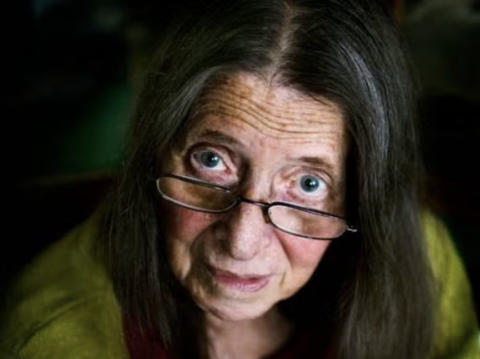
The woman’s name is Lydia, which is not revealed until near the end of the novel. But Trotzig is not trying to spring some surprise on the reader or artificially increase any mystery by withholding the name. Rather she seems to be making the point that Lydia as an individual does not matter as much as the role she plays in the lives of the Lindgren children, saving Viktor, at least for a time, and enabling — though through no fault of her own — the damnation of Judit and Albert, or at least exposing the weaknesses of their humanity. When Lydia arrives in Sweden, she is close to giving up, “something in her had been damaged in a way that might not be able to be repaired.” Whatever small measure of control she had over her impoverished life with Viktor in New York City is gone. She is a stranger in a strange land where she speaks fewer than a dozen words of the local language. And yet Queen sees her as an adversary, a threat, “another weakling over whom to command,” and Albert sees her as something to be conquered, not out of malice but due to his simplemindedness and isolation.
Making broad judgments about an author based on a single book is probably logically unsound, but taking into account the astute judgment Vogel has displayed throughout her career and her commitment to translating more of Trotzig’s work, I feel comfortable in saying that Birgitta Trotzig is likely to attract a whole lot of English-speaking fans over the next few years. Who knows, maybe long after Anglophones get ahold of Vogel’s next two translations —Trotzig’s novel The Marsh King’s Daughter and her essay collection The I and the World — we can even think about adding “Trotzigian” to the dictionary as a synonym for Bergmanesque.
[Published by Archipelago Books on February 24, 2026, 160 pages, $19.00US/$25.00CAN softcover]
One comment on “on Queen, a novella by Birgitta Trotzig, translated from the Swedish by Saskia Vogel”