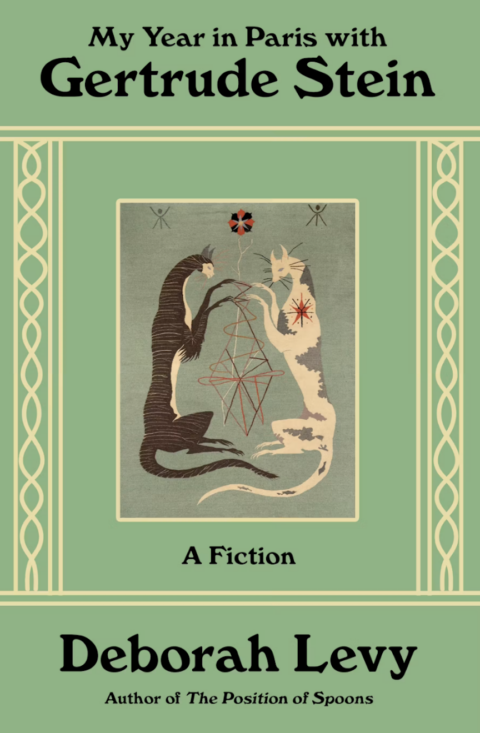
In My Year in Paris with Gertrude Stein, two-time Man Booker Prize finalist Deborah Levy (for Hot Milk and Swimming Home) weaves fact and fiction to craft a book that defies traditional categorization yet completely satisfies. Nestled alongside chapters focused on biographical recaps of Gertrude Stein’s life, Levy’s narrator, an unnamed British writer living in Paris and conducting research on the author for an essay, details her own goings-on in the city, as well as those of two friends, graphic novelist Eva and financial advisor Fanny, incorporating quotes from Stein and her modernist contemporaries along the way. The book, which Levy dubs “a fiction” rather than “a novel,” functions then as a brief journey through the titular writer’s pioneering career as well as a slice of Parisian life, relishing in wordplay that draws from Stein’s bag of tricks to chronicle the mundanity of Levy’s characters’ routines — be it swimming, dining, or bicycling. This verbal banter elevates the story by evoking Stein’s style, forming recurring patterns, and serving as a testament to the importance of art as cultural commodity. The more Levy’s narrator consumes Stein’s history and words, the more she sounds like the author.
 Several of these homages are easy to detect. As Stein expounds upon in “Poetry and Grammar,” and which Levy quotes, “A comma by helping you along holding your coat for you and putting on your shoes keeps you from living your life as actively as you should lead it.” Stein’s aversion to the punctuation mark is honored by Levy’s protagonist in lines like, “She wanted to tell the story of ‘a family’s progress’, how anger fear anxiety aggression are passed on through generations of a family and then repeated in every human that has ever lived,” and, “Fanny believes that Eva’s blue eyes have to fight fight fight with the world’s fantasy of endless girlhood and submission …” Stein’s attachment to alliteration in her prose poetry collection, Tender Buttons, is also embraced in Levy’s narrator’s voice. Where “A BOX” from Tender Buttons opens, “Out of kindness comes redness and out of rudeness comes rapid same question,” Levy’s narrator opines, “What else are wars for except wounding? What else are words for except to press on a wound?” Later, after being called “deracinated,” she suggests, while thinking about modernist art destroyed by Nazis in World War II, “It was fragmented and disorienting and it had been made by displaced artists who were deracinated.”
These small nods to Stein are lovely details for readers to discover. However, the most consistent tribute to Stein’s style in My Year in Paris comes in the text’s use of repetition. Levy’s narrator notes that Stein was “obsessed” with repetitions, and despite Fanny admitting that Stein’s “repetition drives me in-saane. In France we like a clean sentence,” Levy’s protagonist seeds her writing with recurring words and phrases. While railing against technology and the 2024 U.S. presidential election, Levy’s narrator, in two chapters, declares the world is “scrolling, scrolling, scrolling through the various wars in the twenty-fourth year of the twenty-first century.” In observing Eva’s magnetic blue eyes, the narrator six times claims they make people coo “awww,” and when Eva is sad, the narrator thrice switches the public reaction to “owww.” Fanny’s catchphrase, “O-kaay,” pops up nine times in the book, and after quoting Stein’s sentence, “My writing is clear as mud, but mud settles and clear streams run on and disappear,” the narrator twice refers to situations as “clear as mud.” Yet Levy’s best use of repetition blossoms from the book’s opening line: “Eva called to say she had lost it.” The ambiguity of this statement feels Stein-like, yet the “it” in question is Eva’s cat named “it,” who has vanished, though Fanny has decided to call the animal “Bob,” instead. “It is doing my head in,” Fanny says. “From now on it is Bob. We know where we are with Bob.” Much of Eva’s storyline revolves around her search for the lost cat, but this initial mention, alongside Fanny’s renaming of the animal, allows Levy to exploit this pattern via a series of “it” sentences and questions throughout the book: “I had lost it,” “They had lost it,” “Gertrude had lost it,” “What is it?,” “What was it?” Like Fanny, for each of these, Levy’s narrator offers a new replacement for “it” — “daring,” “courage,” “colonialism,” “representation.”
By redefining “it,” Levy and her narrator reflect upon the elasticity of language. Beyond this, each of these repetitions conjures rhythm, creates an echo across chapters, and yes, mimics elements of Stein’s stylings. They also unveil the limits of Levy’s narrator’s friendship with Eva and Fanny, as well as her understanding of Stein, for whom she says to know “too much and nothing at all.” In The Making of Americans, Stein writes, “Every one then has in their living repeating, repeating of every kind of thing in them, repeating of the kind of impatient feeling they have in them, of the anxious feeling almost every one has more or less always in them.” And within her considerations of Stein, Levy’s narrator concludes that repetition in Stein’s writing “was her way of moving closer to her enquiry but never getting there. After all, what might she find?”
 Compare this to the narrator’s relationships with Eva and Fanny. Early in the book, she insists, “We liked not knowing much about each other because there was so much to find out.” She explains what little she has gleaned: that, besides having lost her cat, Eva is saddled with an estranged husband living in Seattle; and that Fanny, the lone French native of the trio, spends her days sleeping with a series of female lovers and advising wealthy clients from around the world. As chapters amass, however, a disconnect between the threesome surfaces. Originally from Copenhagen, Eva speaks five languages, and the narrator laments, “Eva knows much more about Fanny than I do because they speak in French with each other. My lack of language has shut me out. The door is not exactly closed, it is ajar, perhaps latched on to a chain like Eva’s door when her cat lived with her. Really, I know a few basic things about my new friends.” The three share meals, spend weekends away with each other, and collaborate to find Eva’s lost cat, yet Eva and Fanny tell the narrator little of their personal issues. In one instance, the narrator pries Eva about a phone call with her husband, only for Eva to reply, “You will have to speak to me in a language that is not English if you want that conversation.” Then, rather than be truthful with the narrator about her fractured family, Fanny lies, saying she frequently drives an hour to play boules with her father. “In fact,” Eva discloses to the narrator, “they don’t get on at all and he kicked Fanny out of the family home when she was sixteen.”
Like Stein, the narrator constructs her life through repetition to “mov[e] closer” to her companions, yet she “never [gets]” to the point of absolute trust and comfort. Levy’s narrator pushes against these friendships being superficial, avowing, “I was pleased that Eva knew nothing about me except for our life together in the continuous present,” yet this shortsightedness plays into the narrator’s critical assessment of Stein’s use of repetition in her oeuvre. As a result, final act revelations from Fanny and Eva that would appear natural to a close friend strike her as surprising.
My Year in Paris with Gertrude Stein is filled with lively reverence to Gertrude Stein’s biography and style, providing the manuscript structure and clever moments of realization, yet the book is more than just riffs on Stein. Levy’s narrator dabbles in mystery when wondering about the status of Eva’s marriage, and after the trio meet a man, Jean-Luc, during a nighttime search for “it/Bob,” the narrator suspects his potential involvement in the animal’s disappearance. As for comedy, most laughs come from Fanny, who roams the world without a filter. She juggles three lovers, debates their ranking, and ends up buying one a pet pug who will only drink coconut water and fears the moon. Every time Eva and the narrator ruminate on Stein, Fanny makes a point to express her hatred for the writer. She is blunt, as well, when clarifying why a man would prefer Eva over the narrator, stating, “Eva is young, slim and beautiful and you are not.” And in the days following Donald Trump’s reelection, after the narrator notices mice in her apartment, Fanny provides perspective by reminding her, “Look, there’s bad shit happening in the world and you are going crazy about one mouse.” With a cigarette always tucked in her belt, Fanny adds spark by exhibiting the stereotypes typically reserved for heterosexual cis-Frenchmen, and her attitude bounces nicely off of Stein’s thoughts and influence.
Late in the book, Levy’s narrator writes, “I needed to be deep in it so I wouldn’t notice the mice. What was it? My essay on Gertrude Stein.” Moments later, she changes her mind: “What was it? Love. I needed to be deep in it.” Here, definition and desire are moving targets, kaleidoscopic in meaning, and as Deborah Levy sends her characters traipsing through romance, loss, and confusion in My Year in Paris with Gertrude Stein, she continues her streak of “living autobiographies” and novels that magnificently tap into the human condition, navigating friendship, companionship, and scholarship to address the ways we connect with each other, even transactionally.
[Published by Farrar Straus & Giroux on June 2, 2026, 228 pages, @27.00 hardcover]