The stunning cover photo of Jonathan Aaron’s new poetry collection, taken by the Finnish photographer Pentti Sammallahti (born 1950), shows a frog, the top of its head only, poking out from an unnaturally still body of water. Behind him, we see a white sun hovering in the sky over an indistinct landscape devoid of human presence. Is it sunrise or sunset? The frog’s ancient eyes look fixedly at us, daring us to come closer.
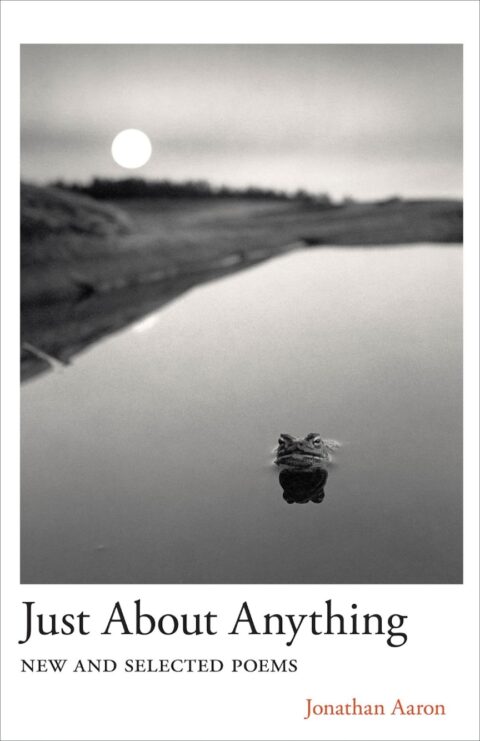 Just About Anything is Jonathan Aaron’s fourth volume, the first he published after his retirement from Emerson College where he taught poetry for almost 30 years. The sampling included here of poems from his three previous collections (Second Sight, 1982; Corridor, 1992; Journey to the Lost City, 2006) suggests that we are to take the new book as a kind of summa of his work, not an unreasonable assumption given that Aaron is now in his eighth decade. But what these teasers quite wonderfully show is that Aaron has been on a continuous journey that will probably extend beyond this latest compilation. He has fashioned a voice fairly unique among contemporary poets, both austere and satirical, spare and conversational, erudite and accessible, and his interests have circled around a set of familiar themes.
He has always, for example, admired the resilience of animals. In “Giacometti’s Dog” from Second Sight, a poem about the well-known bronze sculpture at the Guggenheim, Aaron sees the skeletal creature not as a metaphor for something else (Giacometti’s self-portrait, as is sometimes claimed, or the projection of a dismal inner state) but first of all as a still-functional animal whose papery skin still holds in, however provisionally, his inner organs and whose legs still carry him forward, even though his hindquarters seem to be moving in a different directions from the front. E pur si muove — an achievement, Aaron wryly points out, that is “less / than the sum of its parts.” The poem memorably ends with the dog checking both sides of the street before crossing, at which point his robotic neon eyes shift to a demonic “green of sea-worn glass.”
In Just About Anything, animals are once more a sturdy presence. Consider “Russian Studies,” in which we meet a dog who insists that all literature is really about dogs — and that if we haven’t found this to be true (“Well, I can’t recall / any dogs in Solzhenitsyn”), then we just haven’t looked hard enough: “‘Read him again,’ she said. ‘More carefully.’” Then there is the wise pony named Oaty that “knows more than I do” (“’Oaty'”); the tiny fruit fly that gets the poet to share a glass of wine: “I’ll pour another one for the both of us” (“To a Fruit Fly”); the crows in “A Couple of Crows” that make fun of humans and other animals (including “three or four rabbits unready for anything.” The latter poem reminds me of Christopher Cranch’s delightful “Bird Language” (1875), in which the poet-painter, “sketching under a whispering oak,” overhears five bobolinks laughing at “some ornithological joke” he doesn’t get, because he doesn’t understand the language of birds. For all we know, Jonathan Aaron, writing 150 years later, actually might. In “Cedar Waxwings,” he delightedly watches these birds, “in their black burglar masks,” living it up: “They love to party. Sometimes they get so drunk // on overripe berries they keel over / and then have to sleep it off.”
Humans have long fantasized about what it would be like not just to understand animals or, for that matter, plants, but to be one of them, to have the daily struggle of making sense of life replaced by an existence dictated by simpler needs. Jones Very, a contemporary of Cranch, once dreamed he was a columbine in a field of other columbines, feeling the wind and the sun just like they do, too: “I forget that I am called a man, / And at thy side fast-rooted seem to be, / And the breeze comes my cheek with thine to fan” (“The Columbine,” 1838). One of Aaron’s explicitly named tutelary spirits is the “peasant poet” John Clare (1793-1864), who once wished, “in one of his elevated moods, / he were a fly” (“The Subjunctive”). (Aaron might have had in mind Clare’s prose sketch “House or Window Flies”). But the (often unacknowledged) granddaddy of all shapeshifting is Publius Ovidius Naso, better known as Ovid, whose Metamorphoses (8 CE) starts with a preamble explaining how the world, before the gods put things in order, was a boundaryless chaos, with earth, water, and air all mixed in together. Ovid’s book then shifts to a series of narratives about humans or half-humans challenging the gods’ boundaries: the nymph Daphne who becomes a laurel tree rather than be assaulted by Apollo; the hunter Actaeon who, having incurred the wrath of Artemis, is changed into a stag (and is promptly eaten by his own hounds); Arachne, changed into a spider by the jealous Athena after a weaving contest, and so forth.
What these transformations have in common is that they are responses to some unspeakable trauma, to threatened or actual violence. Aaron’s metamorphoses are subtler. Here there are no vengeful gods to run away from, no contests to lose. His problem is, the speaker admits in “Just About Anything,” a personal one: he often finds himself “of too many minds / when it comes to, you name it, just about anything.” But that’s in fact an appropriate way of looking at a world in which just about anything goes, where even everyday things constantly want to be something other than what they are. In Aaron’s “Disappearances,” from Journey to the Lost City, mundane objects — a pocket knife, “almost any pair of socks,” the car keys on the table — are being lost at a dizzying rate, an exodus of cosmic dimensions: “As you read these words, // a million needles are flying out of this world / like drops of water haloing a dog shaking herself / after a dip in the ocean.” (Elizabeth Bishop once sighed, in her late villanelle “One Art” (1976), referring to, among other things, door keys: “So many things seem filled with the intent / to be lost”). Yet in Aaron’s poem, things that disappear go on to discover their true purpose, congregating in another “dimension where anything / anyone ever lost is found.” Our loss is their gain.
No such other dimension is needed in Just About Anything. Here, tangible and intangible things as well as people shift shapes before our very eyes, inviting us to join the dance. The night, wearing the moon on its forehead, looks like a coal miner with a headlamp (“Night”), and a gazillion, a number so vast that we can’t begin to comprehend it, may unexpectedly step out from behind a neighbor’s barn, transformed into a fearsome feathered snake, of the kind the Maya celebrated, dragging behind it its long tail of zeros, “baring its teeth and flexing its brilliant feathers” (“Big Numbers”). In another herpetological adventure, the speaker discovers his landlord has changed into a giant python, a humorous reimagining of Kafka’s “The Metamorphosis” (“Herpetology”). The landlord’s name, George, directly recalls Kafka’s unfortunate Gregor Samsa and his transmogrification into some hideous bug. But in Aaron’s poem, the landlord’s serpentine alter ego is not an embarrassing calamity but a pastime, a forgivable indulgence: “every so often / the mood comes over him,” the landlord’s wife explains.
Perhaps inspired by such examples, Aaron’s speaker tries his hand at his own Ovidian metamorphosis. In “Acting Like a Tree,” having committed the familiar faux pas of showing up at a Christmas party without the required costume, he decides, because it seems like fun, to pretend he’s a tree:
I narrowed my eyes and pursed my lips, making
a tree face, and started slowly hopping on one foot,
then on the other, the way I imagine trees do
in the forest when they’re not being watched.
Maybe people would take me for a hemlock,
or a tamarack.
The speaker’s tree performance earns him the skepticism of one of the party guests, a girl dressed as an elf. “Oh, come on! / her expression said. You call that acting like a tree?” Note how the elf-girl isn’t the least bit surprised that someone would want to be a tree; the only criticism she offers is that the speaker hasn’t worked hard enough to be convincing. The evident problem with the speaker’s first effort was that he was imagining what it would be like to be a tree, conjecturing what trees might be doing when no one’s around (“the way I imagine trees do”), a niche detail unlikely to convince his audience. (Aaron might also be referring to the old philosophical saw: “If a tree falls in the forest and no one is around to hear it, does it make a sound”?). His is an anthropomorphic fantasy, too childish even for the child who witnesses the performance—trees don’t have feet, and what good would it do them to hop around at night? To relax the muscles they don’t have? To party like cedar waxwings? On a side note, was Aaron familiar with Woody Allen’s stand-up routine “The Moose,” in which he brings a real moose to a costume party and mistakenly leaves with the Berkowitzes, a couple dressed up in moose suits, tied to his fender?
The speaker’s second attempt to become a tree, delivered, with his eyes closed and with the utmost concentration, to the accompaniment of the chords of “Joy to the World” (played on the piano by a guy in a reindeer suit), is more successful. Thinking the way a tree would think, rather than just pretending to be one, the speaker acquires true tree-ness, transporting himself into the habitat of forest trees, leaving behind for now the ridiculous party with its ridiculously costumed guests. The stages of this transformation are given to the reader as a series of facts:
… This time I could feel the wind
struggling to lift my boughs, which were heavy
with snow. I was clinging to a mountain crag
and could see over the tops of other trees a few late
afternoon clouds and the thin red ribbon of a river.
I smelled more snow in the air. A gust or two whispered
around my neck and face, but by now
all I could hear was the meditative creaking
of this neighbor or that — and a moment later, farther off,
the faint but eager call of a wolf.
Aaron’s enjambments, by instituting pauses that paradoxically push us forward (“how will this line end?”), pull the reader right into the process of arboreal transformation. By the end of the poem, the speaker might be even more of a tree than before: he feels the way a tree would (there’s the wind in his branches, the snow weighing on them), sees things a tree on a mountain would (clouds, a river), hears the sounds made by other trees. The “eager call” of the wolf is a nice touch at the end — eager for what? Obviously, this metamorphosis is not a passing fact. The dream continues.
 In Aaron’s poems, dreams may, as they do in this poem, lead to further dreams, a never-ending loop throwing doubt on the firm existence of anything one would normally call “reality.” In “Dreamland,” the speaker is cautiously moving through a pitch-dark room, past “books stacked next to / the bulky shadow of an armchair,” through a maze of shelves, when from somewhere a voice asks him if he wouldn’t rather be in bed right now with a book that would surely transport him to the book-filled dreamland where, of course, he already is. “Among the Russians” records another dream in which the speaker has gathered around a ceramic stove with a bunch of Russian literary luminaries (Nikolai Gogol, Anna Akhmatova, Isaac Babel, and Maxim Gorki), waiting for a soup that is being prepared by Gogol, which the latter promptly ruins. Looking out the window over Gogol’s shoulder, the speaker sees the next dream rolling in: “darkness … with its flock of devils and witches.” Incidentally, White Flock (Belaya Staya) is the title of a 1917 collection by Akhmatova, a reference to the poems she was addressing to the artist Boris Anrep, with whom she was deeply in love.
“The darkest days of the year / Must become the most clear,” Akhmatova exhorted herself in 1913, lines that could also serve as a motto for Aaron’s work. His poetry doesn’t purport to make the word a better place. It has no evident political insights to share, no tangible advice to give. But I know few other poets who can guide us with such humor and melancholy determination to the ways in which we may carry on with our lives even in the shadow of overwhelming grief and loneliness. Several of the new book’s most haunting poems capture the pain of losing a beloved person: “Who’s there? / Nobody / It’s only my heart knocking” (“Knocking”). The memory of those once-familiar sounds makes such silence even more devastating: “No one // in the kitchen laughing or speaking quietly on the phone” (“I Look Up”). In “Breath,” the bereaved speaker convinces himself that his breath is hers, imagines, too, how she would immediately correct him: “No, you say, that’s not my / breath. It’s yours.” But this is, as the poem’s last line reminds us, just a dream: “I grope for the light switch.”
Aaron’s “Presence,” by contrast, envisions a more enduring solution. Here the speaker no longer imagines but acts, using his metamorphic powers to exchange his identity for hers:
I keep finding myself walking from room to room
as if I’m the ghost, you the one deep
in your favorite chair reading a magazine
or talking on the phone or about to tell yourself
it’s time for lunch. Then some hint of my presence
occurs to you, and you raise your head
and get to your feet and glance around,
trying, trying against your better judgment —
you were ever skeptical — to understand
the nature of my stubborn lingering.
As the “I” transfers agency to the “you,” the conditional “as if I’m the ghost” morphs, without much fanfare, into a declaration of fact, even if some skepticism remains. Before we know it, the poem’s absent addressee is in the room again, present not just through her personal preferences (the favorite chair, the magazine, the ritual of meals) but her mental disposition, too. Disbelieving in ghosts yet sensing the presence of one, the “you” now wonders why the speaker is still around: suddenly it is he, not she, who has died, he who is “lingering.” Turning the tables on death, the poet, after a fashion, kills himself so that she may, in a way, live again — which means that he, too, can go on living: dying into a new life, he performs the ultimate transformation.
The Greek philosopher Heraclitus, fervent advocate of constant change, now remembered mostly for his dictum that one can’t step in the same river twice, also claimed, as quoted by Aaron, “that the living and the dead, the waked and the sleeper” were the same (“A Few Things I learned from Aldo Buzzi”). And while this idea might be hard to grasp philosophically, and impossible to implement in daily life where the void left by a beloved person seems so palpable, Aaron’s poetry, for the length of a few lines, a handful of pages, persuades us that things or people that are gone aren’t, in fact, lost. They may have merely assumed new shapes. You just need to keep on looking. As the dog said to the reader of Solzhenitsyn’s work, staring him in the face the way Sammallahti’s frog stares at us: “Read him again … More carefully.”
[Published by Carnegie Mellon University Press on March 21, 2025, 128 pages, $22.00 paperback]
To read Christoph Irmscher’s essay “Alexandrian Delights: Rereading Cavafy,” click here. Published March, 2025 On The Seawall.