I once read a review of a jazz musician, possibly a Marsalis, playing in a nightclub, possibly in the Village. One of his solos was intruded upon by a patron’s ringing cellphone. The musician paused, then continued. As his piece neared its climax, he incorporated the errant ringtone into a riff, transforming the annoyance into delight. I was reminded of this when I read Jazz June, a collection of 22 essays by Clifford Thompson in which he recounts his obstacles not as defining wounds but as motifs to incorporate into his own discursive but always guided narrative. As a personal essayist, he emphasizes gratitude over grievance. As a Black male coming of age in segregated District of Columbia, Thompson faced plenty of challenges but found solace in his obsessions. What Thompson writes of John Coltrane might be a blueprint he chose to follow in laying out this collection:
 “The tune begins … then Coltrane … plays the simple theme repeatedly, seeming to mull over the idea of it, each iteration more complex than the one before, until, at last, he takes off, begins to take the theme apart, seeing what it’s made of, what he came make out of it …giving the feel of a search, a quest.”
Thompson’s father died just as his son was entering early adolescence. As the much younger child of the family with three grown siblings already out of the house, Thompson grew up in a house maintained by his mother, who also supported her mother by working the night shift sorting mail at the post office. She would return to spend breakfast with her son before she went off to bed and he, a dreamy, slightly built, comics-obsessed teenaged boy, went off to school to face the demons without much ammunition. “As the general of our household,” Thompson writes of his mother, “in the long slog of a battle that was her life, she seemed to view the problems of an enlisted man like me from a great height.”
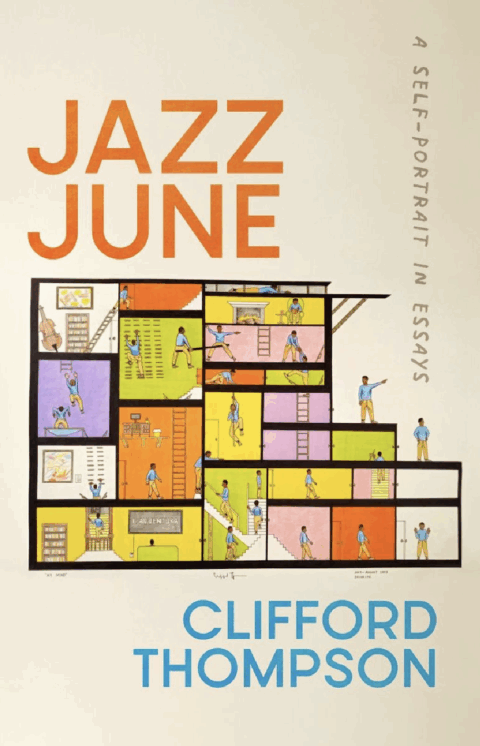
Thompson has navigated the world through his avidity for what he cherishes — music, movies, books, but also art, with an emphasis on comics. In addition to his creative and critical writing (he is the author of What It Is: Race, Family, and One Thinking Black Man’s Blues, 2019), Thompson is also an acclaimed artist (one of his paintings serves as this collection’s cover art) and is the author most recently of the graphic novel Big Man and the Little Men, a timely story about a political campaign stained by racism and scandal.
 His experience as an artist and a graphic novelist provides a structural grid for this collection. His essays’ titles firmly define his interests: “Summer of ’83: On Family, Travel, War, the Women of Youth, and Redemption,” “The Home of Two Cliffs: On Finding One’s Way and Fathering,” and “Cities, Bulls and the Boy at Seventeen: On Criticism, Romantic Yearning, Film and Redemption.” Film, jazz, family, women, race, identity, and joy are his key subjects.
Regarding joy, his charm is found in his ability to find it in unlikely places. “Out of the Past: On Family, Work and Looking Back” recounts his days employed in the South Bronx by the reference publisher H. W. Wilson, which he at first describes as “a workplace for those not up for the excitement of the library,” before immediately apologizing, advising, “There is treasure to be found in most places if you’re of a mind to look.”
This might serve as the motto of this collection. Thompson is most decidedly of a mind to look. He spent years at the Wilson publication Current Biography, a monthly magazine profiling prominent people, a standard reference source in libraries. He began as a copy editor and rose through the ranks while raising his family, making a home in Brooklyn, and forming close friendships with his colleagues. Punctilious grammarian types? No, “thoughtful and personable with good senses of humor … faux aunts.” Was the hour-plus subway commute a slog? Undoubtedly, but what an opportunity to dive more thoroughly into the literature he studied in college: “I took to wearing a fedora in those days, and not only did I imagine I was a more urban, darker-skinned version of the daily commuters in the world of John Cheever’s stories; I was steeping in other fictional worlds, too.” Was the location, pre-internet, isolating — so far from the bustle and gossip of the midtown publishing world? Yes, but it was also “an introvert’s dream … I got lost in my work in a way that feels impossible now.”
Prior to his gig with Current Biography, Thompson was a freelancer hoping to write a young adult biography of Gwendolyn Brooks, whom he approached at a reading in Manhattan, an encounter recounted in the title essay, “Jazz June: On Romantic Yearning, Jazz, Ambition, Poetry and the Girls of Youth.” When Brooks turns to the shy young man to ask if she can help him, he blurts, “I was hoping I could buy you a cup of something.” In the moment, Brooks laughs (though she later gamely helps him with his project) while Thompson describes this exchange as “cringe worthy.”
 Thompson can be curiously self-effacing, a trait he claims others noticed as well. “I’ve never met anybody as good-looking and underconfident as you are,” a woman tells him. A camp counselor describes him as “too quiet.” The critic Stanley Crouch complains that he is “too respectful.” I suspect that what Thompson is doing is listening, like the musician who incorporated the cell phone ring tone into his solo. Still, it requires no small amount of confidence to so thoroughly detail one’s diffidence. Thompson would agree: “What is a personal essayist if not self-obsessed?”
He’s obsessed with many things. He approaches his enthusiasms with pleasure — and his fears with what Robert Burns would call “rue.” In an appreciation of soul music and singing (primarily Otis Redding and Sam Cooke), Thompson writes of Cooke, “In his more soulful numbers, in that rasp, there is still another quality mixed with joy, one that recognizes joy’s darker side.”
Joy’s darker side encompasses, among other things, the experience of being a Black man in a world and time in which they are murdered on the street while their killers walk free, a subject he tackles in the essay “Eric Garner and Me: On Race, Identity and Redemption,” although “tackles” might be putting it too strongly. Having been raised, as he writes, with “no scarring experiences,” and having made a choice at his (mainly white) college to “judge people as individuals, if I had to judge them at all,” he comes to terms with his belief that people’s “color [is] less important than their desire to see the right thing done.” Thompson’s primary struggle regarding identity, in these pieces, is to stake his claim as a writer (“writing is the one thing I have always pursued whether I knew anyone was interested or not”), as a father, and as a New Yorker. He strolls his favorite neighborhoods, accompanied by the soundtrack in his head, riffs of appreciation, while on the prowl for a cup of something.
[Published by The University of Georgia Press on October 1, 2025. 152 pages, $23.95 paperback]