Some works of speculative fiction explore radical breakthroughs in technology, surreal epidemics that ravage the population, or political developments heretofore unimaginable in the present moment. Think Octavia E. Butler’s Parable of the Sower or Karen Russell’s Sleep Donation. Other works that share this taxonomy opt for a different route, presenting a world that’s mostly recognizable as the one its readers live in — albeit where everything’s gotten ever-so-slightly shinier — or has taken a turn for the worse. Paolo Bacigalupi’s The Water Knife and Claire Vaye Watkins’s Gold Fame Citrus fall into this latter category; so too does Delaney Nolan’s debut novel Happy Bad.
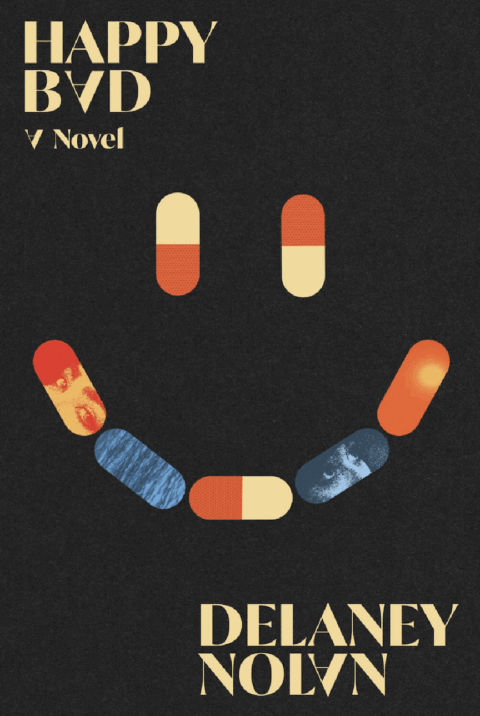 This is the thing about Happy Bad: it doesn’t read like speculative fiction. There are a few references to historical events having taken place in 2028, and one line that puts the novel’s action some time in the 2040s. Otherwise, this story of a woman trying to make a life for herself in a small Texas town and grappling with events wholly beyond her control feels thoroughly contemporary. As I type these words, the federal government is shut down and the House of Representatives is in what seems like a perpetual recess; it’s not hard to get a slightly dystopian feeling from the world outside my window, especially when prominent political magazines are publishing speculative fiction of their own. Happy Bad is a fascinating case, though, for the way that it feels thoroughly contemporary while also grappling with countless Big Ideas. It’s sneaky like that.
That surreptitious quality is very fitting for Happy Bad, given what Nolan reveals about narrator Beatrice over the course of the novel. The bulk of the book focuses on Beatrice’s work at Twin Bridge Residential Treatment Center, located in Texas and home to a group of teen girls and an adult staff. Early on, Beatrice explains the complex economic web in which Twin Bridge is enmeshed:
“Teetering on the verge of bankruptcy, the center fell into the clutches of private equity and was thereafter purchased by a private social services company, within whose subsidiary, named TENDER KARE, we snugly nested. The state had privatized these social services and outsourced them to TENDER KARE, who had in turn partnered with a multinational pharmaceutical company whose record of lawsuits I once googled in despair.”
That partnership includes a medication called BeZen, which appears to be effective in improving the mental health of the residents at Twin Bridge. Eventually, corporate dictates instruct Beatrice and her colleagues to take the center’s patients to a new facility in Georgia. Under normal circumstances this would not be a difficult task, but as social norms and economic bonds erode, Beatrice is forced to improvise in order to obtain transportation — something that leads to a shocking act with ramifications that won’t be fully apparent until Happy Bad is nearly over.
Interspersed with the scenes set in the novel’s present are some flashbacks to Beatrice’s young adulthood, including a moment when Beatrice, along with her sister and father, attempted to kidnap a vulture as a gift for their mother. Nolan hints at where this is all going — the fact that Beatrice doesn’t have any contact with other family members in the present-day sequences is a big hint that these flashbacks aren’t heading to a happy place, but — without spoiling too much — it’s also true that the payoff isn’t an instance of grand tragedy. Like many things in this novel, it’s sadder and stranger than that.
***
Nolan has set herself a challenging task here. As a protagonist, Beatrice has a host of challenges awaiting her, from the logistical ones posed by her journey to the romantic ones raised by the presence of Frank, a man she briefly dated, on the trip east. But there’s also a lot in the world of Happy Bad that is wholly outside of Beatrice’s control, something she makes clear early on in discussing the corporate structure surrounding TENDER KARE.
 However, that lack of control goes beyond one corporation. There’s also the matter of a slowly disintegrating federal government, a fraught process of crossing from one state into another, the risk of lethal blackouts, and weather conditions that border on the biblical — including one especially unnerving dust storm. At one point, Beatrice references “a cascade of failures” that takes place elsewhere and turn out to have catastrophic implications for her journey; there’s nothing that she can do about it. Nolan also drops periodic hints at other ways the world had devolved in the time between the year of this book’s publication and the year in which it is set, from jellyfish running rampant in the world’s oceans due in part to the extinction of salmon, to a hint that the canine population of the U.S. has sharply declined.
Beatrice is not an entirely reactive protagonist, however, which helps keep this book gripping. Much of it is about the decisions that she makes under awful circumstances; even as the world around her crumbles, she seeks something better for herself — and for the young women in her care. This contrasts significantly with one of the threads in the flashbacks to her youth: Beatrice’s parents’ gradual immersion in a cult called Double Truthism, which advocates attempting to find a better parallel universe and — somehow — make their way there.
There’s a relatively subtle quality to this novel, considering the way it depicts a fragmenting society and contains several scenes of implicit and explicit violence. That naturalistic mode is a welcome way to depict a societal collapse in slow motion: these are characters doing the best they can to get by, as opposed to pausing every few minutes to ponder the chain of events that led the country and the world to be in this particular condition. There are a few moments where things feel a touch more heavy handed, including some animal kingdom imagery early on and a sequence about what Beatrice and her sister Jemma decide to do with their family home. But largely, Happy Bad avoids grand pronouncements about humanity and society, and it’s a stronger novel for it.
***
What is at the heart of Happy Sad, then? There’s a scene about two-thirds of the way into the book where Beatrice, her colleagues, and the youths they are supervising are beginning to make their way east where Nolan describes their surroundings in language both evocative and chilling:
“People were embracing this soft apocalypse, the blackout, the evacuation; people were casually wheeling carts of tinned groceries out the smashed doors of convenience stores, sitting in the buckets of abandoned construction differs with their shoes kicked off to get a breeze, walking around in their underwear; people were setting bad examples for our charges; people were flashing the van.”
That idea of a “soft apocalypse” is central to this book. And fundamentally, the shift in Beatrice’s eastern traversal — from workplace assignment to something more primal and inexorably connected to survival and preservation — acts as an understated arc for the character and the book. The near future it depicts is thoroughly unsettling, but Nolan leaves space within it for notes of grace.
[Published by Astra House on October 14, 2025, 320 pages, $26.00 hardcover]