Andrew Martin’s fiction took flight, he says, when he started writing about his interests rather than writing about what he thought his interests ought to be. “Which is basically,” he told The Paris Review, “book chat, sex, and — well, that’s basically all it is.” These formed the basis of his debut novel, Early Work (2018). The novel follows a graduate school dropout and writer named Peter who cheats on his long-term girlfriend, a medical student named Julia, with a “wild creature” named Leslie.
Early Work’s recognizable people and detached dialogue earned Martin a particular pitch of critical praise, which continued in the same key upon the release of his story collection, Cool for America. The characters were of the kind reviewers describe as “overeducated” and “deeply flawed,” people who pride themselves on discussing Future’s DS2 mixtape and Robert Musil with equal aplomb — and probably on never using the word aplomb. When these people spoke, it sounded like your friends. At its best, Martin’s fiction feels especially alive. His novels — now he has two — rely for their appeal on their convincing portrayals of particular elite-Millennial illusions and allusions.
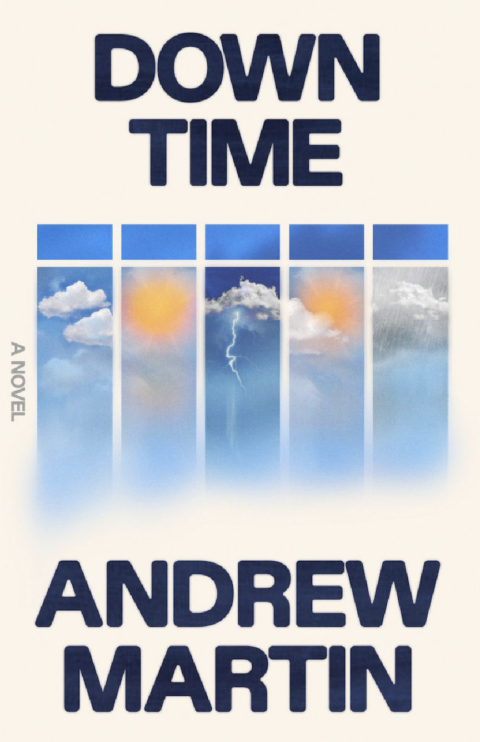 Martin’s new novel, Down Time, is a thematic sequel of sorts to Early Work. The novel’s five principal characters are in their 30s rather than their 20s but play out their roles in front of the same bleak, coastal, post-MFA backdrop. The plot once again outlines a series of betrayals rendered in literate and slangy dialogue. Malcolm, the only first-person voice, even mentions having known a Leslie, maybe the same one in Early Work, in his program.
In Down Time, the long-term girlfriend Malcolm cheats on is a resident, not a medical student, named Violet, and she cheats back. One of the women he tries to cheat on her with, Antonia, rejects him to be with two other people who are cheating on their partners. And Malcolm’s ex, Cassandra, a codependent high school teacher, cheats on Malcolm’s writer friend Aaron, an addict who cheated on her in rehab. “It didn’t feel that much like cheating,” Aaron tells himself, before doing so.
Down Time’s basic elements remain unchanged from Early Work, but Martin’s tone has sharpened and curdled. If Peter and Leslie’s slacker animalism was charming and exploratory, by the time the five characters of Down Time get around to it, their charm is gone. The pandemic and its attendant political eruptions, along with their more numerous betrayals, lends the book’s ironies a greater darkness. In Down Time, Martin has written a cruel and thrilling book, one whose satire reflects with terrible clarity the ways we want to hurt each other.
In a tradition of comic novels, Down Time shines when it tears things down. Spending time with the voice of Malcolm in particular is like taking a dip in acid. His primary target is the moral framework around romantic relationships. By way of introducing himself, Malcolm avows that he has “[n]o traditional values, or at least none that I wasn’t actively working to undermine.” Marriage is an “insidious bourgeois institution,” one whose rites and vows must be denounced as “intellectually bankrupt.” Raised Catholic, he rejects the religion these rites emerge from as an “arbitrarily cruel exercise of power.” All must be stripped away.
What Malcolm and the others are left with is the view that “most everything is, in fact, about sex.” Sex for Down Time’s people is the way to fracture a relationship or to heal it, to motivate themselves or to gain the upper hand. Most everything else is only pretense. When Antonia and Malcolm meet for drinks, he confesses he had an affair with a friend of theirs who passed away. “‘Whatever moral dimension there was,’” Antonia, assures him, “‘is pretty, you know, moot at this point.’” What she cares about is “‘Was it fun?’” When Cassandra discovers Aaron’s affair, she cheats on him within hours to accelerate the breakup.
Martin’s prose ironizes the arbitrary stances the characters do take. “‘I don’t care about fucking up a marriage,’” Antonia says to her date at a bar, “‘but you have to promise me you don’t have a kid.’” When Malcolm receives a manuscript from a friend’s father, he refuses to quote it to Violet. “‘I don’t have a lot of fundamental values,’” he tells her, “‘[b]ut one of them might be not sharing words I’ve been asked not to share.’” This he says to her after having sexted other women for the novel’s duration.
Their overeducation and literary chops come in handy, for the most part, to sneer. Strangers, lovers, friends — all can catch a sneer. Lying on the beach in the early days of the pandemic, Antonia spots the people around her reading “the usual garbage, the singing crawfish and little Nazi boys who fixed clocks or whatever.” When she arrives later at the apartment of a girl who’s taken her home, she surveys her bookshelves: “Murakami, Murakami, Fates and Furies … So she wasn’t a big reader.” Aaron makes sure to write Malcolm a note after the publication of his first novel calling it “‘poker-faced kitsch of the highest order.’” Aaron himself, of course, has not written a novel.
In fact, when it comes to defending or articulating their own thoughts about art or writing, Down Time’s people are out of their depth. Cassandra thinks opera’s central function is as a “social display.” Antonia’s lover poses on the couch with a copy of the New York Review of Books almost as product placement. Despite their status, the characters’ talk or reading is crass and sciolistic, full of empty signaling. When Malcolm’s students challenge him to defend the photographs of James Castle he’s brought in for them, he folds and wonders if maybe it “just wasn’t as interesting as I thought it was.” Malcolm’s honest at least about what he values: he’s able to get writing done later in the novel only when Violet threatens to stop sleeping with him if he doesn’t.
 Down Time’s own aesthetic preference is for verisimilitude —i.e., in an irony it seems unaware of, for fidelity.. Writers in their thirties who come from money really do speak this way. They really do hold these political views. Cassandra and Aaron are “actual socialists,” she’s quick to disclaim, distinct from the liberal boomers. All that time online during the pandemic radicalizes Martin’s characters and makes them tire of the slow and meager motions of electoral politics. Antonia thinks of how the group of protestors she saw crush a Mercedes with a trashcan “had still done more good […] than her quiet sign-holding” during the 2017 inauguration. And true to life, their radical politics amount to nothing beyond critique. Malcolm declares that he’s “temperamentally unsuited to radicalism.”
Martin’s comedic voice is temperamentally well-suited to real-life targets. The book’s funniest moments describe the oppressive ubiquity of DaBaby in 2020, or make of John Oliver a “high-handed Englishman who pretended he was flabbergasted by American politics and, like, the existence of hamburgers.” His dialogue nails the Millennial dialectal imprecision — the assertion that something’s “‘like a thing,’” an actual “ha” said instead of a laugh, or a tragedy made syntactically banal: “‘And then her brain, um, swelled, I guess.’” When we can see or hear what he’s sneering at, it’s most fun.
The goal of such verisimilitude is complicated. When Malcolm presents the James Castle photographs to his students, he speaks of the “melancholy of rendering things again and again to fix them in one’s mind.” In another kind of novel — one that is not, as Martin insists, “autobiographical but not autofiction” — this might be an articulation of the author’s own project. (After all, Malcolm does seem to steal a line from Martin when he describes a new burst of writing as feeling “as if I’d had the parking brake on my whole life.”)
In Down Time, however, there is no attempt to fix these people or their problems. The goal is replication and presentation, nothing further than a fidelity to our faithlessness. Martin’s characters tear down previous generations’ illusions to replace them not with some grand truth but instead with uglier illusions — the illusion of democratic politics with the illusion of political violence, the illusion of romance with the illusion of hedonism, and the illusion of morality with the illusion of honesty. Rather than abandoning theater, they’ve tacked up a rattier scrim. It takes Cassandra, the novel’s least dishonest character, to admit what’s at bottom: “Underneath her outward-facing, socially conditioned empathy was, now, a hard core of uncaring.”
[Published by Farrar, Straus & Giroux on March 10, 2026, 304 pages, $28.00US/$39.00CAN, hardcover]