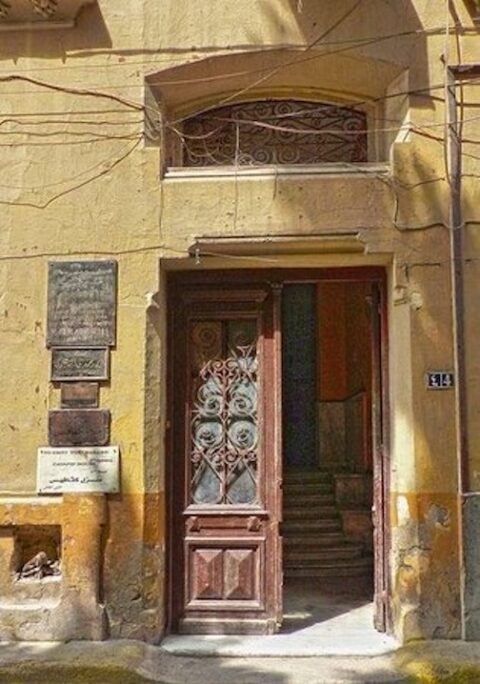
 The homes of revered poets tend to be churchy affairs, compendiums of period furniture, display cases holding manuscripts and locks of hair, typewriters and stubby pencils, writing desks and daguerreotypes, all of it leading to a museum shop where you can purchase your Dickinson totes and teabags, your life masks of Keats, your Fernando Pessoa tee shirts. Until it was spruced-up through the help of the Onassis Foundation in 2021, the Alexandrian apartment building where Constantine Cavafy lived was a decidedly forlorn place, off the tourist path, hard to locate, and by no means a posh address. When my wife and I visited it in the late ‘90s, we were admitted by ringing a bell on the street level, making our way through an inner courtyard to the second floor, snaking past several lines of drying laundry as we ascended. A sleepy docent, employed by the Greek Consulate, met us at the apartment door, informing us in a very short spiel that Cavafy was “the greatest poet of the modern Greeks,” though he “only wrote 200 poems.” The rooms were ill-lit, the furniture grandiosely carved. A display case held Cavafy’s death mask atop a garish purple pillow; beside it was a pair of the pamphlets of his poetry that Cavafy prepared for his friends, held together with a stickpin. The pamphlets were hardly things of aesthetic value in the way that Dickinson’s fascicles are: they looked as though they’d been put together by the Alexandrian equivalent of your neighborhood Kinkos. (It was only in 1935, two years after his death, that Cavafy’s poems were issued by a publishing house.) Those same friends more than once asked the poet why he lived on the street that was then known as Rue Lepsius, for the neighborhood had become a slum. The poet answered that, on the contrary, the block he lived on had everything a person needed — a brothel on the floor below him for the flesh, a church down the street to absolve him of sin, and — farther down — a hospital where one went to die.
During his childhood Cavafy and his family lived briefly in London and Istanbul, but returned to Alexandria when his father’s business interests failed, once again joining the city’s Greek-speaking minority. For 20 years he served as a clerk for the city’s Dantescan-ly named Third Circle of Irrigation. And there he stayed, with the exception of two visits to Athens, for the rest of his very circumscribed life. And yet, as Gregory Jusdanis and Peter Jeffreys’s new biography of the poet makes clear, Cavafy was by no means a homebody. He frequented the tavernas and the greasy spoons of the city’s Greek community, and hosted vistors aplenty at 10 Rue Lepsius. And he was known, as E.M. Forster’s recollection of his visits to Cavafy attest, as a brilliant conversationalist, specializing in gossip and trash-talk about long dead Byzantine emperors or Selefkid kings. This all took place while Cavafy labored on his poetry, inventing modernism in almost total isolation from the literary capitals. There are precious few poets who could claim such a distinction: Pessoa in Portugal is one, Cesar Vallejo in Peru the other.
The poems’ transit from Cavafy’s desk on Rue Lepsius to their posthumous fame is a decidedly unlikely story. But Jusdanis and Jeffreys are right to variously label Cavafy a “Global Poet,” and a “World Poet.” Scores of American poets, from James Merrill to Marilyn Hacker, from Mark Doty to Carl Phillips, have paid homage to Cavafy directly or indirectly. And his most famous poems have entered our collective consciousness. “Waiting for the Barbarians,” Cavafy’s mordant little parable about moments of historical upheaval, inspired J. M. Coetzee’s novel of the same title, which in turn inspired a Philip Glass opera and a dismal movie treatment starring Johnny Depp. “Ithaca,” Cavafy’s other anthology chestnut, was read at the funeral service of Jackie Kennedy. Google that title and you will be directed to decidedly hammy YouTube video of Sean Connery reciting the poem.
Unlikely, too, is the preponderance of English translations of Cavafy’s poems. Jusdanis and Jeffreys place the current number at thirty. W.H. Auden, in his 1961 introduction to Rae Dalven’s translation, asserts that something of Cavafy’s “tone” can be rendered in English, and this is an intriguing claim. Many of Cavafy’s poetic effects can’t be replicated. Few of his English-speaking translators attempt to reproduce Cavafy’s use of end rhyme and internally rhymed caesurae, or his mixture of literary and demotic speech. Daniel Mendelsohn’s translations have been justly praised, but I prefer the Edmund Keeley and Philip Sherrard versions, and those of Stratis Haviaras, featuring a trenchant foreword by Seamus Heaney. But most of the remaining English translations convey something of Cavafy’s stance of ironic detachment, his skill at thumbnail character studies and scathing dramatic monologues, and his mistrust of flashy metaphor. The English-language Cavafy is a minimalist, but one of the highest order, a meta-minimalist, you might say.
 Minimalist, too, is Cavafy’s range of subject matter. He wrote three kinds of poems: the dramatic monologues and character sketches set in the ancient world — most frequently in the Hellenic era or in the later years of Imperial Rome, times of cultural bewilderment; the homoerotic poems, most of them written decades after the encounters they memorialize; and finally there’s his weakest work — epigrams and homiletics that are entirely abstract, Wildean noodlings about the value and vexations of practicing an art. But these categories cunningly intermingle: Cavafy’s historical poems are peopled by connivers, scoundrels, and political hacks, aspiring for power or safety in various satrapies and provincial towns; some of them are actual personages, such as Emperor Julian the Apostate, the subject of several of Cavafy’s later poems, who quixotically tried to revive paganism in his Christian empire. Other subjects are fictive. The protagonist of “A Prince from Western Libya” visits Ptolemaic Alexandria and leaves an exceptionally good impression; his togas are immaculate, his manners impeccable. He’s a man of few words — not because of confidence, the poet reveals, but because he’s tongue- tied whenever he tries to use his Greek. And of course there are the dignitaries in “Waiting for the Barbarians,” haplessly planning a welcoming ceremony for the invaders.
But Cavafy’s treatment of such figures is not without tenderness. A poem about Caesarian, the final Ptolomaic ruler, who was executed by Octavian when Alexandria fell to the Romans, mourns its subject through a fraught sort of idealization. As the translation by Keeley and Sherrard puts it, “My art gives your face, / a dreamy, an appealing beauty. / So completely did I imagine you.” The intentions for this and similar poems rhyme quite ingeniously with those of Cavafy’s homoerotic lyrics, written to memorialize the furtive liaisons and one-night-stands that took place years beforehand. They’re often given time-stamps, as though to be affixed exactly in memory, with titles such as “Days of 1901,” “Days of 1908,” and “Days of 1909, ‘10, ’11.” The erotic poems are snapshot-like, and from line to line they can veer from adoration to a tight-lipped kiss-off. “Days of 1909, ’10, ’11,’” in Keeley and Sherrard’s translation, is worth quoting in full:
He was the son of an harassed, poverty-stricken sailor
(from an island on the Aegean Sea).
He worked for a blacksmith, his clothes shabby,
his work-shoes miserably torn,
his hands filthy with rust and oil.
In the evenings, after the shop closed,
if there was something he longed-for especially,
a fairly expensive tie,
a tie for Sunday,
or if he saw and coveted,
a beautiful blue shirt in some store window
he’d sell his body for a dollar or two.
I ask myself if the glorious Alexandria
of ancient times could boast of a boy
more exquisite, more perfect — lost though he was.
That is, we don’t have a statue or painting of him
thrust into that awful blacksmith’s shop.
Overworked, tormented, given in to cheap debauchery
he was soon used up.
The rueful immediacy of this portrait is attained in part because of Cavafy’s bare-bones treatment: he eschews figurative language in favor of homely intensifiers: the blue shirt is beautiful; ancient Alexandria is glorious; the boy is exquisite and perfect. But he endures in memory and is captured with the same acuity as Caesarion, or the Libyan prince, or the bumbling functionaries awaiting the barbarian hordes. The stance of guarded empathy, of ascribing no hierarchical values toward the subjects he treats — whether they’re from 30 years earlier or 2,000 — is perhaps Cavafy’s most durable poetic strength. The poet George Seferis, who labored for years on an unfinished study of Cavafy, understood this quality very well, writing that: “In the final analysis, [Cavafy’s memory] has one horizon — whether the days of 200 B.C., or A.D. 340, or 1911. The sense of memory is not fragmented, regardless of whether there are gaps, lacunae. Fundamentally, there is no disruption of the continuity.” Cavafy may have been a minimalist, but he created an underlying myth, and a totalizing vision, one just as credible as those of “canonical” modernists such as Yeats, H.D., or Stevens.
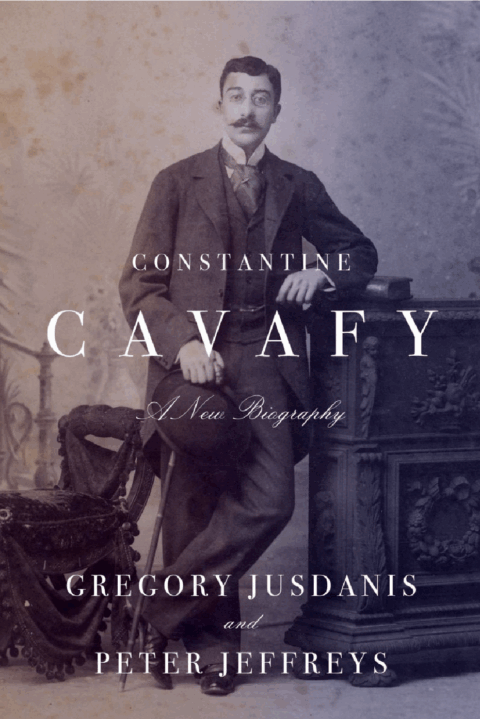
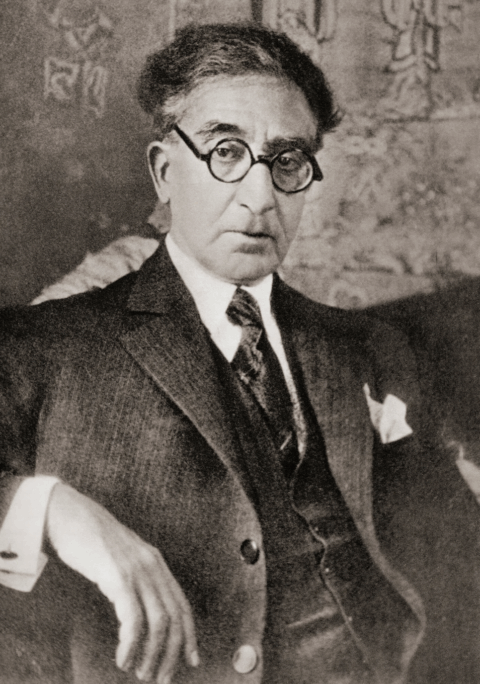 This is all to say that Cavafy has long been in great need of serious biographers, and Jusdanis and Jeffreys succeed admirably at the task. Robert Liddell’s Cavafy, the only other English language biography of the poet, was published 50 years ago, and is about half the length of Jusdanis and Jeffrey’s study. The pair do an excellent job of relating the poet’s family history, and of briskly analyzing his poems, focusing particularly on the deepening his work undertook around 1911, when Cavafy was in his 50’s. They also explore Cavafy’s relationship to his milieu — he seems, among other things, to have had no interest in fostering ties to Alexandria’s Arab community, and appears to have loved everything English save for Britain’s plundering of the Elgin Marbles. Cavafy’s Anglophile chauvinism — learned from his childhood years in Britain, before the family lost its wealth — was often on display, and he was said to speak Greek with a slight English accent.
About Cavafy’s queerness Jusdanis and Jeffreys have a good deal to say: the poet was just about as out as someone of his class and upbringing was allowed to be during his era. Brave though Cavafy’s homoerotic poems often were, he shared them only with his trusted, tiny readership. And it’s likely that the fear of homophobic condemnation was what prevented the poet from seeking a larger audience. E.M. Forster — who lived in Alexandria during World War I and befriended Cavafy, profiling him in his book about the city, Pharos and Pharillon — worked diligently to get his work published in English translation. But Cavafy deflected these efforts. A scrupulous reviser, whose poems went through multiple drafts before they were deemed ready to be gathered in his samizdat pamphlets, Cavafy clearly wrote for posterity rather than for the handful of readers for whom he’d gifted his poems. In one of his efforts — not one that he deemed ready for “publication” in his chapbooks — he envisions his future audience: “Later, in a more perfect society, / someone else made just like me / is certain to appear and act freely.” Cavafy played the long game.
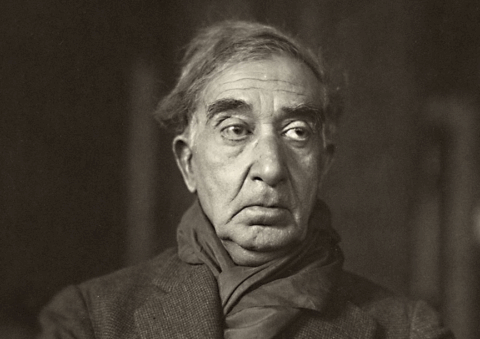 If you’ve tried, as I have over the years, to introduce graduate students to Cavafy’s work, you’ll know what a challenge this can be: Cavafy eschews just about every poetic effect they’ve been told to hone. They complain that the work is prosy, the imagery is cliched, and the poems set in the ancient world are obscure — requiring you to page forward to the Notes section, or (heaven forbid) undertake a Google search. As for the poems of memory and erotic longing, they’re dismissed as prissy (but at the same time oversharing.) Still, a few of these students, in time, will do the rereading that’s required for someone to appreciate Cavafy’s originality. It’s the readers who come to Cavafy in his afterlife who counted the most for him. Jusdanis and Jeffreys, in the epilogue of their study, argue this point persuasively, and with only a very slight degree of hyperbole:
“From the confines of his whimsical apartment, stuffed with memories of loss, trauma, and deprivation, he saw the modern world as an interconnected expanse of ethnic, racial, and national groups. And though he did not live long enough to experience “the more perfect society,” where people “made like him” would act or move freely, he fashioned for generations of marginalized queer people images, words, and ideas of self-representation. Moreover, by looking into his family’s experience with dispossession and into Hellenism’s own history of decline and survival, he created poetry that transcended the limits of the Greek language and the Hellenic world.”
[Published by Farrar, Straus & Giroux on August 12, 2025, 531 pages, $40.00US hardcover]