I avoided the documentary series Couples Therapy for as long as I could. After starting my own psychiatric private practice, I did not want to watch people argue on a couch, to continue working after work. But after a critical mass of friends insisted — sending along clips, color commentary, and even their Paramount Plus passwords — I relented. The drama that unfolded between couples in psychoanalyst Orna Guralnik’s office was compelling, but I found myself most drawn to moments in between sessions: clips of Guralnik reflecting alone in her office and speaking to her clinical supervisor. In these meetings, Guralnik grappled with difficulties that mirrored my own: how our patients’ losses become ours to hold, how the clinical work refracts into the personal. “Sometimes I have dreams that are related to dreams that my patients brought in,” Guralnik says. “Like my dream is continuing their dream — because it meant something to me.”
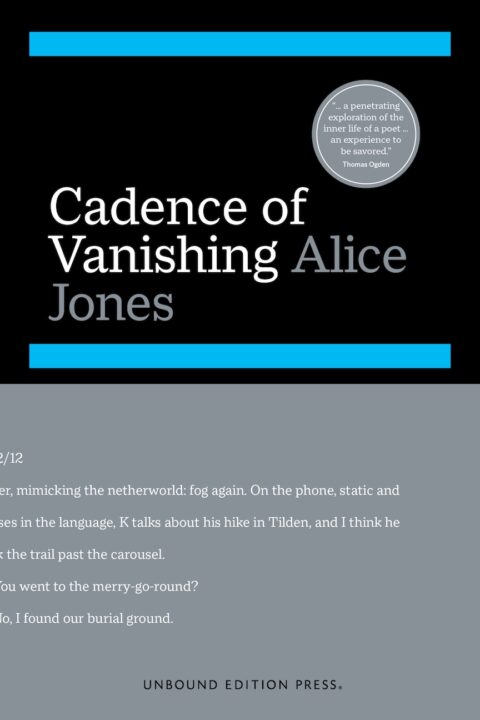 Facing another couch on another coast, poet, psychiatrist, and psychoanalyst Alice Jones obsesses over this same convergence of minds in her hybrid memoir, Cadence of Vanishing. I picked up Jones’ book as I finished the most recent season of Couples Therapy, hungry for another model of embracing both love and work.
Like many analytic treatments that begin with a contained phone call and then begin again in the first session with a great spilling forth, Jones’ memoir starts twice: first, neatly with a short poem titled “Origin,” and then again with an opening of a wound — this one literal. Jones is crossing the street when she falls and smashes her knee. At the emergency department, a doctor rinses away the gravel studding her laceration and chats with Jones about his mother’s mortality. This is the first of hundreds of chronological diary entries that compose Cadence of Vanishing and range in length from a single sentence (“At yoga, 3 analysts in a row, all in child’s pose”) to several pages. Spanning five years of Jones’ life, the sections circle around her psychoanalytic practice and an unrelenting march of personal loss — most notably the deaths of her father-in-law, father, and patient, Blake.
The entries contain a wild variety of forms: poems, emails, patient case notes, dreams (patients’, Jones’, and a melding of both), photographs, weather reports, lists of people who died on a particular date, phone calls, descriptions of public transit delays, mini travelogues, quotes from analysts and poets, and news headlines featuring aviation disasters and international atrocities. We even get a line or two typed by Jones’ cat walking across the keyboard. Each journal entry is fragmentary both in that it exists as a small, contained unit, and that on the sentence level subjects and/or verbs are frequently missing in action. For instance, describing an upcoming medical procedure, Jones writes: “Tired out. An emptiness, hungry hollow, the place to put something where there is nothing to put. They’ll be scraping out the hollow sac again; anesthesia again; pro-op labs, again; EKG, again. Falling apart. Inside out.”
Often the capaciousness of Cadence of Vanishing rewards the reader with meaningful echoes: Jones ruminates on plane crashes and vanishings, later recalling the many ways her father, a pilot in the Army Air Corps, disappeared — into his work and now into death. The memoir is chockful of parapraxis — misdirection, mishearing, miscommunication — and at times even induces a kind of misplacement in the reader. Sometimes I lost track of peoples’ names: have we met Jason before? Is he a friend, patient, or a family member? One of the more interesting effects of the book’s voluminous, fragmented form is that it highlights the permeability of Jones’ analytic practice. Even more than those in-between moments in Couples Therapy, we see how a conversation with one patient reverberates into both other sessions and Jones’ personal relationships. Returning on edge from the office, her husband asks, “Your anger or someone else’s?”
The most affecting clinical work in Cadence of Vanishing is Jones’ relationship with her patient Blake, who is diagnosed with glioblastoma 12 years into his analysis and dies a year and a half later. As Blake’s prognosis worsens and he loses the ability to communicate, Jones attunes closely to both of their griefs. This is difficult, beautiful work that Jones simultaneously wishes would end and last forever: “I imagine my schedule without the 5 hours for Blake, how I could swim in the morning, sleep later, restore myself more than has been possible. And I hate this thought.” After his death, Jones’ mind continues to hold space for Blake, the architecture of his dreams embedded inside her own. Even the book’s title — a line from a poem by Galway Kinnell, who dies the same day as Blake — vibrates with his absence.
 Jones’ memoir demonstrates such a remarkable willingness to entertain all of the detritus of her life that one begins to wonder what was cut out. The reader is thrust into the position of an analyst, asked to make meaning out of everything that comes to Jones’ mind. But there is a reason that the analytic hour is only 50 minutes long, and Cadence of Vanishing tests its readers’ patience with both banal and impenetrable content. The most frustratingly inaccessible moments occur with Jones’ longest analytic patient, Stevie. Jones has presented Stevie’s clinical case at various psychoanalytic conferences and she recognizes the difficulties of conveying the arc of several decades of treatment: “How to bring strangers, and the visiting luminary, into 20 years of work? We’ve gone to the edge of the world and over.” But in Cadence of Vanishing, Jones is either less successful at or less interested in making her work with Stevie scrutable to the reader. While Stevie appears as many times as Blake, we get almost no sense of the basic context of her life beyond a neglectful mother and a history of disordered eating. Instead, we are left floating in a soup of metaphorical and elliptical descriptions:
“With Stevie, I tried to speak to the pathologic organization, and she sprouted a new “part” with its own voice, but then she saw that it feels everything she feels. She — the fish guts thrown in the garbage. People eat the filet. It — the raging controller telling her care is a sham; she’d be a fool to be taken in by me. It thinks it protects her, keeps her alive, saying “Don’t eat” because this was the way to refuse her mother, to stab her in the guts.”
Stevie and Jones are speaking their own shared language, and we are left without an interpreter. Stevie occasionally comes into clearer focus for the reader when she reacts to Jones going on vacation — as if her visibility relies on Jones’ disappearance. But Stevie’s effect on Jones remains obscured. Jones’ case study on Stevie (published in The International Journal of Psychoanalysis, four years before her memoir begins) is unfortunately required reading to parse one of the most important relationships in the memoir.
Cadence of Vanishing is at its strongest when the literal stakes of loss — both for Jones and her patients — are precisely rendered. Jones has numerous occasions to practice this; while her book may begin twice, it contains infinite endings, including the fracture of familial relationships, the passing of a dozen loved ones, and terminations with patients. As these conclusions accrued, I became more and more curious about how Jones would choose to end her book. As we approach the last year of her memoir, Jones increasingly turns to describing her own dreams and the quotidian pleasures and disappointments of grandparenthood. Appropriately, in her very last entry, she finds poetry in the most unexpected of places. While on her way to an analytic meeting, she pops into a pizza parlor for a slice. Watching the basketball game on television, she suddenly notices a Galway Kinnell poem written on the restaurant wall, where we finally read the concluding line (“The still undanced cadence of vanishing”) that Jones poaches for her title. Just a few lines earlier, Kinnell entreats us to “learn to reach deeper/into the sorrows / to come.” Ultimately, this is both the project of Jones’ memoir and the work of the analyst: to summon language for our fear of loss, to allow it to clarify the present. This difficult labor — and its effect on its practitioners — is often hidden from public view. Thanks to Guralnik, Jones, and all their patients who generously agreed to be filmed and written about, we get a brief peek behind the curtain.
[Published by Unbound Edition Press, on September 23rd 2025, 383 pages, $28.00 paperback]