With his mind over — though more literally on — matter, hammered by language into a multitude of shapes, the deep changeability of Aaron Fagan’s fifth collection of poetry borders on transmutation. The Kenneth Noland target on Atom and Void’s cover is apt, referring as it must to the popular conception of atoms as rings of electrons orbiting a nucleus. That model, promoted by Niels Bohr, has now been supplanted by the understanding that electrons are cloud-like in form. It’s a conceptual change, from rational predictability to gaseous uncertainty, that mirrors, not only the disturbing insights of quantum mechanics, but the precarity of American life today as compared with the postwar decades.
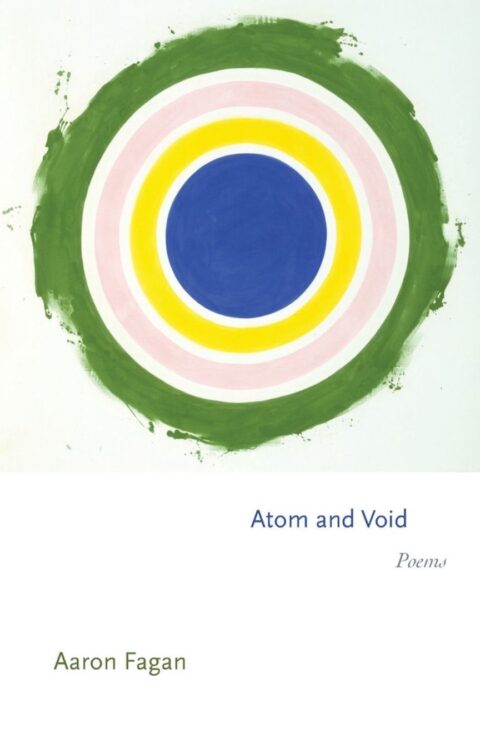 Fagan’s title isn’t new but borrows from a selection of essay lectures by J. Robert Oppenheimer, published in the late Eighties and itself a nod to Democritus, the pre-Socratic Greek philosopher who conceived of nature as ultimately composed of indivisible units and the “not-thing” in which they move freely: atom and void. Oppenheimer, following his tenure at Los Alamos National Laboratory, directed the Institute for Advanced Study at Princeton University; thus, coincidentally, Fagan and the man hailed as the father of the atomic bomb share publishers.
Fagan’s armchair interest in the sciences resembles those of Joseph Brodsky and Rainer Maria Rilke; the latter’s reputation as a scrawny, rose-sniffing mystic likely explains why his obsession with physics has been under-appreciated among critics. (Ange Mlinko, however, noted in 2009 that “what is original about [Rilke’s thing-poems] is that their still lifes are dynamic; it’s as if Rilke translates the seemingly random movement of their atoms.”) In this century of urban sprawl and algorithm-driven consumption, the rise of surveillance capitalism and breakdown of social bonds has left us stranded between extremes, with the individual’s search for meaning threatened by the emptiness which surrounds them:
The watch at first ran fast now slow.
We sleep and wake all watched over
By unseen machines. A circle invented
The wheel while wisdom slept off
Its catalog of embarrassing wonders.
Fagan’s spiritual ambivalence (“You’re already dead if you don’t become supernaturally / Cheerful when someone mentions the word revolution”) leaves it unclear whether he actually expects us to cotton to Atom and Void’s homespun paradoxes — that, say, form deforms and a lie may be truthfully communicated — or is content to shrug at a literary distance while less enervated voices are “praised / Or spat upon.” Good luck disagreeing that “[a] glance at so-called history proves nothing can be done.”
 Tautological by default, the rhetoric “tilled under, / Folded back against itself,” a lot in these sonnets comes around more than once. A koan about problems (“The solution to most problems / Is to destroy the illusion of clarity”) multiplies, appearing as it does across consecutive pages; “echo,” unsurprisingly, is echoed. Assuming one notices, that “Pretty Soon,” a meditation on mortality, is anticipated by its facing poem, “The Near Future,” feels bleakly comedic. The redundancy is as depressing as it is funny, or nearly, as the local and the philosophical repeatedly collide. At a drive-in, we are passengers to our own bodies (cinema’s “rough magic”) and “All images agree in the dark.” But turn to “Intermission” and, in lieu of a movie, the speaker reminisces to an anonymous companion about the long silences of a patriarch who “would get emotional when he saw a barn fallen into disrepair.” The mundanity of damnation horrifies and bores in equal measure. Fagan casts a knowing eye over zoned-out ghosts in divey joints with names like The Zebra Lounge, where shades wait with an obol for the boatman:
The coin I carry under
My tongue in death,
Sandwiched between
Two biscuits and honey,
Appears when I come
To along the riverbank
Where my shoes were
Taken off and put back
On backwards to confuse
Whatever might try to
Return along my tracks,
Wash my hair with mud,
And know none of these
Things ever happened.
Atom and Void is a collection in the truest sense, rounding up the new without section breaks — what is there to interrupt when you aren’t writing a novel, or pretending to? — and nary a project in sight. Though occasionally opaque (“Your spirit blinded us with twilight / In the mirrored spectrum,” “Staged energies compete to pierce the actual”), Fagan’s latest boasts consistently terrific titles; albeit, by virtue of the fact that many of them are already known to us, such that “The Passenger,” “The Cloud of Unknowing,” and “Rings of Saturn” fit together like a core sample of the author’s home library. Ruminative, and with a proclivity for doing things the hard way, Fagan aims “to build houses from the roof down,” adapting the English Renaissance play A New Way to Pay Old Debts but which sounds like a line out of In Praise of Shadows. (Admirably, he doesn’t bother to include any notes, so it’s hard to say for sure.) Speaking either in the second person or to an unspecified You, the vowels of whose gravely southern drawl are qualified as “catastrophic,” Fagan pursues his goal to “beautify the plural.” So we’re told about walking dogs, a pink capsule of cyanide held against the sun, deepfakes and a hazy remembrance of cocaine. Property is erotic. Continually one grows older, but unfortunately “not less wrong.”
 Certain quirks, like verbing nouns that weren’t hurting anybody (“Occulting each event that landed us / Here”) and the odd paroxysm of mixed phrasing, as when the sight of a dead bird “Stings your mouth with its burns,” actually enliven Fagan’s style. Gross intelligence wants a little personality. Here, that outer world mostly takes the form of culture: a Beatles song and the art of Goya, Parsifal and a film about Caligula which doesn’t exist. That the mental furniture in Fagan’s head is overwhelmingly Hellenic, besides a heap of Shakespeare, means that sullen boozers and the curmudgeon who’s out on romance, with its “workaday Symbols” and lackluster promises, could be disguised gods. Having thought through Atom and Void’s more abstract efforts, the reader feasts on these slice-of-life vignettes greedily, whether they’re set in a mansion in California or a small-town saloon:
Debbie the bartender is drunk and showing off
The lamb-shaped pound cake she made for Easter —
The back legs broken and soaked with Grand Mariner.
The result is agreeably concrete, or more Sisyphean than Promethean, where all that was stolen was a look (“Our eye contact is a moment old / But my face retains the expression / It held long before you appeared”) and the running joke is classic rock.
Fagan is by turns wryly self-critical and mutedly humorous at a pitch almost beneath that of human hearing. If many a stanza in Atom and Void seem more parts than whole, those parts frequently have a compensatory power, with an advancing tide anticipating, a page later, “Meditations at Sea Level” or “fire saying farewell to fire” hinting at the burning sword barring the way to Eden (“I’m writing an essay in my head about Masaccio’s Expulsion”). Lyrically ironic, Fagan’s oeuvre is, by his own admission, intended as “a protest aimed / At the librarians of the present and the future” — which makes him sound like a performance artist rather than a mild-mannered formalist. He starts, for instance, on “For Starters,” and concludes with a cave far from paradise, maybe the same one in which Philoctetes, banished by Ovid to the island of Lemnos and name-dropped in the opening poem, took shelter. Indeed, familiar sayings are constantly metamorphosing. Burying one’s head in the sand, taken literally, prefigures the exhumation of a skull and what springs eternal is no longer hope but martial vengeance. Pyramus blows smoke in Thisbe’s ear. The originals, Fagan notes — of expressions as much as legendary tales, something that ought to guide us — have been lost.
[Published by the Princeton Series of Contemporary Poets on October 12, 2025, 72 pates, $45.00/$17.95 hardcover/paperback]