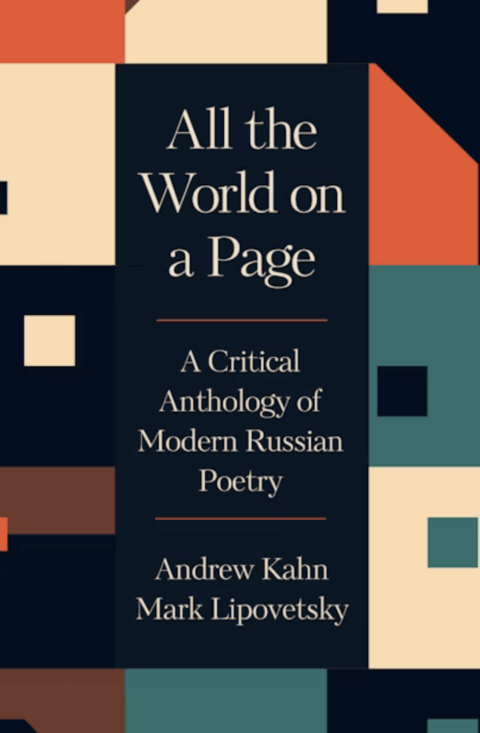
All the World on a Page by Andrew Kahn and Mark Lipovetsky is subtitled A Critical Anthology of Modern Russian Poetry, but this marvelous book does not set out to establish a canon from the vast expanse of Russian poetry of the last century. Rather, the authors, both scholars of distinction, do something far more courageous and original. In a uniquely detailed way, they explore and uncover the varying trajectories of inwardness which have characterized the work of poets writing in the often maleficent and lethal chaos of the period from the start of the 20th century until now. The book is a rich display of the many ways women and men found to link the intensity of their imaginative inner longings and an outer world bristling with indifferent rigors and brutal obstruction. Thus, this is a book that stimulates both appreciation and inspiration.
 More than in any other country to its west, poetry has a uniquely central place in shaping Russia’s inner sense of identity, purpose, and destiny. For 150 years, its rulers took great pains to watch and supervise what poets did. Alexander I and Stalin were particularly attentive literary critics. However, we might step back for a moment to remember: a poet is a person alone, a person given to looking inward, waiting for moments when experience and language come together with uncommon intensity, writing it down, making it public. Poetry emerges in the privacy of language and refines it publicly. Since language is our deepest social linkage, a poet is a person who finds, in this deepest part of our social fabric, things that society did not expect, and then may celebrate as a confirmation of its life force or may despise as something almost inhuman. Poets are rarely in control of this. Rulers often are. In Russia, one’s most inward human expression could thus easily prove lethal, and writing even the most intimate personal poem could require enormous courage.
The core of this sensitive and revelatory book consists of 34 poems, each in Russian, then an English translation and an essay examining the poem in historical and analytical detail. These provide a rich field in which the reader can explore Russian history and culture from within, as inner experience, as hope and loss, as will. Thus, “the set of poems illustrates an underlying coherence to the history of lyric in a period marked by much historical discontinuity and dispersal.”
The fountainhead of Russia’s unique approach to lyric poetry is the work of Alexander Pushkin (1799-1837). In him, the inner impulse of the poem is inseparable from the longing for freedom arising within political oppression and social indifference. It is a kind of longing for one’s birthright and bears with it the desire for love, beauty, justice and compassion. Simultaneously, the intensity of such yearning makes intensely clear the bleak desert of loneliness, the desolation and arbitrary cruelty of the world in which he finds himself. The worlds unveiled within these sensitivities and the ways he found to convey them were Pushkin’s gift to all who have come after him. It was almost as if he opened a vein that couldn’t be closed off.
Thus wrote Alexander Blok, a great poet devoted to Pushkin, 70 years later:
O heart!
it’s you who must be my guide, and with a smile
consider death. You also will grow tired,
too tired to bear the kind of merry life
that I am leading. People are not able
to bear the kind of love and hate
that fill my heart.
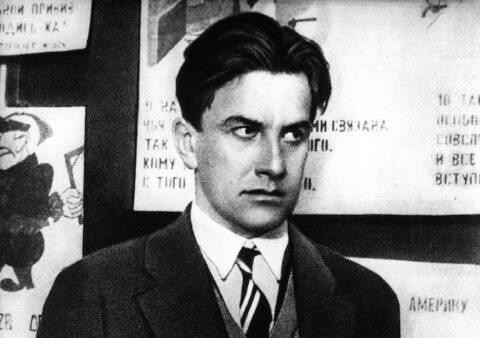
[left — Mayakovsky] It would be a huge mistake, however, to think that Russian lyric poetry was one long river of elegies. This is a tradition that has been and is still capable of engaging and supporting an enormous range of experience and expression, as is evident from the variety of poems which Kahn and Lipovetsky have chosen. I have read along with such excitement and, often, awe. There are so many discoveries in this book that I want to include everything and I regret leaving out anything. Time and space intervene, so I must confine myself to only two comparatively classic writers: Mayakovsky and Mandelstam, and then Zabolotsky, Shvarts, Fanailova, and Barskova from the four generations following.
Roman Jakobson was a friend of Mayakovsky and met often with the great revolutionary poet. “The unbending spirit of eternal rebellion,” he called him and quoted him: “The accursed earth has me chained.” And “I am too small for myself. Someone obstinately bursts out of me.” The conflicts and yearnings which lived in Pushkin, Blok and others were deeply part of his makeup, but he identified with these vectors in a way that the poet and the world are indivisible. To represent him, Kahn and Lipovetsky have chosen the poem, “Listen!” where, in a verse of beautifully simple directness, Mayakovsky moves through the destabilizing vertigo of love as if (or simply as) he is walking beneath a night sky.
So if the stars are kindled
Doesn’t it happen in answer to someone’s pleas?
Doesn’t it mean someone wants them very much to exist?
Doesn’t it mean someone calls these droplets of spit pearls?
…
begging:
“Let there be a star!”
Swearing:
‘This starless torture he cannot stand”
And after,
Walks about anxious
Pretending to be at ease,
Asking the one:
“Are you not afraid anymore?
Are you better?
You are?”
Listen!
If the stars are kindled,
Doesn’t it happen in answer to someone’s pleas?
Doesn’t it mean someone needs to see
Every single night
Above the rooftops
At least one star?”
The poem does not present the night sky and stars as a metaphor for complexities of love and yearning; they are not a verbal device. Rather, outer and inner are not separate. They are mutual reflections, mirror aspects of a single intensity. This was the very essence of Mayakovsky’s path as a poet, and what made him the most powerful of all revolutionary poets.
For Mayakovsky, when the public world split too far from his inner life, he felt he had no choice left but suicide. His renowned younger contemporary, Osip Mandelstam, managed to preserve the long streams of his luminous interiority, but was sent by Stalin himself to the gulag and died there. Here, from the end of his long, free verse ode, ‘The Horseshoe Finder”:
The sound rings on, but the source of the sound in gone.
The horse lies in the dust , and snorts and foams
But the sharp twist of his neck
Still carries the memory of the race, legs flung wide-
Not just four of them
But as many as stones on the road.
Starting afresh every four beats
The number of strikes made on the earth by the steaming horse.
When he finds the horseshoe
Blows the dust from it
Wipes it with wool, till it shines
Then
Hangs it over the threshold,
So it can breathe deep
Never again will it be made to shear sparks from the flint,
Himan lips with nothing more to say
Hold the shape of the last word,
And the hand still knows the sensation of weight
Although the jug has spilled half its load on the way home.
That which I say now is not spoken by me-
It is scraped from the ground like fossilized grains
of wheat
Some
Inscribe lions on their coins
Other
A head
All the various rounds of copper, gold,
Bronze
Lie with equal honor in the ground
The age bites down on them, leaving the marks of its teeth.
Time clips me, like a coin.
And I have already felt the loss of myself.
And here are a few elements from the wonderfully insightful essay that follows:
“‘The Horseshoe Finder’ devises yet another way to sing a new song for a disrupted age … (It) is a work in which free verse conduces to unpredictable repetition because its images reify discontinuity as the key to history … the journey the poem makes from myth to history, from a state of intoxicated movement to primitive ending, from forward motion in mythic time to archaeological time, from one form of subsistence…to another.. ultimately a journey that has circled back on itself … (and) the final images of the poem may refuse closure and suggest that the process of loss and recovery extend indefinitely.”
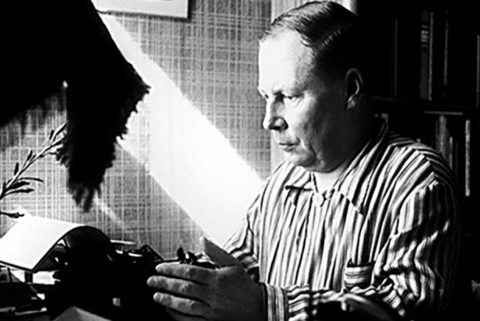 [left — Nicolai Zabolotsky] Perhaps this gives a sense of the way the book works and the subtle, probing way that Kahn and Lipovetsky approach the poets and major themes in the book. And, just as their book does not set out to establish a canon of the Russian poetry in the 20th century, nor can this brief essay hint at the superb works and provocative insights here. The following four poets, Nicolai Zabolotsky, Elena Shvarts, Elena Fanailova, and Polina Barskova may not be well known in the West, but the citations give some indication of the variety of experience, struggle and art represented in this anthology.
Nikolai Zabolotsky’s “Somewhere Not Far From Magadan” (1956) is (as the authors state), rare as a treatment of forced labor and recovery of inner freedom.” He writes:
Two ill-fated Russian Men
Two old peasants yearning for their huts,
The far-off huts where they’d been born.
Burned out by life, they’d no heart left,
Far away from all their folk;
And their weariness that hunched their bodies
Now consumed their very souls.
Up above them, all the forms of nature,
All of life proceeded on its course.
But the stars, those harbingers of freedom,
were no longer looking down at men.
The mystery of the universe might still
Have been unfolding in the northern skies, but these two- they were no longer
Pierced by these penetrating fires.
Round them whirled a blizzard,
Spreading on the stumps a snowy cloak.
In her ferocious poem “Rubbish Heap” (1983), Elena Shvarts lashed out at the decay and stagnation of the late Soviet period. In calling out to Russia as a great mountain of all that is rotting, broken, degraded, cast away, she deployed a stylish, implacable violence to produce a poem of extravagantly perverse, mock-heroic allure:
A child burned by boiling soup
Dionysus torn asunder,
Or pocket mirror to the world.
I am speaking to you, Rubbish Heap,
Stir yourself. Arise. And then, O monster,
Rasping from your ripped lips, Night outcast
Stir yourself! Arise! O wondrous tip
Sing of how you lie so long in the sun’s heat,
Your flaming, ripening giant’s brain
Baking, consumed by decay.
Let bloom your great thoughts. Sup on rot
Like vodka, chew a chicken wing
Stir yourself, most wonderful being, and sing!
O Rosa Mystica, the gods are listening.
Elaina Fanailova also focuses on contemporary political horrors, but her work is very different in its fractured journalistic method and objective tone. Though she lives in Moscow and writes on current events, previously she had studied linguistics and been a practicing medical doctor in her birthplace, Voronezh. “Fanailova developed a poetic optics that allowed her to spot the return of the eroticism of violence in post-Soviet culture and politics …” As she said:
“The sense of violence is the main thing that I remember about this era; this sense penetrated all entertainments, pleasures, sensations and feelings, not to speak of work, and I was fully present in the conversations of these people, my contemporaries. They speak about monstrous things in a rather ordinary way, even with some animation, because it is their youth they are referring to, and in the moment of telling their story, they re-enter it.”
The following poem, “Again they’re off for their Afghanistan,” is from “Scars of Imperial Eros”:
Common myth and communal hell,
She’s off to the abortion clinic,
Exactly as the doctor has prescribed,
like a soldier marching the familiar march,
according to the commander’s drill.
And there she is, surrounded by her friends,
Slender and skittish fauns and dryads all-
Cattle at an abbatoir.
There’s no free will,
Just chance, the luck to simply stay alive.
And there in ‘Ghanistan were beer-soaked mustaches,
Fucking beautiful Uzbek girls
Unbraiding bridles with their tongues.
They got to ride on armor metal, Fast and crude.
Later, to keep the whole affair from leaking out,
The colonel himself shot them dead
In front of the regiment- or more precisely
Had them shot, the ones who dragged
The girls into the bushes by their braids
And those who raped them in the bushes,
The Afghan girls who looked about sixteen
But weren’t any older than twelve, and barely.
The rapists weren’t more than twenty.
Their families heard nothing of it.
And the ceiling bore down slowly like
A chopper to the sound of women wailing.
Now they’re at the river getting soused
And reminiscing about the good old days.
And its as though a strange chill tugs
Against their corporeal flesh.
Now the lovers are both forty.
Or, more precisely, the husband and the wife.
The kid is ten, they had him late by Soviet standards.
Their scars speak for themselves.
I’ll never find another country such as this.
Fanailova has spoken of her poetry in this way: “It’s the internal intonation of a condition in which the border between worlds, the border between the world of the living and the world of the dead, is erased. The old rhythmical framework completely collapses.” But here, the inner world is not that of a poet but that of wife left behind, conscripted soldier far from home, Afghani girls raped, all of whom are the inner voices of a world that is relentless, empty cruelty.Fanailova does not let us look away.
Finally, Polina Barskova, a poet who moved to the U.S, in her early 20’s and has lived her for 30 years since, gives a poem called “Children’s Literature”:
Both were tortured.
What color traces
did they leave on the wallpaper?
I bet you golden
I bet you blue
Burns of crystal, drool.
Observe droll colors
Preserved in the confines.
We come here to a museum.
What do we see in this museum?
We see: a trail of fellows
Who dragonfly on summer days.
Kharms shies away Shvartz ha-has
To Shvartz, Oleinikov prefers
to slug by a stream
poking a toad to death.
Their journey has just begun,
Not ended, they stand
For poetry and weave the thread.
Through the web, through a dragonfly’s wing,
I watch a blistering scene
And see them living not:
One in the ice, another on the rack,
Poet Vvedensky floats atop a pike,
Poet Vaginov twinkles on the river’s bed.
 [left — Polina Barskova] Now Barskova lives at a distance, both in space and time, far from the culture which gave her birth and shaped her inner life. In this poem. she turns her view to a circle of poets deeply involved in children’s literature, a kind of writing that supported them, even as their more serious work did not, and as they felt the forces of oppression gathering to crush them. But, as Khan and Lipovetsky put it: “Barskova defiantly refuses to look into the horrific details of her characters’ fates. What does she put in their place? Surprisingly, the answer is beauty.” This strange insistence on a children’s picture book beauty echoes Shvarts’ account of life in the terror: “Outwardly we lived as before…We ate and drank, And we laughed. In our slavishness, we laughed even about our shared tragedy- what else could we do? Love remained love, life remained life, but every moment was saturated with terror.”
Their journey has just begun,
Not ended, they stand
For poetry and weave the thread.
As Barskova writes, and on these lines, Kahn and Lipovetsky’s comment could almost serve as a manifesto: “For Barskova, it is less the texts than the poets themselves who are poetry. Her work can this be read as a meta-fantasy of what poetry can do. Its main product is a thread which — almost literally, from line to rhyming line — connects the author with the dead poets, one era with another, happiness with horror, the paradise of childhood with the hell of torture, the visible with the invisible. The image of a thread embodies an understanding of poetry as the joining of the disjointed, the crossing of boundaries, the breaking of limits.”
*
This review is written at a time when the people of the United States have elected and have, in polls, indicated widespread support for a government which is actively destroying the national educational system.
The universities in question have been the homes for the extensive scientific research underlying the country’s technological superiority which, in turn, has been at the base of its dominance in the spheres of digital processing, weaponry, medical application, climate science, surveillance and communications applications. These universities have also, since the end of WWII, been the prime institutional support for its cultural studies in history, languages, philosophy, and the arts. Government support in all these areas is now being extensively politicized or cut back (as was the case in Russia earlier) and universities are ending such programs accordingly. Also, because college education in the US is mainly paid for by individual personal loans, students must enroll in courses that may give them a higher probability of higher income employment. Universities have already responded to this demand with radical cuts in what used to be called “Humanities.” Thus, these two vectors converge, challenging the continuity of traditional culture in the US. What remains to sustain, foster and shape inner life is commercial culture in the form of industrially produced mass entertainment.
In Russia, as this marvelous and penetrating book makes dazzlingly clear, poets and poetry, whether in times of comparative freedom or total oppression, have continually played an essential role in shaping the ways people thought and felt. This has been essential to the continuity we call culture. Poets have been celebrated, exiled, destroyed, but the expansion of the language’s capacity to articulate the inner fears, yearnings, aspirations of all women and men has continued. Such continuity will, of course, persist in America, even if it is not clear at this moment how this will happen. It is, however, now, for us, almost conceivable that the coming generation will be, as Jakobson remarked, “allotted the morose fate of building without song.”
In All the World on a Page, Kahn and Lipovetsky open for us a large, complex and variegated terrain in which to wander, explore, to ponder the work and lives of men and women who, without exception, wrote poetry in periods of oppressive degradation and danger. And here we may find the inspiration, the courage and the idealism to seek the songs hidden in what may well be a bleak and unpromising future. Poems, as ever, are not simply instances of elite insular self-expression, but, as is clear in the work presented in this anthology, the redemption of our inner journeys and the cultures where they take place. These poems thus expand and deepen our common language and thus enable us to find an ever broader and more profound common ground.
[Published by Princeton University Press on April 15, 2025, 550 pages, $39.95 hardcover]