Cumin Baleen, the narrator of Caren Beilin’s Sea, Poison, is a novelist who, in planning to tell this story, wanted “to try invoking a frame narrative,” but “the hardship … of writing a whole novel brain-injured” resulted in what we have before us, a recollection of – let’s call it “persisting.” Cumin has a job at “an upscale corner grocery” called Sea & Poison, specializing in fish and wine. It’s in Philadelphia (Beilin’s hometown), “this city of universities and their hospitals, or perhaps the other way around.” On page one, she relates an appointment at the Moody Eye Clinic where she learns that her autoimmune condition might trigger sudden blindness; later, the laser surgery intended to preclude blindness singed her brain. Or so she says. “And after that,” she continues, “I began having some cognitive problems. The best way to describe them is something between aphasia and writer’s block. I could speak, and write, but I had become very spare somehow, unable to elaborate or more importantly to me, to use language – namely sentences — elaborately, I mean with multiple clauses, which had always meant so much to me, to do that, to keep going.”
 Is this an illness narrative? She claims on page 4, “It’s not a pity party, it’s a character sketch.” But by then, we’ve registered the comic verve of Sea, Poison – or most of us will have. “Writing, for me, was born out of the need to create a language unreadable to my family of origin – unreadable because it was so beautiful!” That’s Beilin, interviewed by Sheila Heti in The Paris Review in 2002, upon the publication of her earlier novel, Revenge of the Scapegoat. The ones who don’t get the joke are those who approach a novel with demands for familiar gratifications. Fortunately for us non-family members, in Sea, Poison Beilin has extended her revenge campaign.
This is a novel that deals mainly with situation, not activity. Characters speak but are barely described; Cumin tells us what they do and have done. Digression eclipses progression. For openers, to set context, Cumin describes getting dumped by her boyfriend Mari after he starts sleeping with their landlord, Janine. So Cumin rents a closet-sized room in the bedroom of Maron, a “theater professional” who, Cumin later learns, had been attacked by a zoo leopard (the animal had been tutored to do so by Maron’s father, a salvo at dads first launched in The Revenge of the Scapegoat). Beilin incorporates autofiction here and there, such as those instances when people tell her she looks like Anne Frank. Maron practices polyamory with Alix, a guy who stirs Cumin’s ludic lust (“The BDE of Alix was getting to me. A coin purse of leopard neck muscles was opening in my underpaints!”). There are flashbacks to Cumin’s mohawk-sporting schooldays. Culture and literary icons pop up throughout. A sampling – Camille Paglia, Daniel Day-Lewis, Donald Barthelme, Georges Perec (Beilin should be admitted to the Oulipian club), Marie Ndiaye and Marie Darrieussecq – and that’s just what may be found in a random five-page selection. At several spots, one runs into Shusaku Endo’s novel The Sea and Poison, beloved, quoted and reworked by Cumin.
 Beilin won’t let us settle on certainties (or anything else), even about Cumin’s “It’s not a pity party” avowal. Cumin’s dissatisfaction with an Endo excerpt, in which the character Suguro weeps, leads to this: “What a victim! Everyone hates that. Everyone loves victimized people who don’t act like it much, not seeing yourself that way.” But when Janine says to Cumin, “And who is to say if your brain got injured. Have you ever considered that what you have on your hands is some extreme writer’s block? I wonder sometimes if you’ve got, like, a victim mentality,” the criticism hangs in the air, and the unknowingness is more real than realism. I’m too curious about Cumin’s “condition” to be merely empathic. Victimized or diminished, every character seems crushed or commandeered by memes. Even polyamorous Alix complains of Maron, “Polyamorers say they’re about being more open to connection but they end up being closed off from anyone they’re not going to ultimately fuck. It’s honestly degraded me …” That’s pretty funny. Beilin’s comedic flair has an anarchic, Marx Brothers-ish aura, mocking everything including itself.
The instinctively discursive style of Beilin’s prose leads me to say: what a spirited and liberated performance, and it is. Yet it is Beilin, in the Paris Review interview, who says, “This idea that the imagination can take you anywhere – into anyone and anything – it thwarts the most basic things we learn as children, which is, Don’t touch everything!” Sea, Poison, for all its eccentricities, makes a surprisingly sturdy sense of its own, and its gestures and form are more shapely than they may seem at first. This novel charmed me from first word to last.
[Published by New Directions on October 7, 2025, 115 pages, $15.95US paperback]
◆ ◆ ◆ ◆ ◆
on Dreaming of Dead People, an autofiction by Rosalind Belben
Rosalind Belben’s autofictional novel Dreaming of Dead People, first published in 1979, is spoken by Lavinia, now living in London after years of travel abroad. She says at the outset, “How … how can I speak from my core; there is nil. I have turned thirty-six and shall never have children. I am a shriveled person, I have sucked myself dry; I am a figure of fun; an object for curiosity; an old maid; or I shall be, old; don’t suppose I don’t mind. I do mind … I have quit growing; whether or not of my own volition I haven’t understood; I can’t begin to understand what has happened; if I could I might accept it; I want to make sense of my life. I want to make sense of my life.”
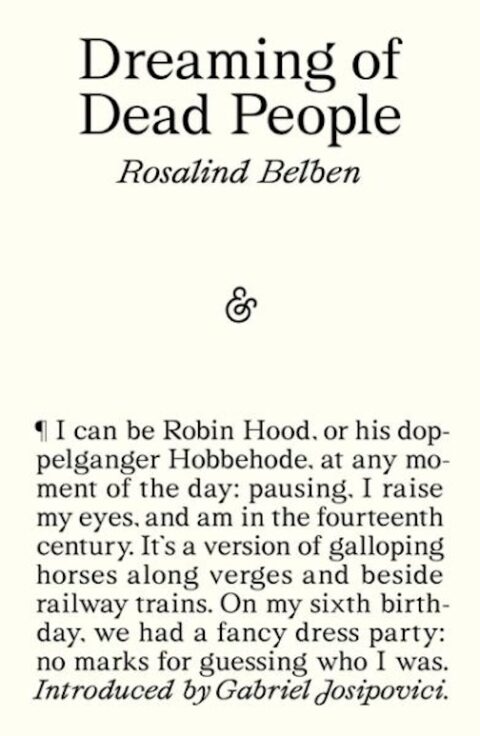 For Lavinia, the affections and attentions of others have withdrawn like an outgoing tide, leaving her stranded. Although this is abjection, her frankness is never acerbic or sour, and unlike many autofictions, this narrative doesn’t allow attitude to override everything else. The world she describes, human or otherwise, is a condition. So when she observes, “I am injured by the fleeting expressions on other people’s faces,” this is not to indict others for callousness or cruelty, nor to nudge the reader to feel empathy as one’s main (or only) response. She is here with us to devise a language that might make “sense” out of her urgently precise and often blunt facets of her existence.
The novel comprises six independent yet interrelated chapters. Beginning with “At Torcello,” Lavinia relates her trip to that sparsely populated island at the northern end of the Venice lagoon. She was ferried to the island with an English family to see the Santa Maria Assunta basilica and its art. As she notes, Torcello suffered a great flood in 1962 that diminished its livability (it once was the most populous Venetian island with 20,000 inhabitants). Soon Lavinia is babysitting for the English children. She says, “I was brought up to be a family person … To know I should have children.” And now, her loneliness “has happened to someone whose will, whose being is implacably against it … I am so intensely deprived that the touch of a human being – the desired touch – can be stunningly electric …” Although she suspects she “never shall be much loved of anyone,” she neither berates nor inflates herself. What we’re listening to is the resolute endurance of a chastened minimalism.
In this first chapter, she also reveals her fixation with her body – not its imperfections, but its persistency. “There have been so many moments, many moments, when I want so much to fuck that I can only curl up and lie still … I have woken sopping and swollen, with a devil to suppress between my legs.” We hear about an abortion at age 16, a relationship of a few years with a man, sexual encounters during her travels, her realization that she had been anorgasmic and her ensuing discovery of an electric toothbrush as clitoral stimulator, and seven years of caregiving for her mother.
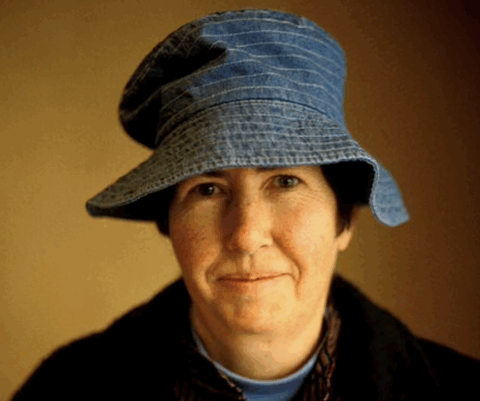 In the ensuing chapters, she imagines the life of a daughter named Jessie. Then suddenly, there is her story of Robin Hood which allows her “to regain another life, another landscape, quite another sensibility … He is so lonely he makes up stories and so child-like he invents his companions.” There is her profound affinity with animals and landscape, and the enduring memories of her mother.
Lavinia/Rosalind unsparingly describe the exile and marginality of this life – and though the harshness and waste are omnipresent, Belben somehow affirms them as an unsuspected means toward a more profound attachment to the world. “I have not grown up,” she says. “I want, when I look, to see something which isn’t there, or not to see something which is there.” And then came the statement that stopped me: “It is perception that alters, not perceiving.” I take “perception” to denote explanation, analysis, conclusion. But “perceiving”? This happens, in her case, through language, freed from convention, “the state of fluidity: the colours of the mind dissolving and reassembling.” Here is the happiness at the pulsing core of Dreaming of Dead People —
“I don’t live in my mind, I life outside it. If I see some mown, unturned hay, I want to get into bed with it, pull it up to my chin like an eiderdown, pull it over my head, bury my face in it. I couldn’t be more ridiculous.”
[Published by And Other Stories on August 5, 2025, 181 pages, $19.95 paperback]
To watch/listen to Rosalind Belben read from the novel, click here.
Of note: New York Review Books has recently published Rosalind Belben’s 1974 novel The Limit.
◆ ◆ ◆ ◆ ◆
on The Brittle Age, a novel by Donatella Di Pietrantonio, translated from the Italian by Ann Goldstein
The narrator of The Brittle Age, a physiotherapist named Lucia, tells us that her daughter, Amanda, has dropped out of college in Milan after being mugged and has returned home for a job at a cafe. They live in Pescara, a small city in Abruzzo on the Adriatic, above which loom the Apennine mountains. Lucia is separated from her husband; she and Amanda have a contentious relationship – “I try to run into her at meals.” Up in the hills, her aging father owns the land that accommodates a campground at Dente del Lupo (“Wolf’s Tooth”), acreage which she will inherit. Thirty years previously at that site, two young women, sisters named Virginia and Tania, were murdered. Their co-camper named Doralice, then Lucia’s closest friend, somehow escaped. Over the story’s run-time, Lucia’s attention pivots between city and countryside. Then word arrives that a resort developer wants to acquire the campground.
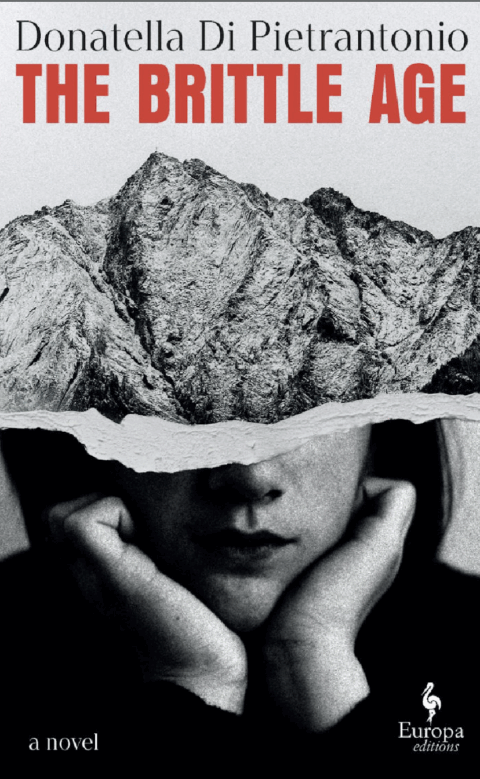 It is not surprising that The Brittle Age has been pitched and reviewed as a trauma novel. The memory of the girls’ murder stubbornly lingers, and may be regarded as a trigger for the telling. But novelist Donatella Di Pietrantonio will not talk down to her audience with the usual exclusive appeals for empathy, not that Lucia et al don’t inspire our concern. With a nuanced approach that never suggests more than its narrator could know, Di Pietrantonio portrays Lucia as observant and engaged but also struggling to understand. Lucia says, “At a certain point life accelerates. Afterward everything remains fixed in an image or a sound of the moment. One always returns to it. I could say this to Amanda, if I could find the words. She asked me again about those girls.” The memory of the killings is fixed, unyielding. This isn’t a novel only about trauma’s enduring effects, which may seem diffuse; it is fixated on the unsettling space between immovability and dissipation. How Di Pietrantonio generates such richly intuitive gestures from such an opposition is the novel’s artfulness and source of gratification.
In fact, for Lucia, the lingering anxiety (I won’t say “anguish”) concerns her alienation from Doralice who, Lucia has just learned, has been in the area for the past 18 months. Lucia had gone to the beach on the fateful day; why hadn’t she invited her best friend? And after the violence, why hadn’t she responded with more sensitivity to Doralice’s shock? Perhaps this would have precluded Doralice from emigrating to Canada (even though she had always “dreamed of going around the world” – so maybe Lucia’s survivor’s guilt is a cover-up?). “We grew up in a single night,” Lucia reflects – perhaps to contrast her youth with that of Amanda who may be more invested in preventing the ruination of Dente del Lupo by a resort developer.
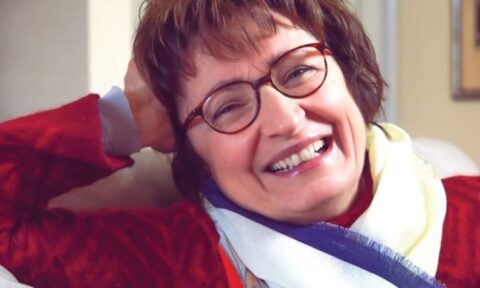 Di Pietrantonio, who is a pediatric dentist (thus, Dente del Lupo?), was awarded Italy’s prestigious Strega Prize in 2023 for the novel. The Brittle Age (L’età fragile) illuminates the way of life in Abruzzo with its embrace of landscape as an organic force – and the novel’s minor characters, particularly those mountainside dwellers, suddenly acquire dimension at critical moments. The cultural antagonism between city and country flares up here and there – and ultimately inspires the novel’s final acts.
“Milan gave me back a depleted daughter,” says Lucia. As a teenager living at home, Amanda “was a teenager who gave me no worries.” On returning from Milan during Covid after having her purse stolen, she was listless, uncommunicative. Lucia says, “Basically nothing serious had happened to her, I thought then. They had stolen only her prepaid card and the phone. The wound was superficial, it would soon heal. I didn’t see the more lasting damage, the trust in the world that had been ripped away from her, along with the purse.” Does she truly see the damage now? Lucia had admitted, “Bringing up Amanda was painful. I didn’t understand her, I didn’t understand what she wanted from me. I was afraid of being alone with her.” It was her husband who carried the infant to bed. I’m not sure why Ann Goldstein didn’t translate L’età fragile as the more literal “the fragile age.” Unless perhaps it is Lucia’s brittleness that provides the tension of this engaging novel.
[Published by Europa Editions on June 3, 2025, 192 pages, $18.00US paperback]
◆ ◆ ◆ ◆ ◆
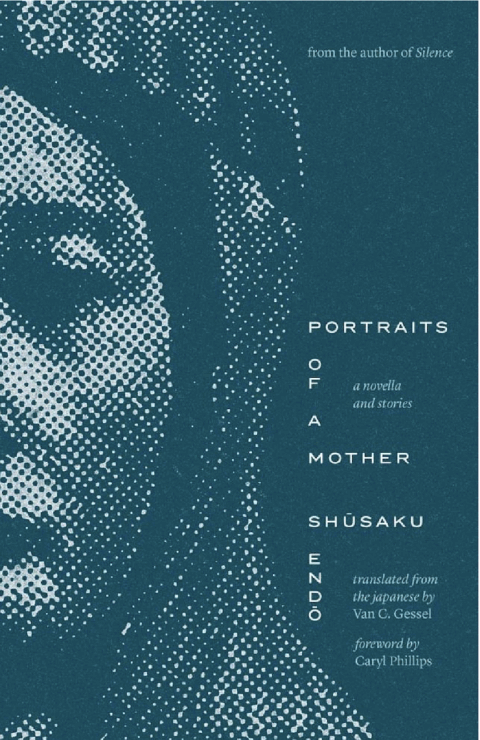
on Portraits of a Mother, a novella and stories by Shūsaku Endō, translated from the Japanese by Van C. Gessel
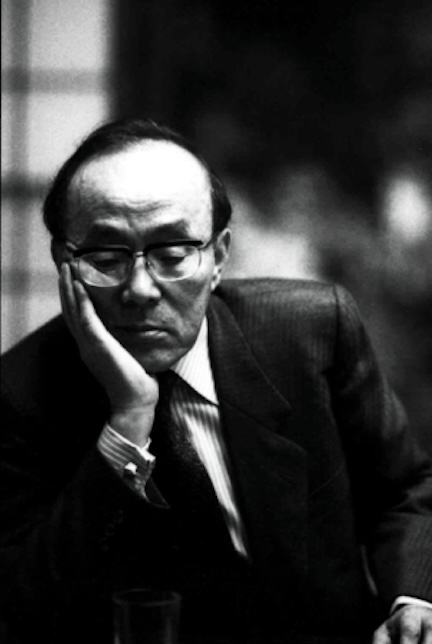
All of the main themes, character protrayals, and key events depicted in the five stories collected in Portraits of a Mother may be found in Shūsaku Endō’s novels. Unlike more widely read and celebrated Japanese writers like Yasunari Kawabata (1899-1972), Endō (1923-1996) favored composing in the watakushi-shosetsu mode, or “the ‘I’ novel,” making generous use of autobiographical facts, employed throughout his novels. In the stories, we find the boy who grew up in the Manchurian city of Dalian (then controlled by Japan), the bickering parents headed to divorce, the mother dedicated to her violin and then her Catholic faith, the boy’s baptism at age 12 in Japan, the fates of his parents, and so forth. “Spring in Galilee” (first published in 1969), a story about a trip made by a husband and wife to visit Christian shrines in Palestine, is more broadly treated in On the Shore of the Dead Sea (1973).
 But to pass by these stories, whether or not you’re an Endō aficionado, is to miss a chance to witness the concentrated force of his obsessions and sometimes harsh perspective. I love Kawabata’s work for its refined fixations on forlornness and grief. But with Endō, it’s all about religious faith, morality, and individual responsibility. Endō was a Christian in a country where today only 1% of the population believes in a supreme being and regards Jesus as savior. During World War II, many Christians were detained in camps, and foreign proselytizers and priests were arrested. As a child, Endō was picked on at school; in “A Fairy Tale,” a boy named Crow, growing up in Manchuria, tells tall tales to his classmates to elevate his status in their eyes.
Endō’s Christian faith, linked to his mother, remained firm through his adulthood. But the differences between Shinto/Buddhism and Catholicism, as played out in the Japanese psyche, also persisted in his creative output. Each of the stories at least touches on this subject. Mothers, the novella that opens Portraits of a Mother, concerns a novelist who travels to Kyushu to investigate “the kakure, descendants of some of the original Christian converts in the seventeenth century who had, over the span of many years, gradually corrupted the religious practices.” The locals look askance at the kakure, who prefer to live on an isolated mountainside. The narrator explains his motivation for the visit: “I am interested in the kakure for only one reason — because they are the offspring of apostates. Like their ancestors, they cannot utterly abandon their faith; instead they live out their lives, consumed by remote and dark guilt and shame.” The narrator then relates a dream — of waking in a hospital bed after a serious pulmonary procedure, his mother holding his hand. ( Endō suffered for years from the aftereffects of tuberculosis, contracted when he was 22 while working in a munitions factory.) The mother appears as a “gray shadow.” And then, just like the kakure “who have had to live lives of duplicity,” he says, “I too have a secret that I have never told anyone, and that I will carry within myself until the day I die.”
 In the stories, several repeated images of the mother depict her as struggling for hours to play a single delinquent note or one tune on her violin: “One single melody was being played over and over for three hours.” This line made me pause — for it suggests Endō himself, writing the same story with variations over and over. This is the pre-Christian mother, lost in and frustrated by the music. The father, who in actual life disowned his son, is heard saying that the uneventful life is a better alternative. Within Endō, there is the constant urge toward expression; in his prime he was producing a novel per year as well as plays and essays. There is also his faith, connected to his mother who came to believe that “holy things were the most exalted and wonderful things upon the face of the earth.” Could Endō still be that boy Wolf, writing these stories to draw us in toward the imaginary, the ungoverned? Or are these stories aspects of the holy?
The young Endō, as incorporated in his young characters, lies to everyone. On the day his mother died, he had lied to her about his whereabouts, going to a movie and meeting his friends instead of attending a preparatory class. When he arrived home, his mother was dead, his relatives and neighbors looking disapprovingly at him. The guilt metastasized over the years. But he also is struggling with the divided nature of himself, and of people and things. The boy wanted his mother’s love; she dragged him to mass in the snow. So when in “A Six Day Trip,” in which a man goes to a restaurant and says to his uncle, “The only thing I’m sure of is the attachment I can’t help feeling toward Mother,” it’s the nature of the attachment that one wonders about. All of this churns, quietly but not sedately, in these stories. The novella, Mothers, was discovered in 2020 by a curator in Nagasaki. We’re still digging up things that help us to understand the intriguing Endō.
[Published by Yale University Press on March 18, 2025, 203 pages, $18.00US paperback]
◆ ◆ ◆ ◆ ◆
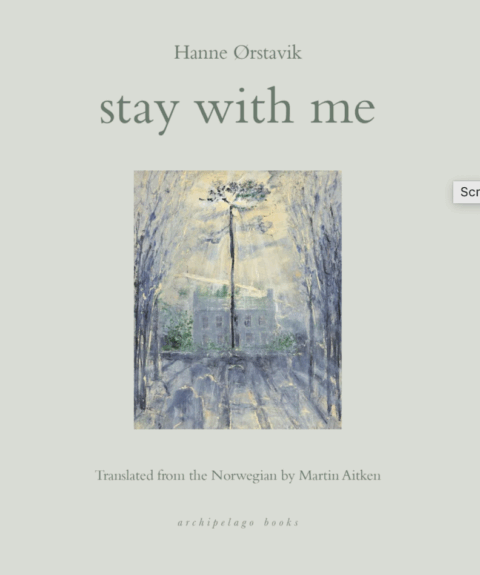
on Stay With Me by Hanne Ørstavik, translated from the Norwegian by Martin Aitken
“No one at home ever said they loved me” reads the first sentence of Hanne Ørstavik’s sixteenth novel Stay With Me, first published in 2023. “The only thing I could feel was afraid, afraid was real, the whole time.” One hundred pages later, the 53-year old narrator, having introduced us to her lover M, a 35-year old man whom she met when he came to fix her toilet, asks, “Why does something in me again open to embrace something bad, something threatening, something frightened?” She had been drawn to his “thin, sensitive, trembling part, the soft place inside M,” but he erupts in anger over trivialities, as well as over her drinking. The Why? is this stricken tale’s impetus, conundrum and blockage.
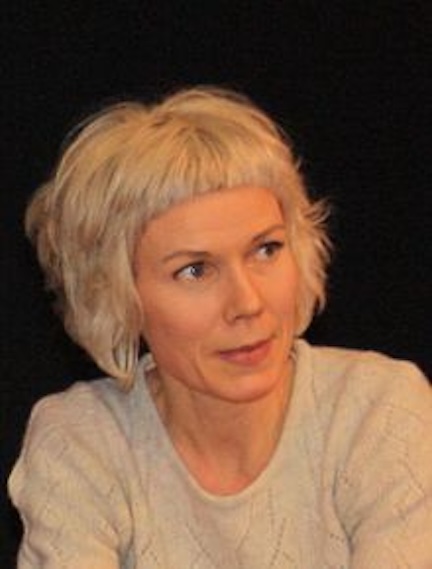
 In 2022, anglophone readers first encountered Ørstavik’s shift to autofiction with Ti Amo (2020), a practice continuing in the new novel. The former deals with her 2019 marriage to the Italian publisher Luigi Spagnol who had been diagnosed with pancreatic cancer the previous year. Ørstavik has insisted that Ti Amo, the writing of which began six months before Spagnol died, was initially drafted as nonfiction in the mode of a journal, and that her editor urged her to recast it as a novel. In an interview published in Reading in Translation, she said, “This text is more of a document for me, a report from a moment in time.” Stay With Me could be regarded as its sequel. The death of Luigi, referred to as L, is reprised: “He asked nothing of me that I didn’t have. He made me feel, again and again, that I was good enough, better than I often thought. That I was welcome, and that he wanted me the way I was.”
My favorite autofictions may spring from memory but are not constrained by it. Yet constraint is the dominant condition of Stay With Me; Ørstavik presents her own psyche as gripped by embedded emotional privations (with the exception of the gratifying affection of L). The main action of Stay With Me is recursive – seeking out M, fleeing from him, returning to him, over and over – renewed for the reader each time through the immediacy of her delivery and the felicity of her details. There are also encounters with her aged father, his former brusqueness now diluted by time even as he reinforces the notion that a rough childhood yields predictable pain in adulthood. On page 214, there is a solitary mention of a daughter and an episode of illness – “I have always been sorry about it, she was all right, so it’s not that, it was me not showing her any understanding” — which comes across as a glaring understatement in light of her own troubled youth.
 Plus, while shuttling between aloneness and M, she is trying to write a novel in which Judith, a 53-year old widower, remains in Minneapolis where her musician husband Myrto had a residency. The short excerpts of this meta-novel are inert; Judith is grateful for her brief time with Myrto, echoing Ørstavik’s marriage, but this aspect of Stay With Me seems forced.
What does gratify in Stay With Me, at least in some measure, is Ørstavik’s candor. One critic cites “honesty of voice” in her praise of Ti Amo. Sincerity goes a long way for a large cohort of readers. I appreciate her avidity in extruding her own materials into a coherent whole. As she said, this work was first intended as a “document” for her. But then, there is that often maligned word “art.” In her literary critique Immediacy, Anna Kornbluh notes that “Immediacy’s propensity to quiver with extremities minimizes art’s capacity to imaginatively break with the merely given.” When Ørstavik says towards the conclusion, “I’ve never, not once, believed anyone loved me,” I’ve not only circled back to the novel’s first line, but I recognize and appreciate her resistance to resolution, which may be impossible anyway. Ørstavik is too canny a writer to indulge in analyses. Although the nuanced resonances of her splendid novel Love may not show up here, she has deftly shaped and voiced the merely given, sincerely rendered.
[Published by Archipelago Books on April 15, 2025, 250 pages, $22.00 paperback]
For Ron Slate’s On The Seawall reviews of Hanne Ørstavik’s Love (2018) and The Pastor (2021), click here and here.