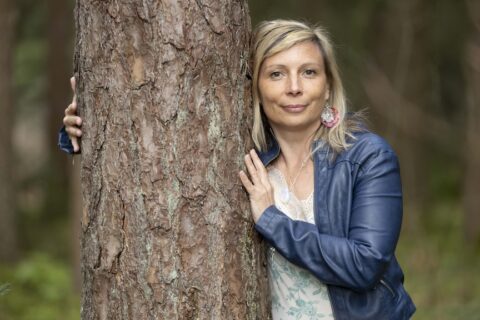
 Alja Adam (b. 1976) has published five poetry collections: Zaobljenost (Roundedness, 2003), Zakaj bi omenjala Ahila (Why Mention Achilles, 2009), Dolgo smo čakali na dež (We’ve Long Waited on the Rain, 2015), Privlačnosti (Attractions, 2020), and Pogled ženske (A Woman’s Gaze, 2022), a bilingual e-book translated into English by Martha Kosir.
Her collection Dolgo smo čakali na dež (We’ve Long Waited on the Rain) was nominated for the Veronika Award in 2016, as was the collection Privlačnosti (Attractions) in 2021. That same year, Attractions was nominated for the Jenko Award, one of the most prestigious literary awards in Slovenia. In 2022, Attractions was nominated for the Chalice of Immortality Award, an all-Slovenian literary award for an outstanding Slovenian poetic opus in the 21st century. Adam’s poetry has been translated into 15 languages and has been featured in both domestic and international journals and anthologies.
The poem “Angelic Beings” is Alja Adam’s most recent work and is presented here in its first English translation. Like much of Adam’s poetry, this poem explores the hidden depths of self and being. Unpretentious yet deeply nuanced, Adam’s poetry is characterized by rich and evocative metaphors that embody the complexities of past and present.
In “Angelic Beings,” the metaphor of composted herbs symbolizes renewal and continuity, much like the journey along the highway. It suggests that holding on to the past serves no purpose; only by moving forward can we discover opportunities for new connections and growth. These experiences, rooted in care and trust, make encounters with angelic beings possible. Such moments can be witnessed both physically, through reflections in the glass of a window or windshield, and spiritually, through feelings of hope. We must succumb to momentum, release the past, and give in to motion, like tea leaves caught by the wind. This makes the journey profoundly transformative, underscoring the importance of perpetual becoming.
— Martha Kosir, translator
◆ ◆ ◆
Angelic Beings
As she sifts through the herbs,
her tea leaves scatter.
She says it’s no good to use old tea.
She tosses it onto the compost
and washes the jars.
She prepares lettuce
for me to take home.
Just recently, a young man
from the village rode in the car with me.
It was my first time on the highway,
but I felt at ease, knowing he trusted my every move.
Isn’t that enough,
why in the world do I
contemplate loss,
cling to old stories?
Angelic beings dwell in reflections,
her wrinkled face in the kitchen window,
the young man’s profile in the windshield.
Doesn’t everything in this space
give in to motion.
Tea flakes slide across the counter.
When I open the door,
the wind lifts them off the ground.
* * * * *
Family Geography
When my father shows me around the houses
of his ancestors, the scientists, on the banks
of the river Sava, I look at his head, nearly bald
and covered with age spots that spread
like continents across the globe.
I imagine how I use my fingertips to navigate
through the brown blemishes,
meander through rare patches of hair
like a man in a kayak who paddles
through stakes in the water.
I stop at a scar
that marks the childhood fall from a tree,
the moment in which my father failed to correctly
estimate the distance between his arm
and the branch for which he had reached,
to separate his mind from his body;
as he lay dazed on the ground,
his skin shivered
in the gusts of wind;
he was becoming a part of the moving landscape,
and even the smallest movements
of the clouds above him
distorted the perfect image of the sky.
I’m overcome with a sense of relief:
as if one of the ancestors
had grasped the great oar of the world,
pushed himself from the edge of the shore,
and let himself be carried by the movements of the rapids.
* * * * *
Rocks
Something between us has crumbled,
like stony fragments from a spiral cliff
that cannot be summited
because it’s too brittle.
I find myself high above the rocks
and feel emptiness through the clouds.
In the middle of the night, I gasp for air
and eavesdrop on the foxes
that gather in front of the house.
When we sum up the courage
to unbolt and shove open the door —
like a boat that casts away its shadow upon departure —
we will learn how to walk on all fours
and follow them into the valley.
What has crumbled, will not disappear,
it will turn into fine sand,
travel with the wind,
bury itself into the pores of the skin
and irritate the eyes.
/ / / / /
ANGELSKA BITJA
Medtem, ko pregleduje zelišča,
se ji razsuje čaj.
Pravi, da starih ni dobro uporabljati.
Odvrže jih na kompost
in opere kozarce.
Pripravi mi motovilec,
da ga bom vzela domov.
Zadnjič se je z mano peljal fant,
spoznala sem ga v vasi.
Prvič sem vozila po avtocesti,
sproščena, ker je zaupal mojim kretnjam.
Ali to ni dovolj,
zakaj, hudiča,
razmišljam o izgubah,
se oprijemam starih zgodb?
V odsevih bivajo angelska bitja,
njen zguban obraz v kuhinjskem oknu,
fantov profil v avtomobilski šipi.
Ali ni v tem prostoru
vse predano gibanju.
Zrnca čaja drsijo prek pulta.
Ko odprem vrata,
jih veter dvigne od tal.
* * * * *
DRUŽINSKA GEOGRAFIJA
Ko mi oče ob Savi razkazuje hiše
svojih prednikov, znanstvenikov,
gledam njegovo skoraj golo glavo,
po kateri se kot po globusu
razprostirajo kontinenti starostnih peg.
Predstavljam si, kako s prstom potujem
med rjavimi znamenji,
vijugam med redkim puhom las
kot moški v kajaku, ki vesla
med količki.
Ustavi me brazgotina,
padec z drevesa v mladosti,
trenutek, ko mu ni uspelo
odmeriti razdalje med roko in vejo,
h kateri se je stegoval,
ločiti misli od telesa,
ko je omotičen ležal na tleh
in čutil, kako koža drgeta
v sunkih vetra,
kako postaja del gibajoče se pokrajine,
in celo najmanjši premik
oblakov nad njim
spremeni celotno podobo neba.
Prevzame me olajšanje:
kakor da bi se nekdo od prednikov
oprijel velikega vesla sveta,
se odrinil od roba obrežja
in prepustil toku brzic.
* * * * *
SKALOVJE
Med nama se nekaj odkruši
kot delci spiralnega skalovja v Južni Ameriki
na katerega se ni mogoče povzpeti,
ker je preveč krhko.
Kot, da bi se znašla visoko nad 4.500 metri
in skozi oblake zatipala praznino.
Ponoči v polsnu hlastam za zrakom
in prisluškujem lisicam,
ki se zbirajo pred hišo.
Ko bova zbrala pogum
in odrinila zapahe na vratih –
kot čoln odrine svoj odsev na gladini, ko izpluje –
se bova naučila hoditi po vseh štirih
in jim sledila v dolino.
Tisto, kar se je odkrušilo, ne bo izginilo,
postalo bo drobno kot pesek,
ki potuje z vetrom,
se zažira v pore
in draži oči.