Jorie Graham writes from within a world where catastrophe no longer announces itself as event and instead settles — almost imperceptibly at first — into atmosphere, into condition, into the very medium through which perception itself must now pass. “The world / didn’t change much / at first,” she writes, and the phrase, repeating, begins to loosen its own claim, as if sameness itself were a residue, an afterimage we continue to see because we have not yet learned how to see otherwise. What disappears does so without spectacle, “without / actually disappearing.” The problem is both loss and legibility: what goes missing when nothing seems, quite, to have evanesced.
The poems in Killing Spree set out from this altered field. Rather than probing how we’ve come to be here, as if mere arrival were still a meaningful threshold, they move within its consequences, testing what forms of attention, of address, of moral orientation remain once crisis has been absorbed into the texture of the ordinary. “There must be a record / of what we’ve lived. Or that / we lived,” the speaker insists, but even this small assertion refracts as it is spoken, qualifying itsel — “I don’t expect you to care” — until the sentence becomes a measure of how declaration falters.
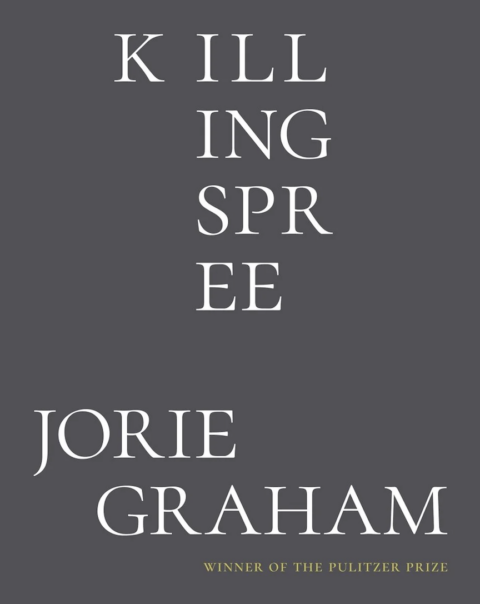 In this sense, language in Killing Spree registers the forces it cannot fully contain. The lyric voice remains, but flickers: now evidentiary, now recursive, now thinning into trace. These are poems that bear witness to the conditions under which witnessing itself turns uncertain — susceptible to being archived, absorbed, rendered inert.
If Graham’s earlier work traced acceleration — Fast, Runaway — with the sense that speed might still offer a form of resistance, Killing Spree writes from the aftermath of that wager, from within a present in which movement no longer promises escape because the systems one might flee now press up against the horizon itself. Urgency saturates. Even the line breaks fragment into particulate units; syntax stretches, retracts, begins again; the collective pronoun flickers, never quite securing its referent.
This saturation registers most chillingly in the poems’ treatment of visibility. Surveillance is not staged as an external imposition so much as metabolized into posture, into reflex, into the grammar of selfhood. “Avoid facial expressions while being assessed. Do not accidentally / express / yourself” — the injunction does away with any presumption of interiority. And then, almost seamlessly, the turn toward offering: “Track me. Track my / proclivities. Harvest me.” The cadence yields — “My gaze is my gift. I give it … freely” — and it is precisely this yielding that marks the transformation.
One of Graham’s gifts is the ability to demonstrate how coercion now arrives as inheritance — as something already internalized, already shaping the contours of desire. The self recognizes itself inside the structure that contains it. Attention becomes both currency and the stuff of legacy: something passed down, rehearsed, enacted before it is understood.
This sense of inheritance — dark, cumulative, difficult to interrupt — threads through the book’s recurrent catalogues, those long, cascading sequences in which violence, history, and perception seem to arrive preassembled. Warheads, viruses, “droughts” and “famines like / bunched veils,” insinuate their way downward through the air: these are not merely images but transmissions, as if the present were receiving, in real time, the accumulated debris of prior worlds. Which is to say, the catalogues do not build; they descend. What we are now witnessing has been in motion for far longer than we can account for.
In Graham, thought does not stand apart from the sensory world as its interpreter. It arises within it, as if the physical — its pressures, its transformations, its collisions — were already composing, already moving through its permutations “of chance … descending,” as forms turn into other forms mid-fall. The poem enters its own music, catching the modulations as they pass from one state into another, as if thought itself were only the after-sounding of those shifts.
Memory, too, returns this way: birdsong, warmth underfoot, hands remembering touch — these are not stable recollections but motifs, recurring with variation, altered by the context into which they re-enter, like that remembered song that once “rang out” and now survives only as something one can still “feel … in the palms” if one tries. This is not the sort of music that restores the past; rather, it is a song that registers distortion, a historical thinning, its merely partial persistence.
The physical in Graham is not inert matter waiting to be shaped by hand. She finds matter in a state of vibration, already carrying within it histories, violences, systems, inheritances — the air itself filled with signals, with forces that “flow,” that “carry,” that alter the one moving through them. The poem listens into that vibration and focuses upon a second-order music, one that makes audible what was already sounding, what had already begun before the poem could name it.
And yet, as Graham is Graham, her book hardly relinquishes inwardness. Memory, affection, joy flicker into presence only to be shadowed, questioned, placed under erasure. “Is joy a mistake now,” Graham asks, and the question does not resolve; it remains suspended, testing whether the poem can hold it without resolution or falsification.
 At times, what appears in place of joy is reprieve — fragile, provisional, already implicated. “Beloveds / were not dragged / into the net of / the eye of / the drone,” the speaker notes, and the syntax itself seems to hesitate, to stretch across what cannot be said alongside it. Survival does not cleanse; it entangles. To remain is to remain in relation to those who did not, to feel the asymmetries of visibility, the uneven distribution of being seen.
Graham returns again and again to scenes of collectivity — bodies assembling, moving together, preparing to speak or to sing: “We walked in unison. We prepared to sing. Soon / we would sing. / The earth was warm beneath our feet.” The moment holds within it warmth and anticipation, but does not resolve. The crowd is double, luminous and perilous, at once refuge and apparatus. What gathers as solidarity begins to tilt toward absorption. Like a lucid dream, the self enters what the poem names, with devastating clarity, “the self-erasing / crowd.”
It is at this threshold that Killing Spree turns its most exacting scrutiny toward poetry itself. “The history of poetry,” Graham writes, “a long string of luminous alibis” — a line whose force lies in its refusal to stand outside the tradition it indicts. Beauty, song, formal brilliance — these have not been innocent; they have, at times, softened the perception of violence, rendered it bearable. What is inherited here is not only catastrophe, but the means by which catastrophe has been made legible.
Graham’s response is neither renunciation nor retreat but transformation. The sentences lengthen, fracture, begin again; syntax becomes a pressure test. Meaning remains in motion. Even the most elemental question — “What can still / be made?” — is unresolved. The question is held open, its persistence more significant than any answer it might solicit.
What emerges here is a poetics of implicated attention. The reader is not positioned outside the systems the poems describe; one is drawn into them, made to feel the difficulty of locating a vantage that would not already be compromised. “We are part of an occupation whose aims / escape us” — the line names not only geopolitical entanglement but the more diffuse condition of inhabiting structures one cannot fully see and cannot entirely refuse. Responsibility does not clarify; it disperses.
Killing Spree refuses consolation. It refuses spectacle. What it offers instead is a sustained, exacting attentiveness — a willingness to remain within contradiction, within uncertainty, within the slow erosion of moral clarity, without retreating into abstraction. To read this book is to endure the sentence as it unfolds: to follow its turns, its revisions, its hesitations; to feel, within its movement, the strain of thinking under conditions that resist thought.
“What can still / be made?” The question persists — not as promise, not as hope, but as inheritance of another kind: a demand that continues to arrive, even now, even here, asking not for resolution but for the capacity to remain, somehow, answerable.
[Published by Farrar Straus & Giroux on May 26, 2026, 96 pages, $27.00 hardcover]