Eduardo Halfon writes about identity, belonging, and the intangible inheritance we are bequeathed — as both blessing and burden — by our ancestors. Specifically, he writes about these themes as they pertain to a character named Eduardo Halfon, a Guatemalan Jew who grew up in the United States and has lived in both Paris and Berlin, just like the author. Does that make Halfon’s books autofiction? Metafiction? Fictionalized memoirs? Some unnamed category? Almost certainly yes, but to what degree is not terribly important because in Halfon’s writing, memory is fallible and imagination is fanciful. He’s perpetually questioning — or being questioned about — his recollection of events, and so he seeks out the recollections of others to help him interpret what he believes he experienced. But the accuracy of these details is rarely as important as the way that Halfon the character has processed what he or his loved ones have endured. Despite this grounding in one man’s life, the themes Halfon wrestles with are universal: What is my role in the world and where is my place? What do I owe to the past, in terms of my actions and my beliefs? How do I establish my own path forward without betraying those who came before me or those who sit beside me?
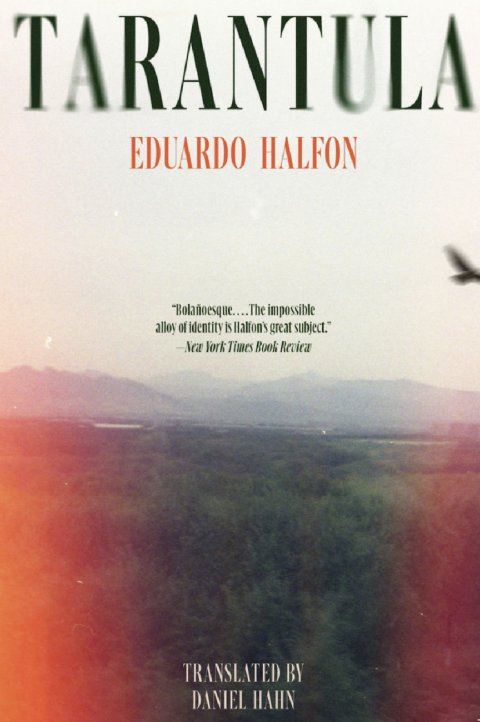 These questions will never have definitive answers, but for Halfon the character they do have a definitive source, namely his conflicted and often adversarial relationship to his identity as both a Guatemalan and a Jew. The prominence and prickliness of this duality is succinctly highlighted in Halfon’s latest title to appear in English, Tarantula, translated by Daniel Hahn. About halfway through the book, Halfon’s fictional stand-in recounts a time when a journalist asked him to name the books that he had never read that had nonetheless exerted the greatest influence on him. It’s a “ridiculous” and “brilliant” framing of a hackneyed interview question and Halfon immediately delivers his response: the Torah and the Popol Vuh. The first is of course the sacred text of Jewish scripture, while the second tells the creation myth and history of the K’iche’ Maya, one of several Mayan ethnic groups whose descendants live in present-day Guatemala. The audacious, witty, and deeply revealing answer acknowledges the importance of Halfon’s identities while at the same time asserting his refusal to embrace that importance.
Halfon’s books hop between present and past as often as they move between countries and continents, making it absurd to try and reduce any one to a single overriding concern. And yet it’s difficult to ignore the primacy of his “apparent flight relationship” to his heritage in light of the juxtaposition between Tarantula and the book that preceded it in English, Canción, translated by Hahn and Lisa Dillman in 2022. Just as the Popol Vuh and the Torah are used as stand-ins for Halfon’s Guatemalan-ness and Jewishness, Canción and Tarantula delve into those separate hemispheres of his identity — and they do so via similar means. Canción focuses on Halfon’s Guatemalan identity through the lens of his grandfather’s kidnapping by a group of Guatemalan rebels, including an elite member of Guatemala’s special forces unit. And Tarantula explores Halfon’s Jewish identity through the lens of his own (essentially) willful abduction at a Jewish children’s camp whose counselors are led by one of the “most radical Latin American leaders and soldiers” in the “secret security and intelligence service” that exists in every Jewish community.
Lest you think the comparison between a kidnapping and children’s camp is inapt or insulting, during the course of the camp, which Halfon and his brother attend when they are, respectively, 13 and 12 years old, the children are physically abused, psychologically imprisoned, and forced to wear armbands with yellow stars before being interrogated by counselors with swastikas on their sleeves, an image that the adolescent Halfon mistakes for the book’s titular spider. As an adult, Halfon accurately describes the experience as a “fake Nazi concentration camp.”
That Halfon should use separate books to zero in on the Guatemalan and Judaic aspects of his identity is unsurprising in light of another anecdote recounted in Tarantula, when he recalls a childhood outing with his father to a Guatemala City golf club where he sees a sign on the front lawn reading “No Dogs or Jews.” The sign causes an irreparable rupture in Halfon’s identity, he writes: “From then on, from those words and from that moment, my two worlds, the Jewish world and the Guatemalan one, parted forever.” And yet Canción and Tarantula have even more in common than their parallel inciting events. In both books, Halfon learns more about the past from a woman closely associated with those traumatic episodes. In Canción, it’s Sara, a former extremist with ties to the kidnappers who he meets in a bar in Guatemala City; in Tarantula, it’s Regina, another attendee of the children’s camp who he meets in a cafe in Paris. And the books have trivial commonalities as well, including women with “cherry red” painted toenails and grazing, just-barely-there contact between Halfon’s leg and the leg of some woman whom he hopes desires him in the same way that he desires her. (They don’t, in both cases.)
The Jewish children’s camp that Halfon and his brother are sent to in December 1984 is in Guatemala, which is “still immersed in the violence and insecurity of the civil war.” At that point in time, his family is living in Florida, to which they fled three years earlier, and Halfon has rejected not only his Guatemalan roots, refusing to speak Spanish to his parents, but also his Judaism, refusing to attend prayer meetings with his father. The camp, his parents tell him, will teach “not only wilderness survival skills but also wilderness survival skills for Jewish children. Which are not the same thing.” Halfon emphasizes the Judaism of the camp by parenthetically providing Hebrew terms whenever possible, whether for the camp itself, a majaneh; for the orders that are shouted at the kids, such as “sheket (silence)”; or for a “folk-dancing activity (rikudim, in Hebrew).” Early on, aside from having to “protect at all costs” the blue-and-white camp flag, or degel, Halfon could just as easily be attending a Boy Scout camp, as he and the other children are taught how to build a shelter and start a fire. On overnight guard duty, he even nurses a nascent camp crush on the coolly flirtatious Regina, whose nose is always buried in Salinger’s Franny and Zooey.
The tenor of the camp changes dramatically one morning when the counselors don swastika arm bands and drag the kids out of their tents to start interrogating them. The children, ages 12 to 14, are verbally and physically abused, made to hurt each other, and forced into cells demarcated on the ground, all while being fed directives about “submission, about surrendering to the rules of the group and to the chain of command, about how important it was to follow orders.” Most of the kids are cowed by the abuse, emptied out by their fear, responding to the counselors with what is “no longer a respectful silence, nor a fearful silence, but something like the silence of a void or an absence, as if our souls were no longer there, nor our minds, nor our hearts, nor our voices.” Halfon, however, flees into the woods, where he gets lost and endures an introspective night of solitary terror, save for an encounter with “two soldiers or two guerrillas or two forest spirits.”
Though Halfon writes from the realistic stance of experience, he skews these memories, as with that mention of “forest spirits,” in order to shape his narrative. This distortion is present in another passage that starts with a vivid description of awakening before revealing its surreality:
“The daylight was only just starting to be daylight. The bedroom, on a corner of the building, was the shape of an irregular quadrangle. The mattress on the bed was a little short and my bare feet hung off the edge, beyond the light white sheet. I looked at my feet for some time, motionless, focused — while my hand was seeking or feeling or seeming to feel the lump in my belly — and I went on looking at my feet until suddenly I had the clear image of a small beige tag tied to my right big toe. My feet were now the feet of a dead man. My feet were my feet in the morgue and my eyes were the eyes of my son looking at the feet of his father.”
Hahn has been a co-translator on the four previous Halfon books that have been published in English, and his solo work here is replete with evocative imagery tinged with unease or despair. In addition to the “small beige” toe tag above, there is a vulture “like a black brushstroke on the indigo tapestry that was the sky“ and “a grayish brown horse, which wasn’t so much a horse as a bundle of bones.” Early on, Halfon compares his mother’s repetitive angry admonishment to “a hammer coming down repeatedly on the same nail,” and Hahn retains that image several sentences later by referencing “the hammering of those words.” Hahn also beautifully renders Halfon’s tender wish for a way to safeguard our past, wondering “if the images we see in childhood might not be stored in some different vault of our memories, a secret vault, a vault protected forever from the passing of the years.”
 The biggest threat to the safety of those childhood memories is Samuel Blum, the counselor who oversees the abuse at the children’s camp. He and Halfon reconnect decades later after a (seemingly) chance encounter between Halfon and Regina in Paris, when she shares the information that Blum is living in Berlin, where Halfon is doing a year-long fellowship. (This is yet another parallelism with Canción, in which Halfon has a year-long fellowship in Paris.) Though he has “no desire to talk to” Blum, Halfon gets in touch with him anyway, leading to a chilling night out at a Thai bar and (likely) brothel. Despite the intervening years, Blum immediately renews his abusive, high-handed, and mocking treatment of Halfon, starting with “a kind of examination that sometimes felt inappropriate, sometimes almost like a police interrogation.” He is contemptuous and belittling when Halfon wonders at the reasons for the abuse hurtled at him and the other children. He tries gaslighting Halfon about what happened, but ultimately gives up any pretense of caring, boasting that it’s “always good to spill a bit of blood.”
Blum’s background is revealed to be “strictly clandestine” and “strictly military,” with possible membership in “a secret militant [group] of the extreme-right Zionist movement Betar,” as well as various elite branches of the Israeli Defense Force. He tells Halfon that “children ought to know the pain of their parents” and learn “as early as possible…that everyone else is an antisemite, that the whole world revolves around this most ancient hatred.” It’s a victim-centric world view that demands the past live on in the present, an argument for the perpetuation of pain and, given his conduct at the camp, of violence.
Tarantula was originally published in 2024, but needless to say its considerations about the necessary response to trauma, pain, and violence remain unflinchingly relevant in 2026, particularly given Blum’s purported ties to the IDF. One argument that Blum makes, which will likely spark considerable debate among the book’s Jewish readers, centers on Henryk Goldszmit, the Polish doctor and author (under the pen name Janusz Korczak) who founded Warsaw’s Jewish orphanage. When presented with a choice, Goldszmit refused to leave his 200 orphans behind and instead tried to put them at ease before accompanying them to Treblinka. After recounting Goldszmit’s story, Blum asks Halfon: “Are you really so naïve as to think that today’s Jewish children can feel and understand what those two hundred Jewish orphans felt as they walked through a ghetto and boarded a train and got murdered like street dogs in a gas chamber, just by reading their story?” Every reader will have to wrestle with this question themselves, but I would posit that simply by writing Tarantula, Halfon the author would say yes, reading can help understanding, can help healing, can help us move forward. I, too, hope that someday we live in a world where more people believe this to be true, instead of ascribing to the antithetical belief that only by passing on a legacy of pain can we finally live in peace.
[Published by Bellevue Literary Press on May 19, 2026, 192 pages, $17.99]