Language is scary in how it holds us in thrall. It can be a force of tremendous good, but it can be used as a tool of control by malevolent, deceitful forces. Today, authoritarian regimes preach nostalgic doctrines of the pure, native, and original, while they demonize the contemporary moment and the hybrid, multiple, and complex. Kasia Szymanska’s Translation Multiples brings to mind this contrast in language’s power because it studies the creative efflorescence of translation after the end of communist rule in Eastern Europe and during roughly two decades of fruitful poetic experimentation in the Anglophone world from 1990 to 2010. The book focuses on how poet-translators used translation to present the ambiguity of language, the complexity of creative expression, and their subjectivity as values of democratic pluralism. Against the backdrop of the political climate today, Szymanska implicitly argues that those of us favoring democratic pluralism should seize on the example of translation multiples as inspiration to fight against restorative nostalgia and homogenizing effects of authoritarianism.
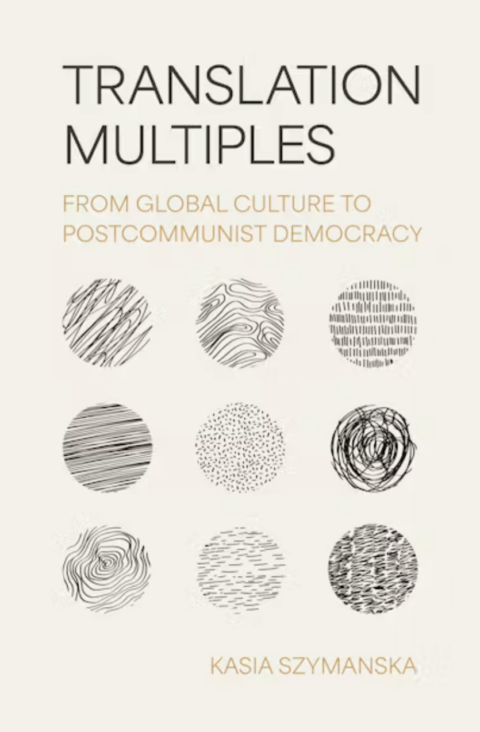 To some readers, the phrase “translation multiple” will be unfamiliar. At least, it was to me. Evidently, translation multiples have been an integral part of translation since time immemorial since the polyphonic nature of literary language produces many variations when translated. Szymanska uses the phrase as a neologism, defining it as a “genre” of creative writing that “resides somewhere on the border between experimental translation and conceptual writing.” This type of translation is distinguished from “more academic prototypes,” nominally, those with an obsessive regard for semantic accuracy or scholarly annotation. Yet, far from engaging in the hairsplitting of taxonomical distinctions, Szymanska means rather to argue that we need to spend more time considering the peripheries of translation because it is in these margins where translation is at its most democratic. It is here that translation shows itself to be always already multiple. Recognizing the full scope of translation becomes key and points to how in general translation resists any “totalizing idea of monopoly on a single truth.”
Translation Multiples is divisible into two parts where the nominal reader will have different levels of expertise or knowledge. The first three chapters largely deal with Anglophone conceptual writing, with a heavy crossover with contemporary American experimental poetry.
In the first chapter, Szymanska details numerous translation multiple projects, starting with case studies from the late 1980s through the early 2000s. First, she features the American editor, essayist, and translator Eliot Weinberger’s 19 Ways of Looking at Wang Wei (1987), then the American computer and cognitive scientist Douglas R. Hofstader’s Le Ton beau de Marot: In Praise of the Music of Language (1997), which is comprised of 88 translations of a 16th century French poem by Clément Marot. “VIA: 48 Dante Variations” (2002), a Dante project by the intrepid Caroline Bergvall follows. Simultaneous visual presentation is fundamental to the expressive power and potential of translation multiples for re-education and concept-changing, and Szymanska cites Weinberger’s mini-anthology (it’s 53 pages long) for its intervention in anthology making by “arranging consecutive renderings according to the act of ‘looking.’” The “visual texture” of this form of conceptual art is where “they reinstate their own plurality most tangibly.” Even more apparent than in Weinberger’s or Bergvall’s editing/creative acts, the Uruguayan artist Alejandro Cesarco’s “Untitled (Dante/Calvino)” (2004) displays ten different English translations of the Inferno first published during the 2012 Deutsche Guggenheim’s Found in Translation exhibition. Books, in this case, fail to produce the simultaneity that visual art can offer.
The next chapter continues the documentation of the archives of translation multiples, largely through the lens of contemporary Anglophone experimental poetry, and poetic practices using translation to generate inspiration. The theory and work of poet, translator, and Brown University professor Sawako Nakayasu is featured prominently. In this chapter, democratic idealism is emphasized as the inherent “ethics” of the “genre.” In the context of the opening up of Poland during the Solidarity Movement of 1980-81, and then more widely after the collapse of the former Soviet Union in 1989, translation practices that emphasize perspective, subjectivity, and language’s ambiguity are powerful examples of how aesthetics, thinking/writing, and socio-political formations are often intertwined. What Szymanska calls the “communist production of literature” tended to stifle thought and creative freedom by limiting the number of translations in circulation, canonizing only certain, choice authors, and “homogenizing their image.” Polish translations changed in the 1990s following the removal of “preventive censorship,” the democratization of the profession of translation (or its emergence, since no literary or creative “profession” is fully democratized), the faster pace of book production, the proliferation of translations and the availability of retranslations. She notes the salubrious effects of these changes in Poland, where translation multiples played an albeit small but important role in undermining authority, and where “plural interpretations bec[a]me a democratic gesture targeting the totalitarian legacy” of the state.
The three Polish chapters are valuable for how they expand the Anglophone reader’s awareness of the sophistication of these practices in the contemporary non-Anglophone world. Polish literature is already “famous” in the US: Olga Tokarczuk, Wisława Szymborska, Czesław Miłosz, and Zbigniew Herbert need no introduction. But these chapters make clear that the fetishization of a text’s purported originality is also a socio-political tool and a distraction from the social-historical construction of texts.
 [left — Kasia Szymanska] Chapter Three is dedicated to the work of Stanisław Barańcazk (1946-2014), particularly his homophonic translation multiple “Oratorium Moratorium” (1991). The timing is critical in Szymanska’s reading, due to the rebirth of Polish publishing after 1989. He was dedicated at the time to a veritable “torrent” of poetic experiments, conceptual translation books, and thematic anthologies. Szymanska characterizes his eccentric poetic profile as being “a refreshing boost” to the Polish language. “Oratorium Moratorium” was a homophonic multiple whose theme was “poetic commentary on recent political events.” Its purpose was “distributing various voices and political arguments” among “different renderings of the same original fragments.” For him, translation was an optimal space for “emancipation and independent thinking” that would “challenge” an “ostensibly monolithic textual whole.” Chapter Four is a case study of the simultaneous release of two translations of A Clockwork Orange in 1999 by Robert Stiller (1928-2016). These two versions were meant to emphasize the way that Polish has been influenced by two imperial languages, English and Russian. That duality then would have been modulated further by a third version that he was promising to complete at the time of his death in 2016, a text that would have assimilated German and Yiddish vocabularies and conceptual universes.
 Chapter Five deserves special mention because it touches on a figure better known in the annals of world literature — Bertolt Brecht. After summarizing Brecht’s reception in Polish, this chapter focuses on All That Brecht (the translation Szymanska provides of the Polish title), a work published in 2012 by four poet-translators. The title is largely ironic because it includes only 81 of Brecht’s thousands of poems. These poet-translators were affiliated with the magazine Literature in the World, and they saw their endeavor as collaborative. It is this collaborative element that makes their work stand out: they were attempting a “collaborative artistic revision of the poet’s image,” the first since 1989. This reclamation centers on displacing the political content from Brecht’s work in order to allow aesthetics and literary language’s natural polyphony to highlight the internal difference of his work. Szymanska emphasizes the intentional, interpretative nature of each poet-translator’s work, as “each translator has a different idea of how to reclaim the poet’s image.” Jakub Ekier, one of the four poet-translators, reads in Brecht how “diverse expressive voices and artistic collectivism” are essential to “political disruptions.”
Szymanska’s cataloguing of Anglophone and Polish experimental translation projects is valuable; it is, to my knowledge, the only one. However, the idea of a translation multiple does raise questions. I wouldn’t be inclined to call it a genre, which implies norms, when the translation multiple as brought into evidence in this book does the opposite. In other words, the most exciting and useful feature of Szymanska’s diverse archive is how it shows that norms (linguistic, aesthetic, sociopolitical) are exposed, then broken, when translation multiples are produced. This book also reminds me broadly of the notion in Matthew Reynolds’ edited volume Prismatic Translation (2019). Reynolds’ idea seems similar — that translation is already always multiple. In that book, the emphasis is slightly different, as the various “rays” produced through the prism highlight the larger phenomenon of adaptation. There, too, the celebratory air given translation seems differently laid on polyphony, diffusion, and an ecstatic distance-reading computational multiplicity. Yet, clearly, translation multiples are different from the prismatic overview of translation because translation multiples are for all intents and purposes presented simultaneously; their regenerativity is more radical because a self-conscious form of conceptual art. Lastly, the idea of translation multiples must be differentiated in some form from retranslation. In this case, retranslation per se is viewed simply as a capitalist phenomenon. A new translation may be commissioned under the rubric of “the times demand it” or some other consumer-oriented emotional appeal when the retranslation is not experimental in any sense but only brought on by the financial machinations of publishers.
This book’s greatest value lies in its emphasis on how studying translation can reveal cultural mores, political attitudes, and varying degrees of social health. Any conversation about translation must deal with language’s inherent ambiguity; to forfeit this topic makes the politics of those in discussion conspicuous. Szymanska’s book demonstrates language’s ambiguity as an inherent element of translation. Translation brings us face to face with the excessive multidimensionality of literary texts. Perhaps for some the realization that we use language but are far from controlling it (or even understanding it) might prove unsettling. Yet this encounter helps us understand the radical potential for freedom laid within the human genome inside language itself. To be sure, there are forces afoot today that want to control language and — by controlling language — control our freedoms absolutely and in a downward spiral toward the univocal, monologic logic of tyranny.
[Published by Princeton University Press on May 27, 2025, 226 pages, $35.00 US hardcover]