Look, now, to the horizon: histories ahoy! An armada of books heads toward us in anticipation of the United States’s 250th birthday next July. Jill Lepore’s bestselling We the People is arguably the flagship, but there are other impressive volumes in formation, including Richard Bell’s propulsive, beautifully crafted The American Revolution and the Fate of the World, which unpacks how and why a sporadic colonial rebellion morphed into a global paradigm shift.
We often neglect the chain of events that gave birth to our nation, fomenting ideas among self-government across continents; Bell, a British-American professor at the University of Maryland, is here to redirect our attention. (I will follow Bell’s usage of “American” to mean British colonists in North America and the polity known as the United States, as rather than the larger context depicted in Greg Grandin’s brilliant America, América.)
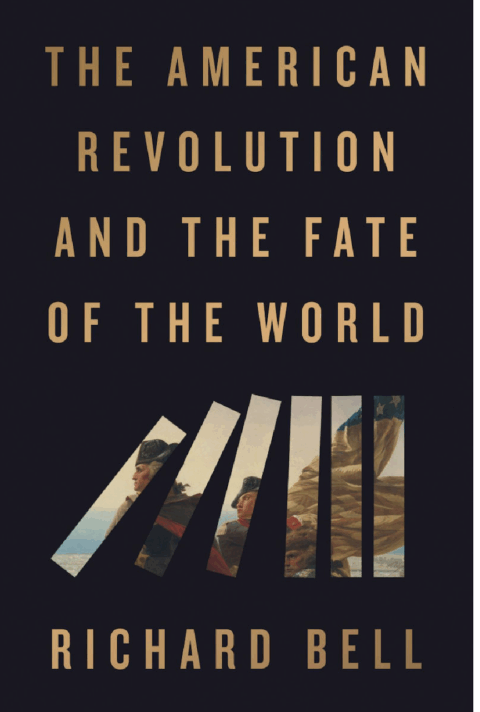 After a decade of “tyranny” surrounding Britain’s need to recoup budget losses connected to the Seven Years’ War, settlers along the eastern seaboard increasingly resented their subordination to George III and his prime minister, Lord North, so far away in London. In truth, a century-and-a-half of geographical separation had divided the two pthe mother country from her subjects, despite a common language and similar Protestant faiths. The Boston Tea Party, an ad hoc response to taxes imposed by the East India Company’s balance sheet, was the first in a cascade of falling dominoes, a local event that rattled the European empires and their scattered dominions. “Winning independence required a world war in all but name. What began as a domestic dispute over taxes, trading rights, and home rule soon metastasized into something much bigger and broader, pulling in enslaved people as well as Native people,” Bell opines in his Introduction. “The patriots’ dreams of liberty ricocheted around much of the rest of the planet, too, pushing questions about human dignity, popular sovereignty, and citizenship toward the top of the global agenda and equipping rights seekers everywhere with a potent new vocabulary.” The story of how half-formed notions of liberty and self-determination evolved and spread is the mission of Bell’s book.
The Tea Party rippled eastward. (The author’s opening chapter suggests that a copycat tea party in Guangzhou triggered the first Opium War in 1839.) Although George III was reluctant to crack down on the colonists — he was more invested in lucrative sugar plantations in the Caribbean — he signed off on the Coercive Acts, consenting to Parliament’s desire to punish the renegades and tightening restrictions within the city. As supplies dwindled, the other colonies dispatched rye, flour, corn, flax, and codfish. One farmer sent hundreds of cabbages. Bell depicts this outpouring of victuals as a “major tipping point,” galvanizing the 13 disparate colonies to act collectively, seeing themselves in Boston’s plight.
He brings a mesmerizing outsider perspective to the Spirit of ’76. France was keen to see their archrival humiliated, yet Louis XVI dithered, despite Ben Franklin’s concerted efforts to win military and financial support. (Franklin stayed the course and enlisted the French.) While the Continental Army’s 1777 victory over Burgoyne’s forces at Saratoga tweaked further European interest, the Redcoats pushed Washington into winter quarters at Valley Forge, backed by hired Hessian troops. A Prussian mercenary, Baron Steuben — unemployable in Europe, possibly due to closeted homosexuality — arrived in the Pennsylvanian chill, carrying a letter of recommendation from Franklin, and commenced to whipping the ragtag Americans into shape, a colorful character: “Steuben’s presence would electrify the camp. He turned out each day astride his horse in full dress uniform, his retinue at his side, and Azor, his Italian greyhound, padding behind him. To some today, such posturing might seem pompous or ridiculous. To the soldiers, however, he was a celebrity, a wonder, and they came out of their huts each day to watch him pass,” Bell writes. “Washington took Steuben into his circle immediately, inviting him to dinner ten times in the first two weeks.”
The American Revolution and the Fate of the World also showcases a range of actors in the conflict. Enraged by colonists who flaunted the Royal Proclamation Line of 1763, which forbade white settlements beyond the Appalachian divide, the Haudenosaunee (Iroquois) confederacy, Creeks, Cherokees, and Choctaws joined the British. Initially ambivalent, the sentiments of the English public hardened once France rallied to the rebels in 1778. Bell underscores the influential siblings, Joseph and Molly Brant, who tapped their influence and connections to advance the British cause.
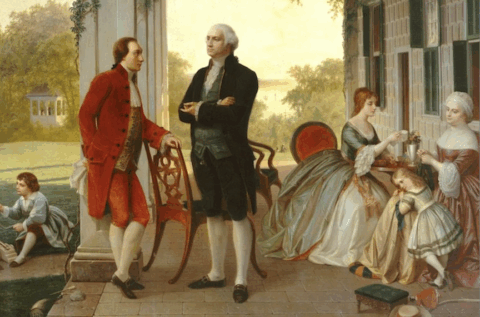 Although Lafayette is the best known among the French comrades, other figures played more critical roles, such as General Rochambeau and admirals d’Estaing and de Grasse. Without France’s interventions the rebels would have failed. The light of revolution then passed back across the ocean, kindling the Bastille in 1789, the rise of Robespierre, and the Reign of Terror. Bell draws distinctions between these fulcrums amid the beginnings of the Industrial Revolution. As blood flowed in Paris, the fledgling American republic distanced itself from the new French order and revived trading and cultural bonds with the Crown, spawning a myth of origins: “The first American historians to chronicle the Revolutionary War gave short shrift to their old allies across the Atlantic. The fallout of the French Revolution and the imperatives of postwar US nationalism combined to celebrate America’s own homegrown heroes almost exclusively, and to buttress an emerging creation myth that the patriots had achieved independence all by themselves. Not even Lafayette’s 1824 return would put French soldiers and sailors back at center stage. Instead, that singular visit shone a solitary spotlight on Lafayette, the Continental officer long regarded as George Washington’s surrogate son.”
The American Revolution and the Fate of the World is rich with delectable trivia, like an episode of Jeopardy! Pierre Beaumarchais, a Parisian playwright famous for writing “The Barber of Seville,” funded a shell company that trafficked weapons to the rebels. New England towns celebrated a version of Guy Fawkes Day (November 5), commemorating the Gunpowder Plot and in keeping with anti-Papist sentiment. There’s a vivid if somber chapter on U.S. privateers and their multiracial crews, lured by the prospects of wealth as well as the fight for independence: “That was the genius of privateer licensing. It leveraged the profit motive, spurring into patriotic service men and boys who might otherwise have stayed at home.” Bell tracks the journey of one Massachusetts privateer, William Russell, who somehow was captured and held twice, first in England and then on board the Jersey, a prison hulk moored in the brackish shallows of the East River, across from lower Manhattan. Eleven thousand men and boys perished on the Jersey and were buried in the Revolution’s largest mass grave. (Russell died from health complications less than a year after his release.)
 While Bell focuses on how the American experiment challenged European powers, he also casts his narrative into Africa, Australia, and Asia, as revolutionary ideals and the United States’ written constitution stirred other subjugated populations. The subcontinent of India, with its profusion of cultures and languages, recognized the benefits of pulling together. “The destruction of the East India Company tea in Boston harbor back in 1773 had ignited the American Revolution, and as the war spread, it had set the Indian subcontinent ablaze,” Bell notes. “By 1782, Haider Ali and his son Tipu Sahib had already led tens of thousands of men against the British in India.” That insurgency faltered, but the stage was set for further confrontation. The Irish, too, felt a kinship with their (often literal) cousins across the Atlantic, and embraced the struggle.
Bell’s trick here is one of organization: by moving between individuals and upheavals — by creating dioramas around actual characters and their respective peoples — he makes a broader argument: the American Revolution did, in fact, mark an inflection in global history, not just the West, as governments moved from absolute monarchies to an array of democratic forms. (Ken Burns’ forthcoming PBS series comes at the same history from a similar slant.) Bell ties this argument to the evolution of the nation-state, now on shaky ground, as technologies like the Internet and AI transform communication and chip away at traditional boundaries. And yet, as the Founders and their fellow citizens envisioned, government of the people, by the people, for the people is principle worth the fight.
[Published by Riverhead Books on November 4, 2025, 416 pages, $35.00 hardcover]