“Was it January or February?” Jan wonders. “The coconut fronds waving, shining like green hair in the sun gave no clue.” She and her husband John, both Americans, are living in a thatched hut on the beach of Yelapa, Mexico, a place so tiny and remote it is “not even a dot on the map below Puerto Vallarta.” The hut, like all those nearby, is crawling with scorpions, so much so that Jan has to step carefully and beware of scorpions falling from the thatch overhead. (When the men replace thatching before the rainy season, they do so “shielding their heads with umbrellas from falling scorpions.”) The couple make do with what little food and fuel they can buy at the small general store, getting by on a monthly check for fifty-two dollars sent each month to Jan by “the famous wino himself.”
 Jan is about seven months pregnant and planning to travel to Guadalajara in a month to give birth. But labor begins two months early and is so intense Jan is “convinced [her] pelvis [would] crack in two.” Amidst the pain, she also wishes she could comfort John because “it wasn’t even his baby.” A local midwife helps deliver the baby, who emerges tiny and stillborn, smaller even than the giant papaya an unknown visitor leaves as a gift. To the midwife’s inquiry (“Estás triste, no?”), Jan shrugs and smiles weakly, feeling “strange relief” but also “acute emptiness.” When the rains begin in the days that follow, Jan thinks of her “poor baby in the ground being inundated, under the banana palms where she was buried.” The “lull of women singing as the [wash] clothes down by the river,” roosters crowing, and dogs barking, sound to her, under the torrential rain pounding the small hut, like “a wild menagerie of souls all mourning [her] Natasha,” the name she chose for the baby after its burial. Two weeks after the stillbirth, it is February 16, 1968: “I cut John’s hair for the journey north. It was my sixteenth birthday. I swept the mass of curls out into the papaya trees.”
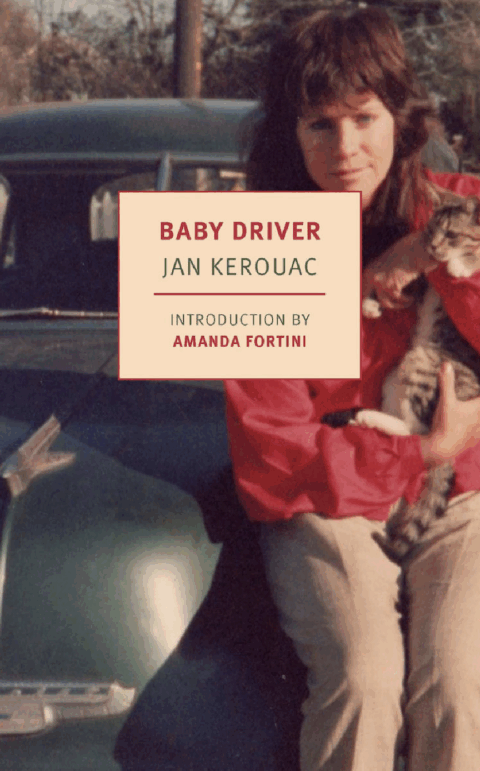
The Jan in question is Jan Kerouac, and this scene opens her autobiographical 1981 novel Baby Driver (the title of which comes from the Simon and Garfunkel song that also provides the epigraph, not the 2017 movie or, for that matter, the Kiss song of the same name), now reissued by New York Review Books with a new introduction by Amanda Fortini. Jan was the daughter of Jack Kerouac and Joan Haverty, Jack’s second wife. It was a marriage so brief that it had been over for months by the time Jan was born in 1952, still five years before the publication of On the Road shot Jack from little-known Beat figure to celebrity. For years, Jack denied paternity and refused to meet his daughter, and although he eventually ceased the denial (and occasionally sent support checks in the minimum required amount), he never officially acknowledged her and met her only twice before he died at age 47 in 1969. His absence — and the complex range of emotions it triggers in Jan and Joan — engenders the powerful farrago of yearning, loss, and restlessness that defines Jan’s life, yet remains implicit, addressed only indirectly for much of the narrative.
Baby Driver unspools in chapters alternating between Jan’s turbulent childhood and her peripatetic and even more turbulent teens and early twenties. Her account of her earliest memories evokes the wonder and sensitivity of that time, especially its vivid dreams, such as one of a “tickly bee” stinging her, and, after smashing it, her feeling “so sorry for the bee who had only wanted to kiss [her],” and the recurrent “Crunchy Dream” of childhood fevers, in which she recalls feeling “as if made out of porcelain padded with felt.” The very young Jan also demonstrates a precocious flair for language, seeing the word majestic as “a short, fat word, kind of smashed up like an accordion” and the Polish grocer’s counting in “solid words that must have tasted good, like crackers maybe.”
 [left — with boyfriend Scott Robinson] Jan leaves behind the child’s innocence early: “Valentine’s Day, 1965, two days before my thirteenth birthday, was the first day I took LSD.” She does so with her “cosmic brother,” a 22-year old man who is her boyfriend at the time. She is soon regularly taking acid and skipping school and causing all manner of trouble for her mother, who eventually has her committed to the notorious Bellevue for a time. Once out, she quickly begins a romance with “a nineteen-year-old Portuguese hashish dealer” and heads to Mexico with her new husband, a different, even older man, to avoid violating her probation and ending up in a home for unwed teen mothers.
The adult-era chapters (in Jan’s case, adult beginning sometime in the mid teens, before legal adulthood) detail her wanderings from Kittitas County (in central Washington state) to New Mexico (bopping between Santa Fe and Albuquerque), to Arizona (and a brief stint as a prostitute), back to New Mexico, then on the series of adventures and misadventures in Central and South America (through Guatemala, Ecuador, Costa Rica, Colombia, and finally winding up in Peru) before returning to her mother back in Washington (and “the charming aura of chaos and disorder” that makes Jan “feel more like a sister to her than a daughter”), the book closing with Jan and Joan, like “two girls at a pajama party,” talking late into the night until they fall asleep.
The two times father and daughter met (the first in New York, when Jan was nine, and the second in Lowell, when she was 15, pregnant, and about to hide out in Mexico) are featured in the memoir, and the latter encounter is particularly poignant. Jan’s description of her father is detailed and at times unflattering; he seems a “naughty bummish fellow” when she first meets him; his fifty-two dollar support checks (the legally mandated minimum) are “autographed by the famous wino himself.” In her introduction, Fortini quotes a portion of an interview in which Jan describes Jack as “very emotional,” and going on to explain that “everything he saw was directly related to his soul,” a profound insight into the man’s character, especially since she knew him primarily through his writing and his friends. After she hears of Jack’s death on the radio, Jan reflects that both her father and stillborn daughter “had been half-formed, then lost.” The pain is intense but understated: “My father, always so distant, whom I had wanted to see again, wanted to know better, maybe even be drinking buddies with, had gone and died without even asking me. How could he do that?”
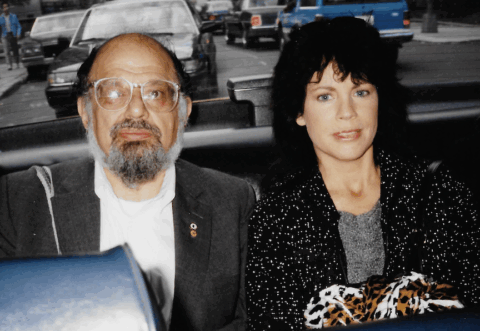 [left — with Allen Ginsberg in New York, 1991] Readers expecting Jan to be a Jack imitator will be disappointed. Although there are broad similarities of theme and motif — countercultural road vagabondage, the thrill of New York and San Francisco, sex, drugs, the quest for spiritual insight through unorthodox means — Jan is her own writer and arguably a better one than her father often was. She has a knack for pithy understatement. About one part of her time in New Mexico, she writes,“I got involved in some mad doings at a creperie with an ex-junkie Jesus freak cripple who introduced me to a fifteen-year-old boy who claimed to be a warlock.” Of her time in Costa Rica: “Back home on the volcano, we’d listen to Vivaldi’s Four Seasons over and over.” Of one episode in the wayward teen years in New York: “I drifted into a cough syrup drinking scene at the Hard Rox Studio, an art gallery of sorts on Third Street.” Baby Driver abounds with such examples of Jan’s eye for detail, her deadpan tone, her ability to evoke a wealth of images, associations, and feelings—to evoke an era—with only a few words.
Jan’s narrating persona is also notable for empathy for animals and even machines. In Yelapa, there are Seymore, the “huge ever-present spider,” and “the Fred Astaire spider,” who “would do the most frenzied, intricate footwork, twisting, hopping, kicking with just one leg, then another,” and, when Jan is cleaning the hut, a “tiny lizard, terrified in the extreme” with “his heart throbbing wildly, shaking his entire torso.” About cars, there is “a two-tone green ’54 Chevy, the kind with the sweet innocent expression on the grill” as well as Matilda, a “’55 Caddy grimacing in her black chrome armor,” and Henry, a green bread truck that at one point rolls over and spends the night lying “sadly on his humble side.” Jan, as a character in Baby Driver, thus comes across as acutely sensitive, which brings into even starker relief the almost casual accounts of harrowing experiences, what Fortini in the introduction describes as a “shrewd, clinical detachment.”
Baby Driver is a very good book, but it is a difficult one to read. Like her father, Jan seems impelled by an unappeasable inner restlessness. Fortini quotes one contemporaneous critic who characterized Jan’s life as “constant directionless movement,” an apt description used here without the scorn the critic seems to have intended. Jan is highly aware of this quality, comparing herself to “a gum wrapper in a whirlwind,” often feeling “no reason to be anywhere in particular” and thus driven to repeatedly upend her life for a “wonderful sensation of insecurity.” The life chronicled in Baby Driver is a hard one, sometimes vicariously painful for the reader. Jan died young, in 1996 at 44, a life even shorter than her father’s. But in this volume, she manages to transmute that tempestuous life into a work of art and thus also the apparently directionless into something beautiful and meaningful.
[Published by NYRB Books on November 11, 2025, 272 pages, $17.95US/$23.95CAN, paperback]