In 1984, George Orwell’s fictional totalitarian state saw the past as an erasable manuscript: “All history was a palimpsest, scraped clean and re-inscribed exactly as often as was necessary.” A palimpsest, from the Greek for “scraped again,” is a parchment from which the ink has been removed, allowing for new writing to replace it. Yet a palimpsest, crucially, and contrary to the authoritarian dream of absolute erasure, is never a total undoing of the past. Even after the parchment is rewritten, scraps and traces of abraded text remain, sometimes partially or even wholly recoverable, and sometimes apparent as no more than ghostly impressions, palpable markers of absence. The past persists, becoming the present and future, no matter how thorough the attempt to efface it, or how compelling or coercive the new material that takes its place. It is this sense of new writing layered over incomplete erasures that prompted the late Elliott Willensky, an influential architect, urban historian, and preservationist, to consider the palimpsest the ideal metaphor for New York City, and to imagine writing a book called The City as Palimpsest.
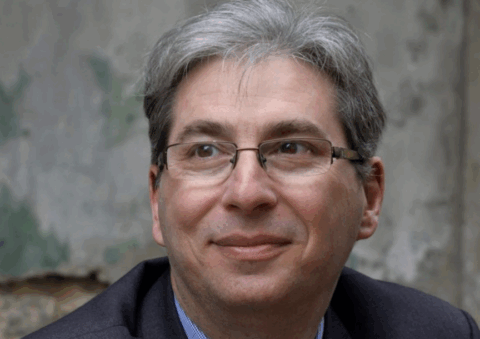
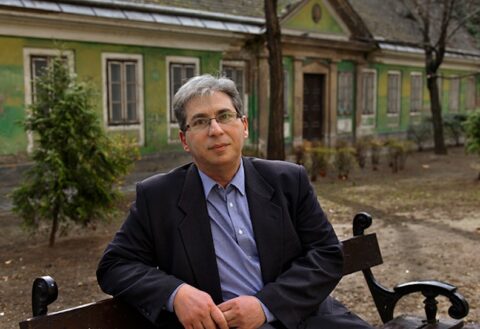
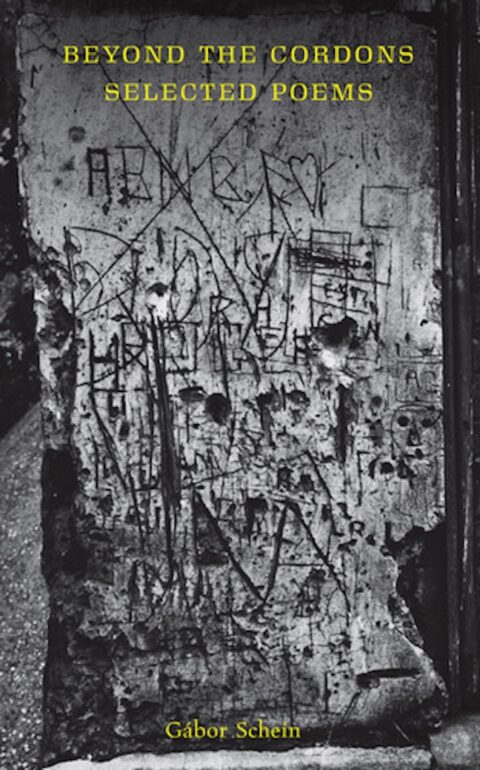 The City as Palimpsest could also be an apt, alternative title for Beyond the Cordons: Selected Poems, the first poetry volume available in English by Gábor Schein, translated from Hungarian by Ottilie Mulzet and Erika Mihálycsa. Schein is one of Hungary’s most acclaimed writers, and the author of over two dozen works of fiction, poetry, children’s literature, and scholarship; Beyond the Cordons follows three of his novels already available in English, The Book of Mordechai, Lazarus, and Autobiographies of an Angel, the last two also in translations by Mulzet.
The urban palimpsest of post-Soviet Budapest shapes Schein’s work, from the opening, title poem of Beyond the Cordons, which presents a contested city in the aftermath of political demonstrations: “If the burnt-out car wrecks / and ripped-up cobblestones had been removed, still the missing pavement / let no one forget: the city center was a zone of uncertainty.” For Schein, the ruptures in the city’s material environment, like that “missing pavement,” persist as a kind of present absence; the lacunae created by the violence of the past remain, and their silence is a testament, regardless of the attempts to clean up after them, or to build something new.
The image of an urban palimpest is a political claim about the tenacity of memory even within a regime that would recreate the past in its own image, like Orbán’s in Hungary, or like the Party’s in 1984. It is also an architectural claim about the physical make-up of a city, where urban renewal always preserves, even unwittingly, traces of the past. But even more, it is a statement about human consciousness, and the human body itself. Schein is a poet for whom the political, the architectural, and the personal cannot be distinguished, but instead co-create each other, interdependently. In an interview, he explains:
“I cannot separate the outside from the inside. The body, the psychic life, is a political formation, just as political power is produced by the subjects. The most accurate way to talk about this relationship is to look at how we live in a city. The city, the streets and their history, the way the houses look, the faces of other people, the language we use in this city — all this is both a psychic and an objective reality, which is constantly changing its meaning and producing meanings.”
 Much of Beyond the Cordons can be read as a lyric enactment of these ideas. “Private and political pathologies overlap,” he writes in “Eyes Turned Inside Out.” (Note, beyond this line’s programmatic statement, the compelling translation: The repeated p consonants form a halting, incendiary music, carried within the poem by a percussive and unstable meter, that together express themes of personal and political disruption within the endless instability of history. This poem was translated by Mihálycsa, but its attentive, sonic skillfulness is characteristic of both her and Mulzet’s translations throughout the volume.)
The seven page poem “Summer Rain, Transparent Borders” locates the inseparability of inner and outer experience both within and at the porous edges of the human body. It begins:
Skin — the blood vessel’s wall — is translucent.
The borders within are invisible, just as they are without,
in that city of genial incongruity. That is why
you are an eternal violator of borders. You would build the city
outward from within …
Because of Schein’s commitment to borderlessness, later lines like “Nothing exists, only what is within the body,” are not the statements of solipsism they might be in the hands of lesser writers, but instead become expressions of a vast, destabilizing, and fertile expansiveness.
The capacious, haunted nature of the body, which echoes and is echoed by the palimpsestic nature of the world it inhabits, finds its clearest expression in Schein’s poems of elegy, grief, and illness. Consider “Pebble,” quoted here in its entirety:
All you who came to visit me,
who sat next to my bed,
or walked with me in the hospital garden
until I got too tired, and with cautious fear
in your eyes, told me to be strong,
that you have need of me,
to all of you, who were silenced by the news,
but you were thinking about me,
you were thinking of your friend,
and to you, my Lord, to whom
I have not been able to speak for so long, before my eyes
I lost the places of your refuge,
all of you should know,
that the course of days and nights
spent in various sick wards
amid breath’s convulsions,
in pain, exhausted, broken,
that I spent in the nearness of death,
were beautiful, beautiful, beautiful:
as if I were clinging to the wall
of a forgotten temple,
and in pain, exhausted, broken
I was submerged in a light with no flame,
but do not ask me what was there,
there was nothing I could show to you,
nothing worth more than a pebble
you have tossed into a lake,
I only know that after I arose,
as slowly my strength returned,
and I could move in the commotion of the days,
for a long time I wished again for the illness,
fearing that I had lost its gifts,
a lack remained for which there are no words.
As with the violence inflicted by authoritarian and war-mongering states on Hungary’s cities and communities, so too with the violence inflicted by illness on Schein’s body: The pain of the past is never totally erased, but persists into the future it is always shaping, and becomes an essential part of that future’s meaning-making possibilities. “The city is built by oblivion,” Schein writes elsewhere, just as the human experience of embodiment becomes more profound, and more real, through its vulnerable proximity to death.
The second-person address in “Pebble,” delivered simultaneously to the poet’s present and absent community members, to God, and to the reader, also exemplifies a relentless, relational yearning that animates Schein’s poetics. “I think poetry is always a dialogue with something that transcends us,” he says in an interview. “With life, with death, with the other person, with the human totality of the world, with God, whether he is present or not.”
 This desire for intimacy with a transcendence that may or may not be accessible thrums in every page of Beyond the Cordons, and the act of writing is that desire’s vehicle: “Your spaceship is a piece of blank paper … You can only escape upwards.” This yearning for ascendant transcendence becomes a physical experience for Schein’s readers too, through the structure of the book itself, which is printed in a landscape format. This allows Schein’s long lines to have the spaciousness they need, without being cut off, but it also means that reading this book requires turning its pages from below to above, a movement that mirrors the direction of Schein’s longing. As he writes in “Love, Sail, Time,” “Everything that can — ascends to the sky.”
Beyond the Cordons is a remarkable collection, and it demonstrates that Schein deserves many more English translations of his prolific work. But the absence of any notes, comments, or contextualizing guideposts by Schein’s translators or editors is a missed opportunity, and will leave English readers who are new to his poetry with questions that could easily have been answered.
The back cover mentions that these poems come from Schein’s “poetic work over the past twenty-five years, but particularly drawing on his seminal connections Night, Travel … and Greetings from the Interior of the Continent, both of which serve as poetic time capsules of the decades following Hungary’s ‘regime change’ of 1989.” But nothing in Beyond the Cordons indicates which poems were drawn from which volume, as is the convention in “selected poems” collections, or even whether this book is arranged chronologically or in some other order. A brief note explaining the principles that guided the selection process would have been helpful; it is hard to appreciate Schein’s writing as “a poetic time capsule” without information about when each of these poems was originally published, or about their historical and literary references that would be apparent to Hungarian readers.
This contextlessness creates a reading experience that occasionally feels frustratingly hermetic, but it also has the effect of focusing the reader’s total attention on the exceptional beauty and power of Schein’s language, beyond any concern for its political or linguistic setting. Perhaps, then, the absence of notes or background markers in Beyond the Cordons can be seen as another absence constituting the palimpsest Schein’s poetry enacts and explores. These poems are, after all, concerned with the ways that lacunae serve not as simple voids, but as invitations into deeper meaning. Schein’s poems insist that what is absent from a book, from a city, from a body, and from a life can have a paradoxical and vital presence. Through careful attention to the gaps in the present, even an irrecoverable past can become a life-affirming resource for the future.
[Published by Contra Mundum Press on December 20, 2024, 188 pages. $21.00 paperback]