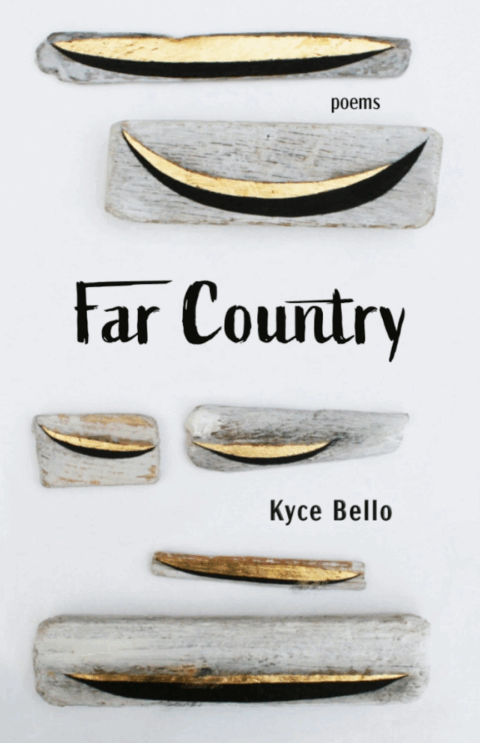
 I’m up early, before the children wake, on another day of horrifying news that I know my mind will struggle to comprehend, reading Kyce Bello’s Far Country.
“In all of this there is room for grief– / the forest we know becomes the forest we have never seen before,” Bello writes, and my clenched muscles relax a little, with the relief of knowing that someone else is here with me, someone else sees this time, too. Bello does not offer us tidy answers, but these poems do offer to stay beside us in the questions. The poet Evie Shockley said, at a recent event, that poetry is not only about telling the truth, it is also sustenance, and Bello’s Far Country offers readers both.
Far Country is poetry as incantation, bringing the world into being while also naming what is here already, poetry that asks, as Bello’s speaker does, “How do we write new myths?” Each word is laid down as carefully and snugly as seeds into a furrow, often using incantation-like anaphora, as Bello does in this section from the titular poem “Far Country”:
First apricots fattening. First nettle soup to tonic the blood.
First warbler in the apricot tree, first yellow wing. First time
I told you I loved you.
First word spoken in the morning. First light on the mountain.
The land in Far Country is as alive as the human speaker, as embodied and empowered. These are poems inextricably of the American West, but they invite all of us into that space, into both the actual West and our imaginations of it:
Meadow grass ripples
as if it were a pelt we could run
our hands through … (from “Far Country”)
Far Country is a gathering place, a confluence between humans, between human and more-than-human, between land and those who live on the land. It is a gathering of times, also, as multiple timelines thread together with their simultaneous possibilities, with both speaker, her children, and the more-than-human going forth into “every possible fate.”
If this happened to us or long ago
or is someday going to happen,
I cannot say. (from “Far Country”)
Some of the many tools Bello uses to create this multiplicity of time are the repetition of images (desert, river, drought, keys, birds, herbs, maps), actions (walking, cooking, singing, gathering), and also repetition of poem titles, as in the many poems in the collection which share the title, “Walk in the Nambé Badlands.” The questions the speaker asks are the questions many of us are asking, her uncertainties are our uncertainties, and it is a balm to hear them called out, as in the poem “The Bend”:
Consider the bends in the mountain road
we traveled to reach here, the elderberry thicket
hiding spring-water seeps, or those voices heeded
since childhood with their insistent whisper: carry on.
Carrying being by no means the smallest part
of what we are asked to do with our despair.
I don’t know what to do about hope. I don’t wager
with longing, nor miracles. I am mostly afraid.
I’d rather not watch the forest give way. I like
who I am and who I am loves these mountains
as they are—dense with mortal pine and spruce.
Women gather around a bonfire and the eldest
asks how do we survive this? Sparks fly and ash
falls on our heads. Consider the midrash
about how when Pharaoh decreed their firstborn
sons die, the Hebrew men panicked. They divorced
their wives, turned celibate, did anything to evade
the loss of their unborn. Consider that the Hebrew women
answered Pharaoh’s threat and their husband’s fear
by carrying spicy soup to the fields, anointing their
men in oil, luring them behind bushes. I don’t think
it was hope that their sons would survive that led them
to seduction, but unyielding obedience to life.
I have abandoned logic before and will do so again.
Consider the bend. I never see it coming.
 Many of Bello’s poems employ both the subject pronoun drop (such as the lines “because lilacs, because willows”) and the conditional tense (“if this happened to us…,”), both moving choices for a collection that returns relentlessly to what is visible versus invisible and what might be. Again and again, Bello’s imagery is lush and startling, stitching us into the moments of these poems, as in “Repurposing”:
At least we have radishes to sliver into moons and lay,
burning, on the tongue. The last words I spoke
were slurred the way lace meshes fabric into dainty
but unbreakable bolts of cloth.
Bello not only employs questions and uncertainty with skill, she also uses humor in these poems, as the speaker moves into an unknown future, struggling to mother her growing children while they struggle to shed her like an exoskeleton. In “Because Envy Leads Us Where We Need to Go,” she writes:
When the road splits
I always go right. I don’t envy those who turn
left. Nobody down that way plays the fiddle.
Nobody there makes pie worth a damn.
Far Country ends, as we might expect, without any certain resolution but not without solace. We want, like the speaker, to keep going, hopefully in the direction with the good damn pies. The final poem is one of the many poems sharing the title, “Walk in the Nambé Badlands,” and the speaker once again is walking, carrying keys that may or not be actual keys, living in another drought but giving birth to something new and alive.
[Published by University of Nevada Press on March 4, 2025. 76 pages, paperback $18.00]