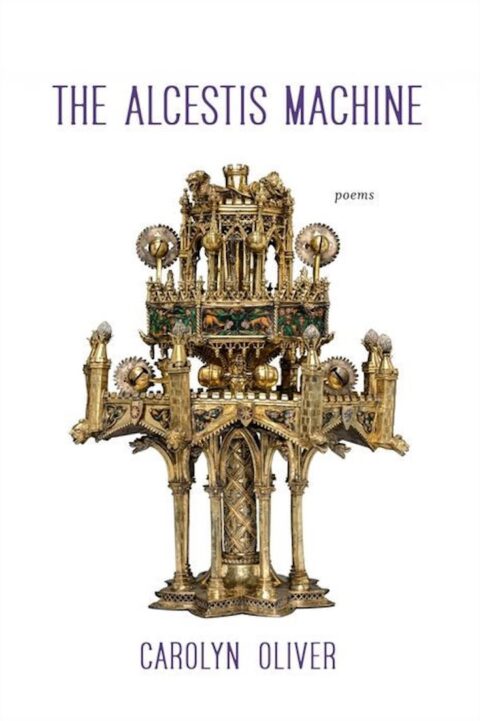
Carolyn Oliver’s poetry is a wunderkammer, a packed cabinet of natural treasures and intricate puzzlements. No contemporary poet is more likely to send me scuttling to the dictionary to define words like “lenticel” or “aurielate.” Hers is a poetry of plenty in both scope and detail, reminiscent in some ways of Erika Meitner’s or Martha Silano’s bursting imagery. Like theirs, Oliver’s is a poetry of things, of objects lovingly rendered, but in a tone more restrained. Less exuberant, though no less attached. Oliver hovers over her poems with the eye of a collector who fuses object and memory but must reckon again and again with the distance between them. In Oliver’s newest collection, The Alcestis Machine, such distances grow to nearly impassable lengths. Poems strive to cross the dark reaches of empty space, or — as the title poem later references — into the land of the dead itself. The venture may be futile (outside of myth, who can meet the dead again?), but the questing is love manifest.
 The opening poem, “Blueshift,” introduces uncertainties of matter and space, past and present, closeness and distance, that will echo through the collection, establishing not only themes but the role of contrast — always an acknowledgment of separation — in framing the work. “In another life,” they begin, “I’m a cosmologist,” a student of space and time, but not a master of it. Space and time consume the speaker because they are the forces that have separated her from a beloved. By mastering them, she imagines returning to that loved figure. Driven by desire for closeness, the speaker feels through hypothetical woulds, the possibility of “braiding your ghostly hair,” or a flower “pressed … between our palms,” but by the end of the poem, acknowledges “Between us // space expands.”
Unbowed to the poem’s truth, the speaker embarks on a journey to cross that space, inhabiting a multiverse of “other [lives]” with a protean shapeshifting that explores landscapes and timescapes from the futuristic reaches of outer space to a swineherd’s woods. In “Space Age,” a “machine for gleaning the sound of light / from deep space trash” replaces the cosmologist. What image could be lonelier? I picture Wall-E, sweeps and searches seeking some connection, some ductile anchor in the endless night. Or Matt Damon’s Martian, alone with his switchboard, though his human heart cannot proceed as tirelessly as the robot-translator, who endures despite the lab’s admonition:
any love song cut loose from the void
you should only interpret as debris
not the sign
of some arrival:
In “Spirit Level,” Oliver’s preoccupation with manifold varieties of distance coalesces in the thwarted longing of a lamplighter for a bridge-builder. As with many of the “another life” poems, there’s a suggestion of fantasy in the setting and situation:
In another life I’m a lamplighter, silhouette reader, watchword giver
bound soon for my rest,
and you’re the bridge-builder new in town, hitching hired horses to the dray
while I unharness the light.
This opening stanza places the potential lovers on opposite sides of the day, as if they cannot move within each other’s spheres. Oliver’s quatrains reinforce the thematic disjunction: first and third lines sprawl nearly to the right margin before dangling short lines beneath, like broken couplets that cannot be harnessed together.
 The lamplighter frets that her presentiments will seem like [b]abble … to you, you of the working day’s domain.” She speaks “askew … learned to veer and spar from fire” (deadly to the carpenter’s trade), but regarding the bridge-builder, wonders “on a profile straight as yours / where could whimsy roost?” The poem’s contrasts encompass time, space, and temperament, even direction: the bridgebuilder works horizontally to cross spaces while the lamplighter climbs towards the sky on her ladder. Even as she enumerates these restrictions, the speaker fears her desire, remembers another woman who “wanted doubly /…// and then sure as a storm she wracked our ferryman.” To cross these divides is a disaster. The poem closes imagining towards connection and then retreating, refusing to share the evening watchword, returning to the shift change of the light, when the bridge builder ‘unhitch[es] the tired horses,” and the lamplighter “set[s] out the harness the light.” A gloaming moment of potential connection, unmet.
No matter the form assumed after the refrain “In another life,” Oliver’s speakers persist in moving toward, collecting stars or “holding vigil over the Magna Carta’s blue felt dosimeter.” These multiple selves oppose the inertia many of the poems claim: that “[w]hen you go, nothing real / will change.” Change or stasis? The collection asks, but the poems fracture from that binary when the choice is pulled by time and by space: Distance must change to become closeness; the intimacy produced by change moves forward in time, pushing the past ever further. Or: To lock time by passing it from one to another, as the Alcestis Machine would allow, means surrendering to a new distance.
Chorus
BASS: Should you afterward find your child gravely ill, or your mother, or your
dearest friend, you may not return
BARITONE: in time. Should you afterward find your lover gone to some other,
you may beg for your day back, but you will
TENOR: never receive it.
In Oliver’s handling, Alcestis, who in Greek mythology volunteered to take her husband’s place in the land of the dead, is rendered as a machine offering such possibilities. The chorus’ warning, rising in voice, breaks on the time and distance that consume the collection. The chorus warns not that return is impossible, but that users of the machine cannot “return / / … in time,” playing on the colloquial idea that their return will be too late while, in the collection’s framing, also suggesting that those who enter the machine become fundamentally outside of time, thereby distanced from it, unable to “receive” or hold it close again.
Alcestis endures as Greek image of the perfect wife, her love embodied in her sacrifice. She abdicates her time, accepts distance from the living world. The speaker, finally, refuses such terms, refuses choosing, refuses completion. The poem ends “Let’s get out of the cellar. / Let’s go feel the heat of the sun.” After many references to the cold light of stars, this contrasting image of the sun appears. Distant as it is, we can feel it, warmth right there on our skin. Rather than resolving the conflicting binaries, we must accept them, a possibility the poems move towards as they build into impossible images like “a lake of fields” that becomes “a perfect balance of repulsion and attraction.”
Balance is not stasis — it is the harnessing of change to hold on. Through the poems’ other lives, the speaker calls over and over to a lost beloved, seeking a perfect formulation that will return the beloved in space and in time. Although that quest can never be successful, the poems are a document about searching. The speaker cannot return to intimacy with the beloved by eclipsing time and space, but the record of the attempt serves as a testament to her feeling, and allows for an unexpected acceptance. In the final poem, the speaker acknowledges silences, unspoken histories, as fundamental to love, “holes in our stories” imagined as the lace “moths … make from their hunger.” In Carolyn Oliver’s luminous and journeying new collection, closeness is not the only connection. Form contains emptiness. Love encloses absence.
[Published by Acre Books on October 15, 2024, 76 pages, $17.00US paperback]