In both Hinduism and Buddhism, the Sanskrit word Avidyā refers to a concept often translated as “ignorance,” or “misunderstanding,” or “delusion.” In this compelling, piercing collection, Vidyan Ravinthiran reflects on what ignorance gives rise to and how it persists, through the Sri Lankan civil war that began in 1983 and ended 2009. One of the book’s first poems opens by describing how “demons” — perhaps supernatural beings, perhaps anyone sufficiently deluded, defensive, angry, or resentful — have a “dilemma”:
as well as feeling all they hear
is either poison or their own
original thought,
otherness is something
they’ll never get their heads around
Demons live in a world where “since they wish to eat people,” they assume “those same people would eat them.” Although the fable that follows is, like most fables, not historically specific, the pressure of the actual world breaks through in one quick figure of speech: “before / you could say, ‘the events of Black July, 1983.’” It is the poem’s only reference to mass violence against Tamil civilians. The poem ends with a husband and wife outwitting the demons gathered outside their house: “So the mob fled, / leaving that Tamil home unlooted and unburned.” In those final words, a very recent, concrete reality rears into the folk story.
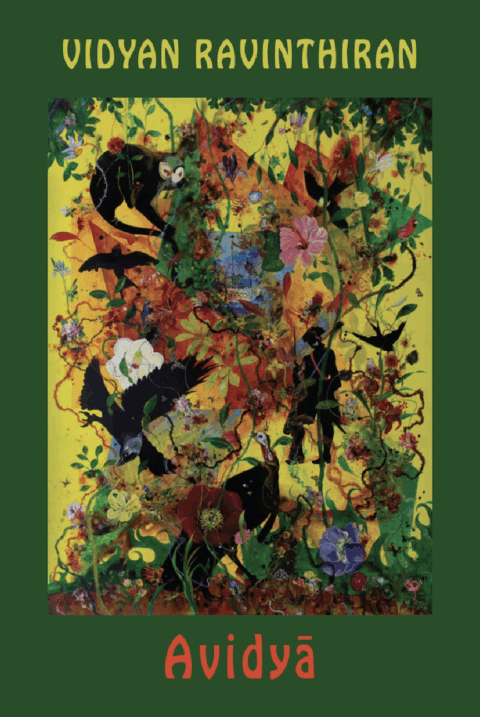 Avidyā is almost constantly mindful of that reality, which flares up brutally and eerily. “Schoolgirls in white blouses and with long, blue-black braids / stream down the road alive, / once,” one poem opens, so that what first seems a picturesque image in the present day undercuts itself repeatedly: “alive”? “once”? Now coming down that road is a soldier “fancying himself / an action hero walking in slow-motion / away from a coolly disregarded explosion”: Sri Lanka remains a place with a constant, outsized military presence.
One of the most arresting poems has a title that is simply a name: “Lasantha Wickrematunge.” Not to or for Wickrematunge, a journalist murdered in 2009. Wickrematunge speaks throughout the poem, mostly in lines written by Ravinthiran, but also through paragraphs of extensive quotation, from two of Wickrematunge’s own columns. One he wrote to be published in the event of his murder. The other is famous for its negatives. [The ‘Tigers’ are the militant Tamil separatist group.]:
Heavy fighting was not raging in northern Jaffna peninsula and Tigers
were not pounding Palaly with heavy artillery and mortars for the
fourth consecutive day.
Tigers did not enter Kaithady on Wednesday night after 12 hours of
so-called fierce hand-to-hand fighting in which more than 40 soldiers
were not killed and scores not wounded.
Technically, those negatives meant that Wickrematunge was not reporting war news. Accordingly, he skipped the mandatory process of sending such reports to the censor, and published the not-report of the military debacle in his newspaper, The Sunday Leader. (Within a few days, the government shut the paper down; Wickrematunge sued, and the court declared the ban had no legal validity.)
Wickrematunge’s defiance and inventiveness pervade this poem. There are moments of colloquial audaciousness [TID is the Terrorism Investigation Division]—
The TID comes for you in a white van,
the poet with his white space; a blockhead
8000 miles from my bloodshed!
Look up what I really said.
Consider that Keats poem
there is no evidence
I ever read […]
— accentuated by how Ravinthiran pushes together multiple sources and voices. There is Wickrematunge’s not-filled article, and the article in which an assassinated man addresses his readership one last time. Ravinthiran also has his speaker allude to Keats’s “Isabella, or the Pot of Basil” (another poem with a proleptically “murder’d man”) and to the last words of Miguel Serveto: “I will burn, but this is a mere event; / we shall continue our discussion in eternity.” The allusions’ points of contact emit sparks: what does it mean for one’s words to outlast one? and what does it mean to put words into the mouth of someone who did not actually say or write them?
The extracts from Wickrematunge’s prose are pushed to the right-hand margin and right-aligned, so that while lineated, they seem a hybrid between the unplannedness of white space in prose and the calculated linebreaks of poetry. Here are the last two verse paragraphs:
I want my murderer to know that I am not a coward like he is,
hiding behind human shields while condemning thousands of
innocents to death. What am I among so many? It has long
been written that my life would be taken, and by whom.
Those are my words:
this
is something else—
This ending has stayed with me because of its entangling of honesty, the illusion of honesty, and necessary artifice. “I want my murderer to know” was written by the actual journalist; the short lines that end the poem, broken off with a dash, were not. The tone of this ending is difficult to describe; it is not glib in the way that breaking the fourth wall can be. It is closer to a moment of uneasy suspension, of words visibly frozen in time.
*
The directness most audible in “Lasantha Wickrematunge” (“So you’ve never heard of me” is how the poem opens) occurs throughout Avidyā, often to semi-comic effect. For example, the first line of “Pillaiyar” is simply “that’s Ganesh to you,” “you” being people who don’t know Tamil. Elsewhere are sudden directives: “you too / should read Tamara Fernando’s essay / on the pearl-fisheries of Mannar.” Frequently there are asides, slang, and interjections: my favorite is the odd little “mind you don’t trip” to no one in particular as the speaker and his mother leave the house of a family friend in Trincomalee. And there are casual, semi-flippant, yet loaded parentheses:
(Unless I tell you otherwise
I am always tearing with my nail
at the skin of my keratinised thumb, leaving
panels of woebegone cerise.)
Tension and playfulness run together in such moments. So too in “As a,” the first poem of Avidyā. It is one sentence and barely a dozen words long, even including that pointedly unrevealing title. It presses at both the expectations elicited by poetic form and the expectations imposed on minority poetry:
As a
Sri
Lankan
Tamil
I feel strongly
about
three o’clock in the afternoon
Ravinthiran withholds the noun phrase from the title, then gives each of its words (“Sri / Lankan / Tamil”) the weight of a whole line. He puts even more space — a stanza break — before the “I.” And another stanza break invites readers to consider all the possible things (geopolitical, historical, cultural, linguistic) about which “a // Sri / Lankan / Tamil” might “feel strongly.”
 The speaker of this book will “feel strongly” about many present-day and recent events, but here my best guess — as a reader from the boondocks of the US — is that three o’clock is a time of day when not much is happening. The workday has become a slog but is almost over; it has been hours since lunch and will be hours until dinner. “As a” is a reflection on how lineation can turn a casual remark — a note about plums in an icebox, one’s opinions about the mid-afternoon — into a joke and more than a joke. This poem also seems to say I’ll tell you about myself, as you expect, but on my terms, and you might not get it.
“It wants you / to understand. Then it plays hide and seek,” Ravinthiran asserts of “all writing, everywhere”; but that fluctuation between revealing and concealing is especially striking at moments in Avidya. In “Leaving Jaffna,” the poem’s “you” — the pronoun that both avoids an I and pulls the reader in — sits on a bluntly functional, immovable “concrete block / at a table of concrete.” It is the “place war widows run, / depending on no one,” and it is an occasion for a list of foods, which end the poem:
paruppu, rice, bangles
of cuttlefish
afloat in bronze
கறி
—wild chicken,
more bone than meat.
A lentil dish, rice, then cuttlefish turned extravagantly and sumptuously into “bangles.” They are in something “bronze”: transliterated, it is kari, or curry. The use of the Tamil script dramatizes a faintly wry avoidance of a word still used, in the UK and US, to signal South Asia.
That meal, with its jewelry and metals, is a good example of the flashes of description that run throughout Avidyā. Ravinthiran’s descriptions are a delight — a baby’s hand is “a tiny moist starfish.” One unforgettable metaphor is in “The Star of India,” a poem about the massive sapphire mined in the “teardrop / island” of Sri Lanka. Here the misty, unfaceted stone is given an apostrophe that is wondrous, ludicrous, and tender, at once: “O / blue-gray cabochon // the colour of my dead / grandmother’s cataract!”
Ravinthiran does describes the feel of places, memorably: the tank bulkheads “drooping apart in slices like carved meat” in northern Sri Lanka have stayed with me, as has the iced-over snow that “gleams evilly, like polystyrene” in eastern Massachusetts. But Ravinthiran also captures the strangeness of having ties to a country with an erased, confused, or vanished history. It is a country one can now visit, but it remains full of “swaggering” soldiers, and it “delete[s] graveyards.” It is a country whose colonizers tended to lump it together with India, and it is a country whose gems are still held by museums in the US and Europe. The Star of India is at the American Museum of Natural History, as the poem indirectly notes.
Attention to what is obscured or ignored, and attention to the work of poetic language, come together in “May 2021,” which documents environmental castastrophe. “It won’t go viral,” Ravinthiran begins, before describing how “for a week / the X-Press Pearl’s fumed slow / volcanic billows / — charcoal over blue-green.” The container ship contained 25 tons of nitric acid when it caught fire off the coast near Colombo, on 20 May 2021. In one of his surprising, sudden flares into rhyme, Ravinthiran declares that the 25 tons of acid — unlike the 25 crew members flown out —“can never be extracted from the sea and its coral // it isn’t moral.” It isn’t moral is literally the poem’s central line, and is given its own one-line stanza: there is something movingly insufficient about that small sentence. Its anger — at a disaster that most people never heard of, at the knowledge of such disasters continuing to happen — is enclosed in the middle of a poem, in the middle of a book of poems.
After the turquoise “billows” and the blunt facts of the ship’s sinking, Ravinthiran pushes the beauty of stars against equally innumerable plastic granules: the oceans will remain “infested / with galaxies / of nurdles” far into the future. That telescoping of scales and timescales continues in the poem’s last four lines:
here and now
lesioned turtles
blaze on the beach
next to a fish with plastic dentures
The world has become a place where we cannot tell if the fish is itself plastic or has choked on plastic, where “charcoal over blue-green” is nitric acid pulsing through the ocean, where “galaxies” are microplastics. The extent of damage is hard to conceive: The X-Press Pearl — its name combining a gemstone made over years and an advertisement for cheap, quick production — was on fire for little over “a week,” yet affects the environment both “for centuries” and “here and now.”
Ravinthiran is willing to use words like nurdles, but also digs up rare words: orts, phthalo, spalled, piffling. The poem entitled “My mother’s English” consists of about three dozen descriptors, from “rivering, glitch-thronged” through to “narrowcasting, plethoric, spry, oysterish, unalleviated, pardonable, spicy,” to “upended, bullied, marginal, bellied, managerial, belayed, belied, believed, beloved.” This poet finds words like the wonderful “glitch-thronged” and “oysterish,” knows to balance “marginal” and “managerial,” and risks ending on that risky adjective “beloved.”
The book’s final poem is also about English. It recalls how the speaker was made to practice talking in front of a mirror —”a murky glass word,” arrestingly —until he acquired a “clarified and potent tongue.” As the poem’s second and last stanza explains, the practice has been useful in two ways. When asked by a US Customs guard if he were “a terrorist,” the speaker had his “borrowed posh” to “abash[] that poor colonial.” And the same practice in front of a mirror has made him into
a scrutineer of sound,
a listener for and into every glitch
in the aathma, the script, the avid void of English.
[Published by Bloodaxe Books on July 8, 2025, 72 pages, £12.00/$17.95US paperback]