At the Readings in Contemporary Poetry Series in 2018, Emily Skillings introduced her poem “The Duke’s Forest” (the first draft of which she was reading and told the audience that it was “not there yet”) in part: “I had been talking with my friend about what was, like, the worst first line for a poem. And he offered up: ‘I love nature.’ And I was like, and I was like, ‘That’s a great first line!’” These charming, off the cuff remarks, are now signposts for Skillings’s second full-length collection, Tantrums in Air.
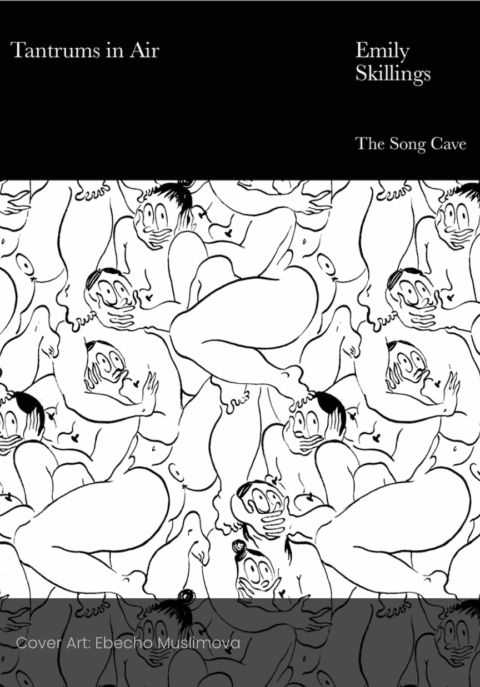 Skillings does love nature. Actually, “love” isn’t the right word. The poems in Tantrums in Air feature some evocative imagery of the natural world, but Skillings is more interested in exploring the complicated nature of the self, something she began in her first collection, Fort Not. In the self-titled poem from that book, Skillings’s writes: “I’m not really that kind / of smart. Sometimes I can hardly.” The first two lines of the first poem in Tantrums in Air, “Rose-Crowned Night Girl,” reads: “I am pointless. This I come to know / by pressing ear to night’s machinery.” I don’t think it’s a stretch to say most people have or will experience a moment (or several) where they feel small in comparison to the world at large, but still part of the puzzle. Skillings’s speaker doesn’t feel that – she feels the opposite, disconnected. “Somewhere there is a hole / waiting for you.”
Her occupation as a teacher appears intermittently throughout the book, but is most prominent in the second poem, “Prelude: A Lump of Pure Sound”:
[…] I began to teach, as one does. When I taught poetry I could get caught at any moment. I didn’t know anything. […] My students email me asking for things because I seem nice. They do not know I am bad. I say, “Yes of course.” When it comes to their poems I want to say, “Just do whatever you want.” […]
This poem could be titled “Imposter Syndrome.” “Could I be stupid?” is repeated over the course of the poem’s three and a quarter pages and ends: “See, that was such a stupid thing to have written.” While this statement could elicit a groan, it’s hard not to empathize, especially as the poems accumulate and more of the world fills in. And it is an absurd world. In “The Bee Eater and the Chamomile” the speaker laments, in part:
Said something about how I didn’t like
That I can choose any painting
From any major museum
Or historical period
And if the resolution is high enough
Can have it printed onto a pair
Of XL booty shorts
And they’ll arrive at my house in 3-5 days
The humor here is apparent, but there’s more than just a chuckle between the lines. What does Caspar David Friedrich’s Wanderer above the Sea of Fog mean when it’s viewed on someone’s ass? This diminishing translates to the speaker’s views on her own writing. “Gargouillade” is the speaker’s lowest point in this regard:
If, as I suspect, all language has died
for me, at least for the time being, then I’ll trot
out the little reeking phonemes,
the dancing spines, the disremembered—
and I promise I will not try. Someone smells amazing
at the weird art party
where I am asked to read poetry
to looping electronic music.
I want to be a poet entirely
of a different kind. Later I discover
the scent is coming from the scrawny potted jasmine
blooming in the corner, dropping her
syrup on the floor. It’s nice to meet a fellow
whore in the world.
Again, an inward focus pushes the reader, and other writers, away. “[L]anguage had died,” not for everyone, just the speaker. She’s “asked to read poetry / to looping electronic music,” but doesn’t want to be “that type” of poet: a New York stereotype of a poet? Feeling more dejection, the speaker compares herself to a “scrawny potted jasmine” at the party, concluding that she and the plant are both whores. Maybe unsurprisingly, this lack of fulfillment culminates in the ultimate expression of “pointlessness” in “A Draped Urn” where she admits:
I am jealous of the dead
and need only the slightest nudge
in order to join them
in the lushness
of their garden. […]
 Tantrums in Air is not a book-length poem, but there’s one speaker throughout 99% of it. The consistency of voice and concerns makes it multiple perspectives unlikely. Where “A Draped Urn” appears, near the end of the book, it makes sense then that, depressed from the very first line, this speaker would feel the way she does. The novice reader might be tempted to read this as strictly confessional poetry: there is a lot of grief, a lot of personal “I,” but that’s a dangerous proposition. The “tyranny of genre” is one that Skillings resists. If this is the new confessional poetry, it’s one that’s evolved from the sometimes-maligned movement of the 1950s and ‘60s. Indeed, the last poem, “A Room in Dumb Bitchville,” defuses the sour taste of inner turmoil and invites the reader to stop being a spectator and share troubles and joys of their own.
The lack of action on the reader’s part is the first thing that changes. To read “A Room in Dumb Bitchville” (what a title!), one has to turn the book horizontally, as the decision was made to keep the long couplets of the poem intact. As a literal “turning something on its head,” this suggests a change, something radical. If “Rose-Crowned Night Girl” prepares the reader for a portrait of depression, “A Room in Dumb Bitchville” is the best possible resolution: the speaker has made it through. Not only that, the speaker actively seeks community and makes an argument for kindness:
Hello. Can you hear me? If not me, do you hear the notifications sweetly intoning?
This is where I come when I’m sad or even confused. Come in. I keep adjusting the layout,
[…]
I can’t really fix anything, but I feel all this pressure to save everyone. To be of use.
My friends, they are coming apart at the seams. Not my problem, you say?
That’s where you’re wrong. What if tomorrow everyone said of other people’s problems
“Not my problem!” What kind of world would that be? […]
In stark contrast to the first poem where no one is addressed, here “you,” the reader, is invited to listen. The speaker sends a signal. She comes to poetry when “sad or confused” as others might to favorite TV shows and the reader is invited to come in, to share space and commiserate. The speaker wants to be a good friend, “[t]o be of use,” even though she “can’t really fix anything.” Don’t we all? The self-doubt that rears its head throughout Tantrums in Air is here, too, but in this dramatic turn from “Rose-Crowned Night Girl,” our speaker looks outward, to us. Her plea to give a damn especially pertinent in 2025.
At the heart of Tantrums in Air is a simple message: existence as a human being is complicated. The world can make one feel less than one, but that’s just a stop along the way (maybe there are multiple visits, but it’s still only a single stop). This collection begins with feeling “pointless,” but that’s not where it ends. In real time we read Skillings’s speaker thinking through her personal and professional concerns, laugh with her, get frustrated with her, and ultimately, feel empathy with her. What kind of world would it be without poets like Skillings? I don’t want to know.
[Published by The Song Cave on June 24, 2025, 96 pages, $18.95 paperback]