Don’t Stop is about Ina, a 41-year-old literary scholar who finds herself questioning everything in the aftermath of an impulsive kiss with a stranger — though I question that impulsivity.
It’s clear from the start that Ina is dissatisfied. On the brink of professional success, she works as a visiting assistant professor at a university that is keen on her scholarship and has promised a more permanent role if she publishes a book. Her manuscript would present a new body of research on language in Eugene O’Neill’s mid-career plays — but she is struggling to write it. She is also distracted by her faltering marriage and her sense that Simon, her husband, no longer desires her. Throughout the narrative, Ina dismisses Simon, pitying him as he struggles to lose weight, often regarding him as childish. At one point, when Simon tries to comply with her request to kiss her with passion, she marvels at his emphatic attempt, comparing it to “a child’s messy, heartfelt gift to its mother.” His lack of career success, as he teeters between a love of acting and the stability of corporate employment, reminds her that she pursued academia relatively late and that she is still chasing a level of success that others have already achieved. The threat of motherhood also lurks; children feel increasingly illusive as she prioritizes her career and dwells on the lukewarm sex of her marriage, all the while remembering how depressed her mother had been while raising her. The kiss is a taste of another reality.
Jack, the stranger-turned-fling, embodies a masculinity that Simon lacks. Although Jack is also emerging as a composer working on the score for a new Broadway musical, his commitment to art seems youthful and unencumbered. Ina is aware of his flaws, simultaneously perturbed and fascinated by his frank misogyny, and the way he quips that “women who cut their hair short usually do it because they dislike men,” more intrigued than appalled by his penchant for voyeurism or curiosity about necrophilia. That Jack desires her and thinks about her when she is away is enough for Ina to recapture a feeling of renewed youthfulness.
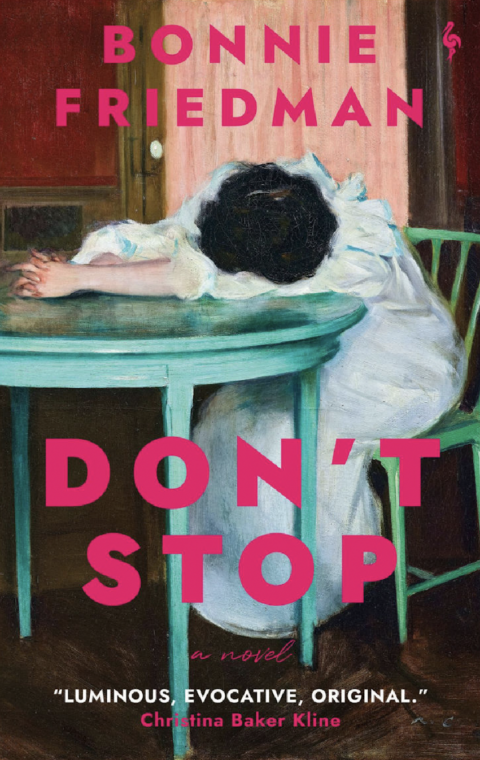 Don’t Stop is Bonnie Friedman’s first novel, but a cursory look at her previous writing, a scattering of essays alongside three books of nonfiction — Writing Past Dark: Envy, Fear, Distraction, and Other Dilemmas in the Writer’s Life; The Thief of Happiness: The Story of an Extraordinary Psychotherapy; and Surrendering Oz — make clear that her novel is a continuation of themes explored in her memoirs. Friedman is preoccupied with the ways we act against our interests in what she described in a Lithub essay as “emotional masochism.” She is drawn towards self-analysis and seems as fascinated by the passing of time as she is perplexed by the way that our childhood selves coexist with our present selves. Certain characters, images, and themes return: a stifling yet voluptuous older sister, a depressed mother, a complicated therapist relationship, a fixation on Eugene O’Neill, a marriage that is somehow lacking.
I sensed a whiff of predictability from the start — there are only two outcomes for an unhappy marriage, and one feels more likely than the other. But Friedman carries the reader along, allowing Ina her reckoning while still sustaining hope. Ina muses towards the novel’s end:
“Athenians entered the theater knowing Oedipus’s fate. They were gods seated on a terraced mountainside savoring the bittersweetness of dramatic irony. But they were also humans subsumed by the action. As it happened, this twinned sense of detachment and immersion was exactly how O’Neill experienced his life. He wrote about it in play after play — the pressures of social convention and the self that, like a jack-in-the-box, leaps out.” In this manner, Friedman, like O’Neill, dances around well-worn questions that may be obvious but also too complicated to answer: How do aging women find meaning if not in motherhood? What constitutes a well-lived life? Which activities make life worth living?
Friedman writes with the female fury of Ferrante and a similar academic adjacency by means of both Ina’s, and Friedman’s, occupation as a professor. The intimate third-person narration, however, creates a sense of distance from Ina that one does not encounter in Ferrante; there’s a quiet cinematic quality that allows us to watch Ina from just outside a window: “She pressed her cheek against his chest. Her eyes stung. Her childhood self, a clumsy girl in a red vinyl beret and white trench coat who didn’t feel she deserved much of anything and whom Ina thought she’d long ago obviated — when she found studying, when she earned Phi Beta Kappa, when she taught college classes — why, that little agonized girl was still there! Still inside Ina! And full of craving. Was there any ending her?”
Friedman routinely begins with direct, concise sentences that move the plot forward, but then unfold into an extension of Ina’s romantic nature, through propulsive, run-on sentences and fragments that offer glimpses both into her past and her inner turmoil. Ina habitually flexes her education, using literary allusion as a way of understanding the world around her. She leans heavily on references to both American and Greek theater — such as the recurring image of mountains as spaces of enlightenment, an allusion both to O’Neill’s time recovering from tuberculosis at Gaylord Farm Sanatorium as well as to Friedrich Nietzsche’s Thus Spake Zarathustra, which Ina claims O’Neill carried with him. Ina is endlessly seeking her own mountain, identifying potential obstacles that she believes might give her meaning. “Something would be revealed if she stayed the entire night,” she tells herself over and over again to justify her relations with Jack.
 Jack’s desire for Ina fixes her with a murky sense of purpose that conflicts with her self-described feminist identity. “With Simon she held onto her full intelligence, and this had seemed like feminism,” she thinks early in the novel. But when Ina uses the word “feminism,” I sense that she actually means femininity. In Ina’s conception of feminism, the body and mind do not coexist — she can be either beautiful or smart. We are reminded that this ideology stems from her sister Violet, who calls Ina out for wearing mascara, suggesting that one cannot wear makeup and also call themself a feminist. This creates an extremely flat portrait of feminism, one that serves the white, middle-aged, middle-class protagonist. Ina defends her actions, her forthrightness, her expression of her own desires and hurts, her desire to feel beautiful and sexy — actions that she variably considers either feminist or not — and just as quickly, she takes it back, just as a character in O’Neill might. By the novel’s end, she seems to suspect that maybe, just maybe, feminism is not about the self but about a larger sense of solidarity, yet she takes no action that demonstrates real understanding of this.
Don’t Stop is an unflinching, and often humorous, take on middle-aged sex and romantic entanglement. In an interview with People Magazine, Friedman described her novel as “equally sexy and smart,” and Don’t Stop largely upholds this. Friedman captures in lyrical prose the feeling of great sex while eschewing the mechanics:
“This, this, this, she thought, as if the walk along the moist pavement with her heels faintly scraping was also sex, as if his hand holding hers, not letting go, was sex too, as if the trees were sex, and the chalky moon leaking all over the moody sky was sex, and the taxis, and the rumble of the subway far beneath their feet, and the high floor of a nearby apartment tower shimmering vaporously in the air, floating aloft in the mist.”
The result is a novel that lends itself towards juicy book club fiction for the literarily inclined, though it is equally a book that may be difficult to read for the unhappy. It demands that you ask: am I happy, am I fulfilled, is this what I had hoped for in life? It sweeps you up in its emotion and makes you feel as if you might vicariously experience Ina’s extramarital excitement. Those looking for vicarious titillation will be disappointed though; there is an emptiness in Ina’s actions. A realization that sex provides only a limited sense of self-discovery. “You didn’t know much about yourself until you discovered what you liked sexually. What you hungered for. What made you grateful. Sex … made your personality seem like a costume — tinsel and masks.” For Ina, sex is a means of accessing a more intrinsic self, but she simultaneously recognizes that this self is not her entire being.
Towards the novel’s end, Ina questions whether the actual self and social self can coexist: “[P]erhaps a person could have both … could have both lingerie and glittering insight. What was the Greek word for recognition? Amphora? Agora?” She seeks anagnorisis (ἀναγνώρισις), defined by Aristotle as a change from ignorance to knowledge, often marking a turning point in a tragedy. For Ina, the turning point is less that she has found a true self and more that she has started asking questions worth answering.
“You shouldn’t stop. You can’t afford an interruption. You’ll lose the organizing idea that was just starting to emerge,” Ina tells herself in the first pages of the novel as she works on her manuscript. The idea of not stopping recurs throughout as a not-so-subtle echo of the title. It becomes clear, though, that the idea of linear progression, without stopping, is a fiction. Don’t Stop makes clear that we are finite beings, and that pursuing something usually means stopping something else. What emerges is a complex portrait of self-discovery in middle age and a reminder that we are never done finding ourselves.
[Published by Europa Editions on April 21, 2026. 352 pages, $17.99 paperback]