on The Reservation, a novel by Rebecca Kauffman
In his essay “The Responsibilities of the Poet,” Robert Pinsky described his sense of social responsibility as a feeling of “not goodness, exactly, but rather the desire to think well of ourselves.” Simple on its surface, the phrase accommodates complexity. If I’m not a good guy, why think well of me? If it’s “not goodness exactly” that is admirable in me, then what is?
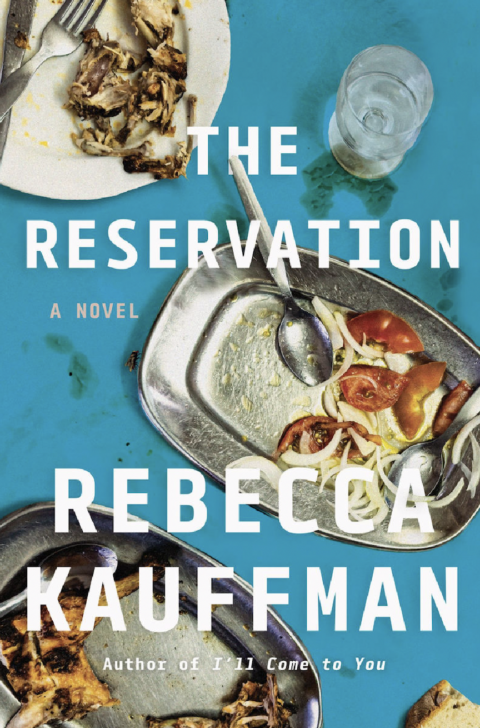 All of this flashed in my head while reading Rebecca Kauffman’s sixth novel The Reservation. The scene is Aunt Orsa’s restaurant, the fanciest place to eat in a Midwest college town. The action occurs during a single noteworthy day, since the author John Grisham and his entourage will be coming for dinner. But the story begins with a disturbing discovery – twenty-two rib eye steaks have gone missing. Kauffman gives us an ensemble of a dozen restaurant workers (and a few peripheral characters) to keep an eye on, with a chapter focused on each one. Kauffman herself has plenty of restaurant experience (see our conversation), and situates us convincingly in both the front and back of the house. Orsa and her helpful husband Larry restock the meats, but other issues arise, none catastrophic but still nettlesome.
Orsa interrogates several of the staff in her office, while relationships and squabbles between some of the workers punctuate the narrative. A number of their backstories emerge piecemeal, but Kauffman has always been a novelist who can generate more significance from a glance or offhand remark than through deep portraiture. Still, the tension builds subtly, and not just because of the puzzling theft. Early in the novel, Kenzie and Rhea, two servers, chat with Orsa about Glen, a reliable and longtime line cook whom the servers eliminate as the potential thief: “Orsa said, ‘I know he doesn’t show up late or make mistakes, but I’d need a little convincing that means he’s some superstar or whatever you guys are trying to tell me. He actually cares? I don’t know. Don’t you all care?’” And that’s the question – can’t we or don’t we think well of ourselves, even if there’s something going on here that’s not exactly “good”? Even so, Kauffman wants us to contemplate this further, in fact, to the very last page and beyond.
 Then, there’s Byron, also a server, who aspires to write and has several opinions about writing to boot. Byron and a busser named Ant discuss waiting on the Grisham table:
“Ant said, ‘I’m surprised you’re not on the Grisham table. Being a writer and all. I’d’ve thought you’d want it.’ ‘Orsa wanted Rhea on it,’ Byron said. He gestured toward the table before them. ‘This one’s going to be twice as much money and half the fuss. There’s no way I want the Grisham table anyway. Guy’s a hack.’”
Byron repeats the epithet later, even while having complained about contemporary fiction and its “depressing burden, as a writer, to meet readers’ trivial and simple-minded demands such as ‘that something happen.” Well, not much “happens” in The Reservation – which I suppose would please Byron, but do we appreciate his tone (and a few other things we learn about him)? Byron also says later, “’First off, I would never write a mystery. I’m not that desperate.’” So, Kauffman has written a mystery that doesn’t have much going on plot-wise. This is probably about as “meta” as Kauffman will ever get, and it’s all slyly humorous. But of course, something is very much happening in The Reservation, even if its name doesn’t shout out to us.
As in her previous novel I’ll Come to You (2025), the third-person narrator speaks with intimate knowledge about the crew — or rather, not just with knowledge but with a sense of kinship. But in The Reservation, the connectedness has been tightened by a notch or two. It wouldn’t be inaccurate to describe the novel as “realism,” with all its restaurant sensibility. But truly, I think of Kauffman’s work as visionary and gently comedic, a peering into a rising world whose life force seems both utterly manifested and coyly shrouded. This notion brings me back to the character of Greg, who at an early age suffered a hypothermial episode that left him with impaired cognition — and it is he in his wonderment, shaken by “the bigness and smallness of his world,” who stands at my side at the end.
I must leave the Grisham reservation and the steak caper for you to savor without further clues. But for those of us who want to write or are writing, I’ll add this side note. While having lunch with a friend, a seasoned psychological counselor who wants to publish her stories, I briefly described Kauffman’s novel and suggested that she read it. “It sounds like a novel called Last Night at the Lobster by Stuart O’Nan,” she said. I know that 2007 novel well. Like The Reservation, it’s a restaurant tale whose action occurs during one day, but unlike Orsa’s place, the Lobster will be closed for good at the end of the business day. There’s a cast of restaurant characters, rue and loss. Like Kauffman, O’Nan gives us a world in which people are trying to live as decently as possible. But beyond all of this, there are striking differences in strategy and execution, tonal control and rhythm, all of which may provide an illuminating comparative study for anyone who wants to understand how superb fiction actually works.
[Published by Counterpoint on February 24, 2026, 256 pages, $27.00US/$35.00CAN hardcover]
To read Ron Slate’s review of Rebecca Kaufmann’s novel I’ll Come to You (2025), click here.
◆ ◆ ◆ ◆ ◆
on True Mistakes, poems by Lena Moses-Schmitt
 The painter Joan Mitchell had “an abiding passion” for the poetry of Rainer Maria Rilke, according to her biographer, Patricia Albers, who noted that Mitchell was deeply moved by “his vulnerability to the external world,” as expressed in the following excerpt from his autobiographical novel, The Notebooks of Malte Laurids Brigge, which “she read many times,” in which the narrator recalls having dinner with his family as a child:
“You sat there as if you had disintegrated – totally without will, without consciousness, without pleasure, without defense. You were like an empty space. I remember that at first this state of annihilation almost made me feel nauseated; it brought on a kind of seasickness, which I only overcame by stretching out my leg until my foot touched the knee of my father, who was sitting opposite me.”
Both Rilke and Mitchell are cited in Lena Moses-Schmitt’s True Mistakes, a debut poetry collection both agitated and exhilarated by the world’s appearances. This duality is manifest throughout the work, even to the final poem, “Untitled (after Joan Mitchell),” where it is spelled out yet again: “Recognition sharpens itself / and then recedes.” There is also the toggling between distress and release, or at least the desire for ease. The poem begins:
It was another afternoon when The Feeling was heavy on top of me.
If you’ve ever spent weeks unable to breathe, afraid
that there is just too much,
even love, getting between you and this life,
then neither of us is alone.
The poem ends with a vision of latitude. Having considered the blank space on a Mitchell canvas, and the recognition “that so much life is left / unused,” she concludes:
So that in trying to use it, and failing,
even still
you can slide out
— brief,
fresh color multiplying on a surface —
from under what was once so heavy.
There are no secrets out here.
And finally everything expands.
This embedded dyad of gestures continually risks turning True Mistakes into a two-note aria, predictable in its movement and gestures. But since her impulse and need require her to concentrate on this essential trouble and troubled essential, her response is not only to incorporate it all, but to step carefully around the traps she sets for herself. I have to believe that she not only calculates the risks, but relishes them. The “I” here often overtly refers to her distress, as when she writes in another poem, “I have no idea what I look like anymore. I’m always startled. // Startled, and absolutely emotionally vacant, picked clean …” And yet, the determination to matter, so dominant in our memoiristic poetry, doesn’t arise. This is a poetry that wants to give the reader something to do and perhaps work out; if there are lines that approach epiphany, such as “And finally everything expands,” they neither indulge in self-crediting nor pretend to resolve the oppositions. It’s all about managing the extremes.
 The work in True Mistakes often reflects on getting things wrong while imagining what getting things right might look or sound like. This amounts both to an attitude and a technique. She writes, “I love to examine the distance / between me and what I desire.” So we encounter lines that specify her condition. Such assertions may point to what the poems are about, this gap between consciousness of her own presence and “mistakes” of perception that disrupt it. But they alone don’t embody this speculative pivot. After reading the first few poems, I asked: will she settle for explaining and depicting her dynamic, or will she enact it in unanticipated form and language? I discovered that she accomplishes both.
Moses-Schmitt may depict her person as exhausted or fed up, but such statements don’t generate a pervasive tone. They work as points of departure, and sometimes, of return. There is a channel of elegaic movement, not of grief alone but also an almost toneless, precise sketching that carries me away. Both I and the poem (and perhaps the poet, as she writes) become intimately linked to the very thing she contests. There is an occasional urge to teach explicitly – “This is a world more cloven / with dimension than we realize.” There are recognitions here that are gorgeously, severely drawn.
Figure Drawing: Elegy (for C. E.)
If I draw you it must be a gift
from my memory as you are
more memory now than woman
your upkeep belongs to the sweep
a thought makes
and the hand its translator
the paper the ear receiving the thought
of your body
if I can still call it yours
but of course it is your mind
I miss where lines can’t reach
though I could try to sketch
from a medical textbook the formation of cells
multiplying fueling
the wildfire in your brain
even then
that wasn’t you
but your illness
let’s draw a line between the two
let’s pretend
illness has nothing to do with the body
& the body nothing to do with the self
better yet pretend
you’re still here that’s all
drawing is pretending
my mind is more real than reality
I draw you so I can talk
to you without language
in the same way I’ve gathered all the paper
where you had placed your hand-
writing a map of how your mind moved
through space maybe
the best correspondence happens
in silence
that place where you now live
between two shapes I recreate here your head
there your neck
from my mind which spoke
to my hand which spoke to the pencil
which spoke to the paper
I fear this is too many steps
to get right
this perpetual conversation
the body trips through itself
and now I see I’ve copied
the slope of your chin wrong
not quite yours I’ve made
you wear another person‘s jaw
an accidental operation
but I don’t want to redo any part of you
even the mistakes
which we’re taught are human
but more than that I think
true mistakes are what the body makes.
It didn’t know what it was doing
when it erased you.
In “Not Happiness,” she depicts herself: “I’m searching. For authenticity. For presence. It’s difficult / to find, sitting at the bar …” In “Scene with Nude, Helen Frankenthaler, 1952,” she wonders if there is a form in which her presence could vanish: “Is it possible to paint myself so precise / I disappear? Can I remember myself / so completely I’m erased?” But after all, words, with their alleged precision, are all she has to work with. And so, Lena Moses-Schmitt has made poems that somehow manage to honor – and proceed within — both exactness and drift, grasp and release. There is a vital discernment, but it is fleeting, an unrequited passion. The poems have been made for all of us. But as the French poet Yves Bonnefoy put it, “Poetic invention brings nothing to the life of the writer other than aimless desire, unrest, and futility.”
[Published by the University of Arkansas Press on March 14, 2025, 80 pages, $19.95 paperback. Selected by Patricia Smith]
◆ ◆ ◆ ◆ ◆
on Talking Classics: The Shock of the Old by Mary Beard
At the outset of her popular history of ancient Rome, SPQR (2015), Mary Beard said about classical times, “Our world would be immeasurably the poorer if we did not continue to interact with theirs. But admiration is a different thing.” Here, Beard advocated for “new ways of looking at the old evidence” – and cautioned that investigating Rome “from the twenty-first century is rather like walking on a tightrope … if you look down on one side, everything seems reassuringly familiar … On the other side, it seems completely alien territory.” Her assessments were delivered with wit and flair. She both respected the academy’s and her readers’ expectations for linear narrative, and allowed herself to linger and leap. Her tone could be chatty. She said of Cleopatra, “Suicide by snake is a hard feat to pull off” – thus letting some air out of the tale.
 Throughout Talking Classics, Beard reinforces this main point: “I have learned that you get a lot more out of classics if you allow it to be a disruptive challenge to self-serving modern certainties, rather than turn it into an untouchable ancestor in whose shadow you should count yourself lucky to sit.”
After retiring in 2022 from teaching classics for 43 years at Cambridge, Beard set to work on Talking Classics, a concentrated expression of the value and means of studying the classics and history, and of the errors we make when we regard them with excessive reverence. The book is also, though hardly primarily, a memoir of her years teaching and writing about the classics. “I don’t study the Greeks and Romans because I love them (any more than virologists love viruses, or astronomers love black holes),” she says, and advises, “You will not read much, if anything, here about classics as ‘the well-spring of Western civilization‘ and there will be no hype about ‘timeless truths’ that classics imparts.” What the Greeks meant by “democracy,” quite different from the modern definition, helps us “to remember how fraught, contested and dangerous the ideal of ‘people power’ can be.”
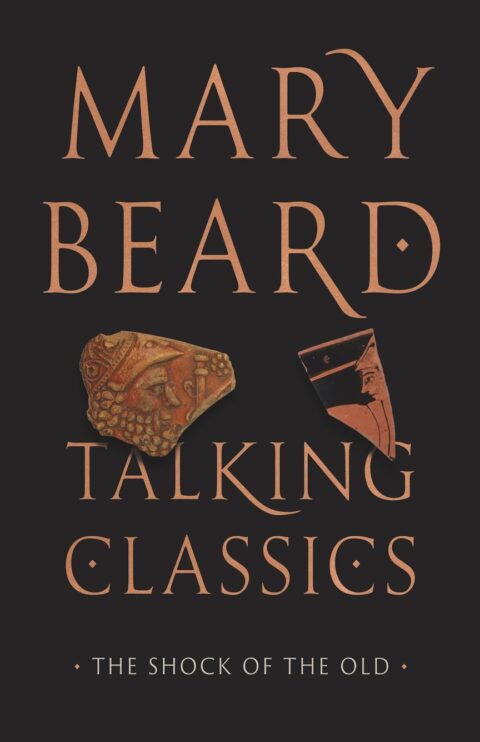
As she notes, it’s miraculous that most ancient artifacts have survived at all. And further, “the perilous fragility of our connections with ancient history” is underscored by the sense that “we never do (and never can) bridge the gap between us and them.” To make all of this palpable, Beard the teaching docent leads us through several sites, describes the artifacts, and tells us what we think we know about them. For instance, she enjoys revisiting the restored Bar of Salvius, a pub in Pompeii, in which “we can still catch a glimpse, through contemporary eyes, of what went on there 2,000 years ago, for facing the counter in the front room was a memorable painting of life in the bar, like an oversized strip cartoon, with speech bubbles giving the words of the character.” From these images, she extrapolates an entertaining narrative, a moment for her when suddenly “the recognizable ordinariness of life in the ancient world unexpectedly breaks through.” Nevertheless, “we can hardly begin to imagine what bar life there was really like … they were governed by entirely different assumptions of what was right or wrong, possible or impossible, certain or uncertain.” Beard expresses her gratitude to her teachers who trained her not to minimize the differences between our cultures and those of the ancients’ and turn them into “a modified version of ourselves.
A. E. Stallings, who teaches poetry at Oxford, once said, “The ancients taught me how to sound modern.” Mary Beard’s chapter “How to be Modern?” amplifies what Stallings means by imagining the newness and impact of classical art and literature when they first appeared. For example, there is the portrait statue of Augustus (which would have been painted in gaudy colors), excavated in the 1860s. When such statues were first seen in Rome “at the end of the first century BCE, they would have been jaw-dropping: a dramatically new idiom for putting power on display” that was deployed throughout the empire. But then, Beard considers Virgil’s Aeneid: “My hunch now is that Augustus is likely to have been very surprised by what he had commissioned,” not only because Virgil pulled off the feat of combining his own takes of both the Iliad and the Odyssey, but because the Aeneid ends in merciless slaughter, not glory: “If [Augustus] had been hoping for some straightforward nationalistic propaganda, Augustus would have fallen off his chair. That is, indeed, what some people are supposed to have done,” such as Augustus’ sister, Octavia, who fainted during a private preview of the text. Beard’s point is that works like the Aeneid “look harder than is comfortable at the very values that seem to underpin them.”
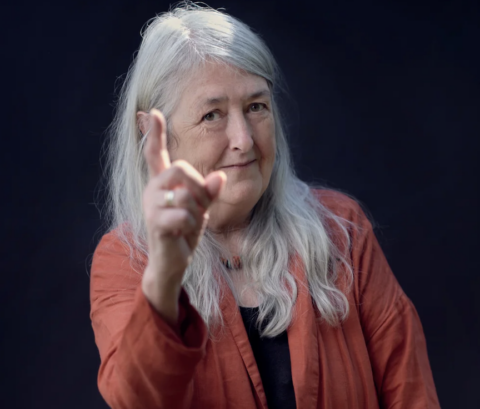 Talking Classics also finds Beard looking hard at contemporary values. When she began teaching in the 1980s, she was the sole woman lecturer among 30 in her department. She recalls “all the struggles I had in discovering what a woman’s voice in the classics, whether spoken or written, sounded like” and “the feeling of being rather like an unconvincing actor, trying to ape the voice of authority in the subject.” From this discomfiture emerged the voice we’ve come to recognize as uniquely her own. She had asked herself, “How about giving myself a bit of slack to write and speak differently? … I felt empowered to write what I wanted to say … I sometimes thought I wasn’t so good. But I did see and hear myself.”
She is sensitive to how classical tropes have been used to support corrupt and violent regimes, and notes how some of the rioters on January 6, 20231 in D.C. wore “Greek-style helmets.” She says that “the fabric of ‘classical’ Rome is in part a fascist creation, and she takes us back to May, 1938 when Adolph Hitler toured Rome at the invitation of Benito Mussolini. Just as the emperors had their images pressed into coins of the realm, the U.S. Mint will now begin to produce 24-karat gold commemorative coins bearing the image of a would-be king. As Beard says, classics teach us “how words can be used to enlighten, please, confuse and deceive.”
[Published by the University of Chicago Press on May 20, 2026, 208 pages, $22.50 hardcover]
◆ ◆ ◆ ◆ ◆
on Every Time We Say Goodbye, a novel by Ivana Sajko, translated from the Croatian by Mima Simić
A man named “Iv” has boarded a train at a Croatian seaside town, headed for Berlin. By the third page of Every Time We Say Goodbye, he has told us several things that will resound through his narrative. First, what we’re reading is what he has written in his notebook during the trip. Second, he is a writer (“I leave no trace except for an occasional piece of journalism depicting human misery and hence paid just as miserably”) who, he says, can’t write. Third, he is depressed (“my depression caused by failure, boredom, provincial life and a lack of talent to turn my misery into a masterpiece”). Finally, he has left his wife of 10 years (“I let myself off with the thought that I was just passing through, that I asked nothing from her and expected nothing, and so I could not be responsible for her discontent”).
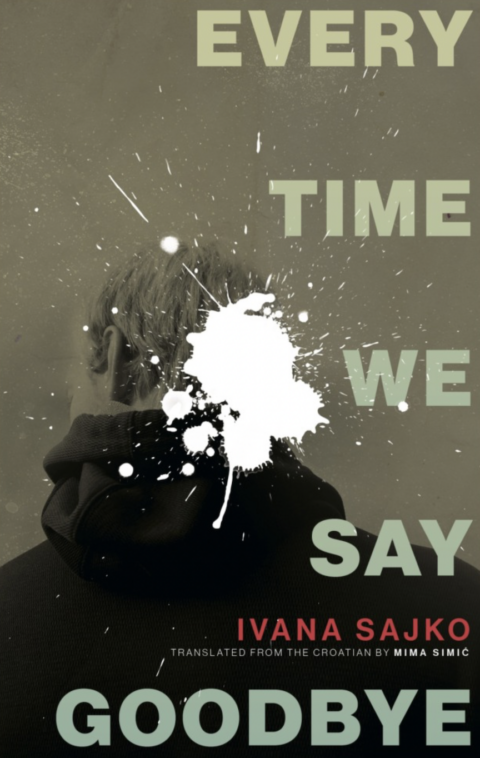 Ivana Sajko has had some experience in conjuring the voice of a man. Her previous novel, Love Novel, alternated between the perspectives of a man and woman who struggle to make a life together even as they spurn each other. The prose of both novels is propulsive – long ribbons of speech, lots of commas. It’s not difficult to keep up with the telling because the phrasing is terse, but there are few resting places. Mima Simić translates all of this with clarity and verve. Iv has much to tell and does so recurrently, shifting between fragments about his youth, days in Berlin when he met his wife-to-be, and the violent and hopeless scenes he witnessed during wartime in the Balkans, and later when Syrians migrated through the area. He is disaffected with the European Union and its harshness toward immigrants, “its humanity already mostly discursive, only to disappear from discourse altogether as a meaningless concept, and it became clear as day that any collective salvation would always be overruled by the instinct to save oneself as best one could, entirely natural, entirely human.” He recalls his childhood, living with his grandmother for years as his mother departed to find work elsewhere in the early 1980’s. He says that as boys “we were born to destroy everything in our path, we couldn’t help it, born to ruin a woman, to waste the best years of her life” – and he portrays scenes to prove it. In fact, for a narrative so absorbed in interior life, the recalled episodes throughout are alternately riveting and heartbreaking.
Iv thus “began to dream of a journey from which I would never return … I am not fleeing because times got tough, I am leaving the raft on which I spent years hating myself, pinching myself, tearing my own skin raw, feeling redundant, though never once … did I take anything from the state, only from my girlfriend, who smoked in the kitchen and sacrificed herself for me, but that’s nobody’s business.” But the relationship with his wife, a translator, is very much the reader’s business. He says it was “in that gap between her possible understanding and my unspoken thoughts that our dying began.” The moment of their break-up, appearing and reappearing, includes a few sparse lines of recalled dialogue, but it is very moving to hear of it.
 Iv’s story includes a meta-moment in which he describes his unwritten novel – “I knew it had to be a story about departure, that it had to take place on a train” and so forth. “I began to feel my silence was due to the fact that I couldn’t tell this stranger’s story, for its essence was precisely its untellability.” The effect of this statement, however, is to force the reader to ask: what exactly has been told to me, beyond the facts? And what is he not telling us?
I read a review of this book in The New York Times that pins all of Iv’s issues on the disappointments he experienced – in youth, during war, throughout his time in Europe. But Sajko has given us something else to do and assess. To what extent is Iv a man who simply won’t take full responsibility for himself in relation to others, namely his wife? It is she who tries to show him “how many disappointments it takes to stop loving.”
In her translator’s note, Mima Simić notes that the original title in Croatian is Male smrti – or Little Deaths. She says of the novel, “If it carries you like a wild river, and lands you bruised, inn a place unknown, I have done my job well.” Then I must congratulate her for a job very well done.
[Published by Biblioasis on March 3, 2026, 126 pages, $16.95US/$22.95CAN paperback]