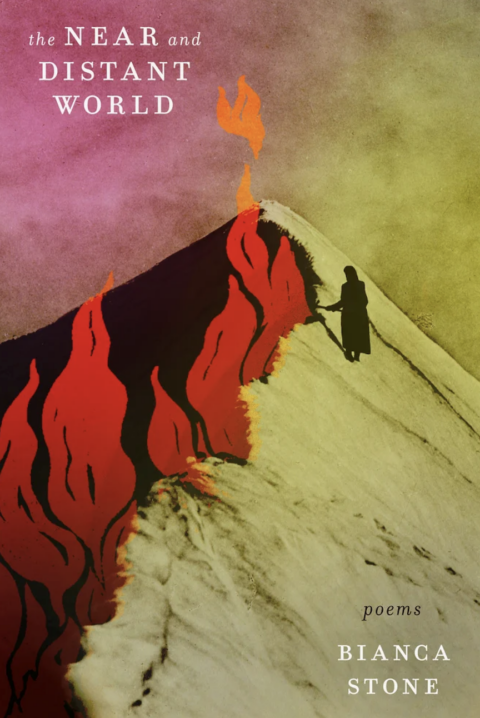
Resonant and impassioned, Bianca Stone’s fourth full-length collection of poems, The Near and Distant World, compels me to use the first person. Why? Because her book sent me back to Rilke, got me thinking about the rattled madhouse lyricism of James Schuyler’s The Crystal Lithium, the Orphic mystifications of Emily Dickinson, and the Zen dailiness of William Corbett’s Columbus Square Journal. I wasn’t comparing Stone to those poets. I was rushing to the shelf, inspired by sudden private recognitions — among them, how language and melancholia have cast an enduring spell over my own life; how the snows of my long ago childhood — not so different from the brooding winters of Stone’s native Vermont — have sifted into every corner of my Gulf Coast existence.
Isn’t that why readers turn to poetry — for that glimpse, in the mirror, of someone else staring back; for songs that wake us; for truths that don’t just rhyme at conclusions, but which echo and confirm that we have been called to witness? By those measures alone, Stone’s book is a triumph.
Still, it’s also nice when a self-aware poet makes one laugh about her ancient and very odd profession. Here’s a snippet from “Old Bio in Snow,” the dreamy, hibernal opener to Stone’s new book, which tells one plenty about public readings and literary careers:
And if they introduce me with an old bio
so be it. No need to mention the latest
gummy linguistic situation in words,
or my recent award
for lying on the rug
and staring at the lacy vacant spiderwebs
in the petticoats of a glass cupboard — no,
forget the laurels. What matters tonight is Time
and blizzards
and saving on your next purchase
with a coupon from your unconscious.
 If you disagree with Stone’s assessment, be aware that she’s way ahead of you. “All poets are liars” she states emphatically, in two different poems — a bow to Plato that becomes her permission to tell the wildest tales. In The Near and Distant World, this Vermonter revives familiar myths and mysteries — of Persephone, of Psyche, of the Immaculate Conception, and the temptations of Saints —and deftly weaves them into the fabric of her life as a wife, mother, and writer.
Sometimes the epiphanies are simple. In “The Annunciation,” a poem dedicated to her husband and set at a New York museum, Stone contemplates the miraculous encounter of Mary and the archangel Gabriel — human and divine, together yet separated — and eventually circles back to the annunciatory miracle of her own marriage:
I love to look at what you love to look at.
See how she is alone yet with another?
I long for how she yields,
even in her fear, she yields to it —
distance which
nevertheless
is touch.
In “The Translation Elegies,” Stone sets her visionary experience at a McDonald’s restaurant, “in the gray November birthday light of Rutland, Vermont.” This cooly distanced, second-person account centers on a mother who sips coffee and watches her daughter play, haunted by a gruesome tabloid account of another child’s murder. Suddenly, her daughter “climbs into a bright blue tube / in the play area and disappears / in her halo of static-electric hair.” And it’s not just this little Persephone who goes down the chute: her mother rambles into a meditation on Rilke, loss, and an “attempt to articulate the question / of why the innocent suffer, why / we cannot gain our innocence back.”
Stone’s maternal narrator is like all of us:
all people, slinking to the
catastrophically informative
mirror. Waiting for a Mephistopheles
to take on more clients; preparing to go
way, way, way down,
into hell, clutching a little gold key,
hoping to be one of the ones
who come back up: the returned.
 Stone’s poem is full of such translations — between death and life, between True Crime and myth, between fear and self-mockery, and, finally, between a mother’s despair and the vision, however provisional, of a lost daughter’s return: “bright, open / the one waiting loyally for you to / ‘work it out’ so she can get loved already…”
Most of this collection is composed of such circuitous narratives — poems brimming with associative leaps, which showcase her command of vernacular speech, and carry one with a sturdy dream logic. But she can turn a perfect lyric, too. In “The Affluence of Being,’’ for example, she spills her cornucopia, offering a linguistic feast full of lip-smacking vocables, sex talk, precise observations, and an exclamatory conclusion worthy of Whitman. It’s also an excellent way to conclude a review:
A gold wreath spins at the core.
Glass-beaded, the soul swings from the nose.
Fine-tooled leather flies apart and together when walking.
Minute loops of brass, chain mail gowns,
draped on, hide nothing.
Yellowing ivory piano key teeth
around a wet, velvet tongue. Fire-drop breasts.
Lapis lazuli sentience. Pigment at the fingertips.
Glass fountain frontal lobe, installation of skin.
Lavish brooch on purple mink genitals.
Sand at the corners, full-length cheering mirror,
parody of time, sharp cold inhale
on a Christmas-morning dawn. The patina,
the verdigris, the grassy pits, tarnished smile and the yawn.
The mortal bone-china clavicle kissed.
Pilled silk eye bone. The hallowed hand-hewn beam
of the cock. The thistledown, milk and lilac, cherry
or amethyst, veins of coal, book of the vagina,
perfectly tuned strings of weeping, and soul’s cello
moan, in the handset type of time —
O matter of the world! — water and butter and wine!
[Published by Tin House/Zando, on January 13, 2026, 112 pages, $18.00 paperback]