City Like Water is an urban dreamscape like something out of a French surrealist film or a psychogeographical map of Paris. Dorothy Tse’s impressions of the city – clearly Hong Kong – slide away just as soon as they come into focus. The book offers a constellation of images, artifacts, and tropes of urban life that reflect the abuses of state power but also exceed it. If Owlish, Tse’s award-winning debut, also translated by Natascha Bruce, tracks how its narrator cultivates an imaginative world that obscures the political conflict unfolding all around him, City Like Water is a novel of unruly dreams that enfold collective experience from which the narrator can’t look away. Its narrator often responds with ambivalence to the confounding events of the novel, in the way that dream selves can tend to do. Yet the novel itself revives late 19th- and early 20th-century forms of urban writing to resist familiar abuses of power and to generate inventive responses to such power that careen past practicable ideological lines.
The novel forgoes traditional plotting, cohering instead around this first-person narrator and their family. The narrator is at one point referred to as a daughter of people pretending to be their parents and at another talks about their voice deepening during puberty, their gender identity as fluid as the rest of their life. They have a mother, a father, and a sister, each of whom disappears, transforms, and/or is replaced with a double in the course of the novel.
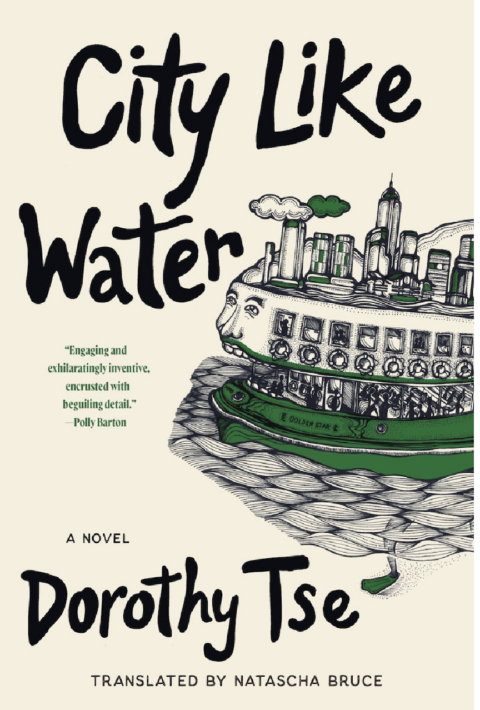 The city is similarly in flux. The novel’s opening pages introduce us to “a place I used to live,” where “all year long crowds of people sprang up from the street like mushrooms, their jumbled shouts and earthy faces constantly vying for attention.” But, the narrator says,
“Those streets are unfindable now. Not because of some developer wiping them off the map, like smears from a kitchen table, or because of a corrupt political regime, or because of any other reason the internet might cook up. The world decided for itself. To evade serial numbers, imposed order and the stink of disinfectant, those sun-dazzled inhabitants gathered close their unspoken words and slunk into the cracks of buildings, where they transformed into cockroaches. With their antenna twitching, and their backs ridged with mysterious codes, they scuttled off into the dark.”
The streets exist now only “inside our muddied, contaminated memories,” something shared in a collective “hippocampus,” but inaccessible by any kind of record. The city has a power to evade order that exceeds that of the economy of the state, though both kinds of power loom large.
The police appear increasingly frequently, first as figures who show up on the street claiming that, despite the unsettling thump the narrator heard, the “cause of death is not suspicious.” Then the narrator’s mother gathers with other women outside city hall to protest being sold fake lotus roots by a street hawker whom they have reason to suspect is in league with the authorities. The women occupy the space in front of the building until one day they are sprayed with a substance that turns them into “bronze statues,” and the police surround them with sheets of metal before the bullets fly.
As the novel progresses, the police stop appearing as uniformed officers of the law and instead as plainclothesmen “dressed up as other people” who “[sneak] about among us.” They might be doormen or cinema ushers, and the narrator reports a collective fear of being somehow caught out: “We [are] perpetually on edge, waiting for them to flip and reveal themselves, like terrifying poker cards.” There are, instead, inflatable “po-po statues” that seem a trap for vandals, and the narrator’s sister does indeed puncture them with a bow and arrow.
The police have a counterpoint in figures of resistance who shape-shift to an even greater degree. The most important of these for the narrator is their sister, whose presence is elusive but who leaves signs of her existence despite being erased from official records. The sister urges the narrator to watch a flock of birds that flies into a bookstore, some of which transform into books in which the narrator searches for answers: “I picked up that body-turned-book, with its vestigial bird breath, and greedily turned over its fragile, yellowing wings, desperate to find out what my sister had been trying to tell me.” The narrator never quite figures it out. But even when journalists come and force the narrator to participate in an interview in which they insist the narrator is their parents’ only child, they retain a belief in their little sister, who takes on a legendary aspect. “[E]very street I walked down was full of people with covered faces, and every one of them had my little sister’s eyes.”
 But while the women of the family disappear to become symbols of resistance, the narrator’s father is a tragically passive figure who goes from being stationed on the couch in front of the television to living life in the television, playing a meaningless “bit part” in whatever show is on. The narrator takes on the father’s position in front of the tv in the living room, watching sadly to see that “no matter which world he entered, he was always the odd one out. Not because anybody outright rejected him, or even acted coldly towards him, but because he was always in the background. . . . He never made any serious effort to inhabit the life in which he found himself.” The father’s seemingly mindless engagement with the tv makes him a useless appendage to the media landscape, and as relationally inaccessible to the narrator as their mother and sister. The narrator shadows each of their nuclear family members as they protest, go underground, or are isolated at home, yet never settles into one role, moving on and collecting experiences of the city.
While the narrator’s family provides them with crucial insights into the workings of this “city like water,” the landscape teems with additional people and artifacts that alternately call back to early city writers like Beaudelaire and capture newer tropes of urban experience. There are flaneurs, cryptic messages graffitied on walls, and subway stations. Tse’s Hong Kong subway is ominous:
“… everywhere the subway passes turns to subway. You exit the barriers and find yourself on underground streets you’ve seen a hundred times before, lined with shops that feel like a perpetual déjà-vu. Light and shadow move in a choreographed rhythm and, when you finally surface, an enormous shopping mall seamlessly continues the illusion. You realize how deeply buried the subway tracks really are, and that you’ll never escape the subwayified city.”
This city gives birth to a particular kind of man, “girder-stiff,” who “loved the subway,” The narrator sees this man every day: he is an economic machine, a self-proclaimed success of rigid routine who turns the unruly mess of urban life “into numbers, then rearranged into files and lists, and this filled him with a clean, orderly, freshly shaven delight.” Even when this man is bleeding with a broken neck, the narrator sees him trying to ride the subway, intent on his routine, a Gregor Samsa whose first preoccupation upon being transformed into a giant cockroach is that he is going to miss work.
As in many dreams, City Like Water boasts its share of body horror. The narrator finds the street littered with human ears that have fallen off their frantic owners’ heads. People transform into beasts while sitting at the noodle counter. The narrator has a mass that migrates around their torso, sometimes settling in their abdomen, and other times rising to their chest. And the people of the city learn that the lotus roots are fake because they are bloody, leading to some gruesome meals. These experiences are rich with metaphoric potential – why is everyone losing their ability to hear? Why has the symbol of prosperity and abundance transformed into a rubbery, gory, inedible substance?
Such questions are, more often than not, collective ones. While the narrator occasionally encounters people like the man of the subway with whom they have little in common, they more often find themselves in the company of crowds whose aspect they take on. When they see “displaced people” making bamboo replicas of things they’ve lost, the narrator is drawn into the creative practice. Later, the narrator wanders a shopping mall when they suddenly hear “forbidden music” coming, ghost-like, from a dried-out fountain and share a collective experience of being arrested by something that moves some to tears, that cannot be isolated or contained by the police. The narrator records a persistent sense of tight-fisted state control that fails again and again to subdue the crowd. The liquid nature of the city makes it impossible.
The interplay between the collective experience of city life at a particular historical time and geographic place and the individual focal point of the narrator produces a memorable piece of city writing that I anticipate has earned a place on many college syllabi. Tse’s dream-like approach to the extreme political tensions between Hong Kong and China engages the European tradition of city writing while playing to her own strengths as a surrealist writer. As Natascha Bruce has said in reference to Tse’s poetry, her work maintains a sense of “defiance” and of “humor” amid the “ominous presences” of authority figures that darken every scene. The result is 100 pages spilling over with potential significance. “Rain falls,” the narrator says, “there’s an opening sound, and every blocked raindrop walks a different path across the canopy of an umbrella.” In a time when much politically-engaged writing can feel ideologically predetermined, Tse’s dream-world of City Like Water offers a sense of possibility, of “leaping between worlds” to practice a new way of seeing.
[Published by Graywolf Press on March 3, 2026, 112 pages, $16.00 paperback]