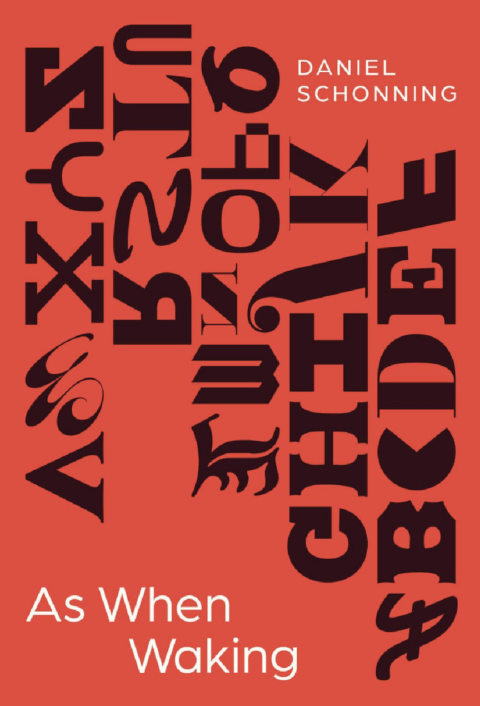
Daniel Schonning’s collection As When Waking arrives as a debut that thinks at the scale of origins. This is not merely a first book but a founding gesture — poetry as cosmology, lyric as world-making act. From its opening intuition — “At first, it’s as if all things are words” — to its closing image of the wild zinnia closing its eyes, the collection unfolds as a sustained meditation on how language enters the world and how the world, in turn, enters language. What results is not simply a sequence of accomplished poems but a coherent vision: a poetry of thresholds, letters, breath, and emergence — held together by a fierce, tender attention.
Twenty-six of the book’s central poems unfold under the formal constraint of abecedarian structure, each advancing through the alphabet. Yet this is no parlor trick. The alphabet here is not decoration but engine — an ancient generative technology. Schonning explicitly invokes the Sefer Yetzirah, that early mystical text in which letters do not merely describe reality but bring it into being. In this light, the alphabet becomes organism rather than index: a circulatory system of becoming, recursive and alive.
That generative impulse announces itself immediately in the opening “Proem,” a long unspooling sentence built almost entirely of conjunction. Storm subsides. A kingfisher paces. An octopus dreams. Meadows mourn their shadows. Drowned bodies lift — only briefly. Each image arrives not as explanation but as adjacency. The poem refuses causal hierarchy. And becomes its governing verb — a syntax of joining rather than mastery. The world assembles laterally, not vertically. Meaning emerges not through argument but through accumulation:
And when the storm subsides, the catchbasin
coos; the sky exhales; the dead rosebush withers;
the bright kingfisher paces in the sand.
And all night, the lemon tree remembers
sun …
The poem concludes …
And the wet clay shakes alive.
And, yes, the wild zinnia open their eyes.
Here, existence does not progress so much as interlink. The poem builds its universe by accretion, not ascent. Ontology itself becomes an act of neighborliness — being as side-by-side.
This grammar of relation governs the book at every scale. A cube of sugar dissolving into tea carries the same metaphysical weight as Saturn kneading Titan in the collection’s final movement. Schonning’s imagination moves effortlessly between the infinitesimal and the astronomical. The macro and the micro fold into one another without strain or hierarchy. Though not explicitly ecological in theme, the book is ecological in metaphysics: everything here exists within a shared atmospheric trembling, no entity sovereign, no presence sealed off.
 The linguistic heart of the book beats most audibly in “Ladder,” a poem that climbs through etymology as through a vertical forest of buried meanings. Infant opens into “speechless”; nerve becomes tendon and lyre-string; cloud thickens into rock; believe returns to its older meaning: to love. Virga — snow that vanishes before touching earth — rises into xylem, the liquid ladder climbing inside plants. Language is revealed as fossil memory of desire, grief, and ascent. These are not facts offered for intellectual pleasure alone; they arrive as emotional voltage. Knowledge never feels ornamental here. It tilts and reorients feeling.
The book’s invented forms extend this logic of constraint as discovery. Among its most striking achievements is “The Beatitudes,” composed as a “lattice abecedarian” in which the alphabet reappears across fixed recursive sequences. God addresses “the meek one” not with thunder but with intimate, almost domestic instruction: tuck dollar bills into trees, paint windows violet, bundle children in pansies. Running alongside these divine directives is the speaker’s labor of tending a dying mother who can tolerate only bananas and milk. Revelation does not lift one out of depletion — it descends directly into it. The sacred here is not transcendence but accompaniment.
If “The Beatitudes” shapes the book’s ethic of care, the small, radiant “Little Box” poems operate as its mythic nerve endings. These syllabic pangrams — each containing all twenty-six letters — compress vast narratives into brief illuminations. Caedmon wakes and sings. Gilgamesh recognizes that Enkidu is clay and water and that he loves him. Ezekiel hears God rustling in bushes. Sappho lifts a half-drowned stone and sings anyway. These poems leave behind empire and plot in favor of residue: voice, breath, articulation. Catastrophe passes; song remains. They read as Schonning’s quiet ars poetica: history erodes, but utterance persists.
Vision — what it offers and what it withholds — haunts the book’s middle movements. In “A Vision,” an actual door rises from stone: a silver doorknob emerging from granite, bindweed trembling around it. The speaker kneels, hands wrapped in vine, unable to turn the knob. The poem refuses its own climax. Nothing is entered. Nothing is granted. Vision appears here not as access but as arrest. Revelation does not authorize mastery. It interrupts.
That same tension animates “Prayer Is Better Than Sleep,” where scenes from Amman, Wales, and an unnamed lake braid together in dream-logic discontinuity. A note pinned inside a door reads: “We enter and exit. We write our poems alone.”It is less pronouncement than condition. Solitude here is not romanticized; it is structural. The poet does not stand outside the world’s suffering — he stands inside it, unable to distribute its weight.
The book’s formal crucible is “The Machine (I & II),” a daring double movement that subjects the Orpheus myth to twin pressures: terza rima contends with the alphabet until both buckle into incantatory loop. Here desire becomes motor. Emptiness becomes propulsion:
O gods, O gods, I am at last a machine
made of wanting — empty but for everything —
In this formulation, hunger itself becomes metaphysical machinery — self-fueling, inexhaustible, radiant and ruinous at once. The machine is not technological but ontological: appetite as the structure of being. Yet even in this most violent lyric terrain, the book’s faith in song persists. Orpheus is dismembered, but the voice survives the body. Lyric endures after ruin.
Despite the book’s mythic amplitude and formal virtuosity, its deepest commitment is ethical attentiveness. In “Dog Star,” Schonning offers what may be the collection’s quiet moral center: “Real things ask nothing — not even to be seen.” This is not a decorative aphorism. It is a poetics. The world does not exist to be converted into metaphor. The poet’s task is not appropriation, but witness.
That ethic reaches its narrative apex in “Scales,” a long, luminous prose poem in which a child and his father travel into the city to visit a bank. The boy notices everything: stuffed animal eyes behind glass, creases in vinyl seats, the half-moon floating between buildings. Later, the father weeps in a motel room. No explanation is offered. The poem withholds causality as rigorously as any vision poem. Its culminating knowledge is negative: “But some things, Paul thought, are / are good not knowing.” Some windows do not open. The poem refuses redemption. It offers only the disciplined preservation of experience as it occurs:
For one, not all windows open. Another:
Even in that strange place, where the sky held more
lit-up hallways and kitchens and bedrooms than stars, if Paul craned
his neck down the right alley, he could still see the half-
moon way up there. Last: At night in the city, when looking from far off,
an unlit window — especially one that does
not open — can sometimes look so dark, it’s easy to imagine someone
behind the glass, looking back.
Here, ethical attention becomes inseparable from uncertainty. Not-knowing is not failure; it is restraint. The poem preserves the dark without filling it.
 The book’s “Postlude” returns us, finally, to the cosmic register of the “Proem,” but transfigured. Now all things have become letters; all letters have become waves; one poem washes ashore upon another. Bowerbirds gather song. Saturn kneads Titan. Sugar beets part the soil. The bellows fill again with breath. This is not apocalypse but recursion — the world entering itself through sound.
And then, in the final gesture, the book rests: “And the wild zinnia, yes, close their eyes.” It is among the quietest endings I’ve read in years. Closure arrives not as erasure but as sleep. Attention does not vanish — it pauses.
As When Waking is rare among debuts in that it does not primarily announce a personality. It announces a system. Schonning builds a world in which letters behave like atoms, prayer behaves like labor, and myth behaves like memory. These poems are not confessions; they are structures of listening. They build rooms in which perception can enter and linger.
What endures most powerfully is the book’s ethic of relation. The self is never the sovereign unit of meaning here. The fundamental unit is adjacency: word to word, body to body, star to field, breath to letter.
In a contemporary poetic landscape often divided between the hermetic and the hyper-social, Schonning offers another path—a poetry of luminous systems, of form as listening practice, of language as both medium and mystery. As When Waking does not ask to be decoded. It asks, more quietly and more insistently, to be entered.
[Published by the University of Chicago Press on October 1, 2025, 78 pages, $18.00 paperback],