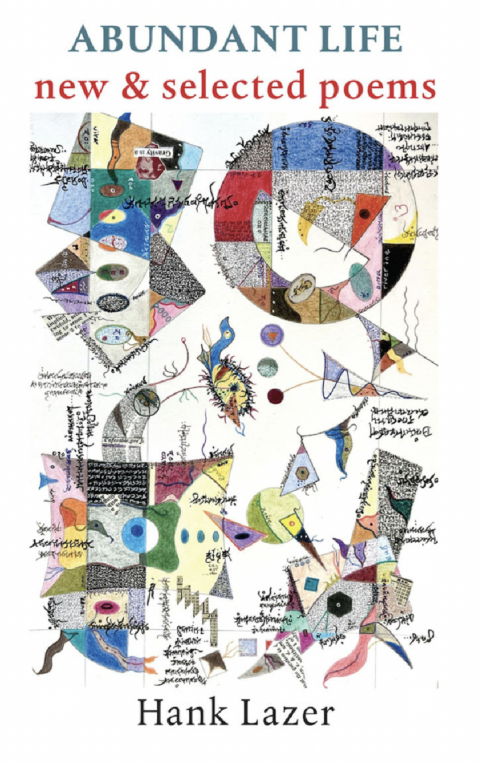
Hank Lazer’s Abundant Life: new & selected poems collects work from 2002 to 2024. It is an extraordinary book for a number of reasons, beginning with its layout and design and an amazing mixed media/collage cover by Cal Wenby. Starting out as an acolyte of Louis Simpson, Lazer and his work underwent a sea-change in the mid-90s when he began publishing bracingly innovative poetry influenced by the Language Poets. But it’s Robert Creeley’s work that looms throughout as his strongest influence, with its dynamic use of a syntax that functions as a form of cognition. Lazer’s career has undergone subsequent shifts since then. most notably his forays into so-called “shape writing” and Buddhist-inflected writing consistent with his deeply serious commitment of practice. To sum up such a wide range of developments over a lifetime of vigorous poetic activity is beyond the scope of a mere review. What follows are a series of snapshots from Lazer’s remarkable trajectory.
Lazer’s turn to the resources made available by Language Poetry is most notable not for his use of fragmented language or how he destabilizes the subject, but for how he employs these techniques to explore questions of spirit. In this – in his investigations of both Jewish and Buddhist spirituality – he has become one of our most prominent innovative poets, remapping the possibilities for the poem as an active and dynamic instrument. The first poem in the book, from Days (2002), sets the tone for all that follows:
and then again back
in it witness
serendipitous atoms drip
& cripple the im
perceptible ache of it
jack she took her
life a parent’s love
called a darkening
of the heart emily to
susan avalanche to avenue
This slim poem teems with wordplay and invention. One sound cluster suggests the next, as does a train of ideas. “serendipitous atoms drip/& cripple the im” offers a brilliant play of assonance inside its description of a method of composition, while “Emily to / susan” alludes to Susan Howe’s groundbreaking work My Emily Dickinson. A succinct genealogy follows a route: “avalanche to avenue” – from volcanic outpouring to smoother channels.
“Deathwatch for My Father” (1995), a deeply textured and moving elegy, eschews wordplay to give a straight-ahead account, in the form of a diary, of the death of Lazer’s father. The diary becomes Lazer’s preferred form – the instant inscription of the mind moving, following the example of another great American Buddhist poet, Philip Whalen. This is not to say that it forgoes subtle formal moves. Rather, it complicates the passage through death and mourning with acute sensitivity. Lazer grounds his elegy in a process of self-interrogation leavened with humor:
what
is it perhaps to
turn your death
into linguistic inquiry
a somewhat familiar
terrain you say
from your hospital bed
henry the one thing I
regret about this disease
is that I have it instead
of moamar khadafy
The poem ranges widely and freely through memories and daily occurrences, brilliantly weaving past and present together to give us the warp and weft of affection and loss. George Oppen and Phil Mickelson make notable cameos (Lazer is a lifelong golfer). The poem closes on a plangent note:
If not
the physical body
what are we
 Yet this poem takes the place of father’s body, standing in for him, incorporating his absence into a continuing sense of presence. Such a hauntology can be viewed as an active, healthy form of melancholy. It is the persistence of what refuses the hygienic absorption of mourning, the refusal of grief or injury to be re-contained within a palliative structure of amelioration. It is not so much a morbid keeping open of the wound as a preservation of the ruin, a memorial to loss that must, if it is to have any force at all, any power to incite recognition, signify that loss actively.
With The New Spirit (2005), Lazer pivoted to a radically new kind of spiritual poetry. The poems in this book reject a simplistic poetry of reverence, what Lazer calls in his groundbreaking book of essays Lyric & Spirit “the troubling persistence of a priestly role” in poets for whom Rilke is their north star. He rejects this “ethereal metaphysics that wishes for a negation of history … as if a timeless spiritual conversation were a replacement for dailyness.” Elsewhere he writes, “I ask that a contemporary spiritual poetry take seriously the labor of innovative necessity.” What Lazer proposes instead is a phenomenological approach to spirit, one free of stultifying preconceptions.
This spiritually audacious poetics transforms experimental poetry by employing daring formal procedures, engaging in a more active process of investigative poetry instead of offering up the kind of complacent platitudes found in the work of Mary Oliver or Denise Levertov. One of Lazer’s most astute commentators, Romana Huk, characterizes his work in The New Spirit this way: “Lazer’s commitment to pursuit of an even ‘truer form of realism’ calls for new sorts of exploratory practice within theopoetics.” And much of The New Spirit is taken up with an exploration of the manifold meanings of teshuvah, the Jewish concept of repentance.
teshuvah: heading south
this or that or some such thing chuck when talking
about a person’s capabilities called it wherewithal toward the
middle trane played just ahead of any sense he already understood
To play ahead of understanding describes a method, an entire poetics – a plunge into a cloud of unknowing where one follows the melody instead of driving to some preconceived outcome – a truly exploratory poetics. Repentance in this sense means making things whole again, closely allied of the work of tikkun olam, the repair of the broken world.
Through whatever horn breathe & shape heavenly blue legacy
golden fall light drove me down the river delta
ghostly sax titled back succession then – when the saints
This last phrase will be familiar to readers of one of Lazer’s inspirations. It is the title of one of John Taggart’s books. As Taggart writes: “the subject was roses the problem is memory/in the end the problem is a song” and this describes the predicament Lazer has taken on with such bright probity.
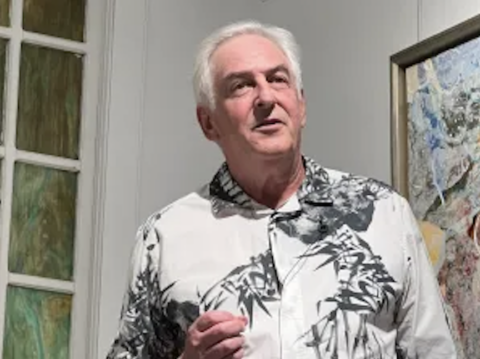 Lazer’s so-called “shape writing” might strike some readers as illegible though that seems to be part of the point. These idiosyncratic not to say eccentric poems defy expectations of straightforward transmission. One wonders what the point is. They seem like self-indulgent larks. N 18 is an impossible book. Written in serpentine longhand, the poems spiral across the page in calligrammes that challenge comprehension. The difficulties and rewards in reading them are central to the question of their form, making that form the very subject of the poems and how they re-spell the possibilities contained in reading, for making meaning as we go, re-making it as we go around and back over. At the same time, their playful inventiveness is inviting, creating an intimacy impossible to obtain otherwise. Over and beyond that, however, these poems continue the explorations begun in the exquisite The New Spirit.
In his essay “Thinking / Singing and The Metaphysics of Sound,” Lazer describes the processes behind the composition of The New Spirit as an attending to not only how we hear music, but how “thinking in musicality” might take place within the poem. N 18 translates this idea into another register – the proprioceptive circuit that is writing by hand, the establishing of hand-to-mind circuit that obeys its own laws of form and formation. In this sense, Lazer is following Duncan, when he writes to Charles Olson that the hand is also a form of hearing, an organ of perception and knowing no less than the ear:
“I have observed in myself a curious double note in hearing. There is a previous ‘hearing’ out of which the lines (or from which – as in sketching an object) are composed, written on the page. Then the central ‘hearing’ is in the hand. The act of writing seems to hold back, rein (Plato’s image of the horseman) – listen (?). But the important thing is that ‘hearing’ only comes as the eyes relay the words seen from the designing hand – ” [N.B. This letter by Duncan is from the Olson archive at the University of Connecticut, Storrs, dated March, 1954].
Lazer’s shape writing in some ways is an exploration of this tantalizing description of a reciprocal cognitive feedback loop. In Evidence of Being Here: Beginning in Havana (N27), he writes: “i have written a wisdom book/lost in a larger book &/hidden from myself if i/would find it i/must do as you/would do I must/read it again.” That the book is approached by its author this way, its words a mystery even to him, signifies the necessity of hiddenness, a classic trope of the esoteric. By remaining hidden a secret text is preserved from profanation. Wisdom literature is the literature of secrets, of concealed logos. The poem closes with a query: “shall we extract it or simply let it remain hidden?” By guarding the secret a certain potentia is not merely preserved but renewed, made capable for new transmission to initiates.
It’s impossible to reproduce the layout and typography of these poems. Suffice it to say they inscribe multiple figures – the labyrinth, the spiral, the wave, and others so complex and delightful that there are no terms for them, really. Each page is a portal of discovery and wonder. Shape writing enacts Lazer’s delicate, nuanced articulation of a post-metaphysical theology and the rich potentialities it carries for an innovative poetics that is polyvocal and decentered, but equally welcoming and affirmative.
The later work, collected in such volumes as Pieces (his wonderful tribute to Creeley), Poems Hidden in Plain View, Poems That Look Just Like Poems, and As We Vanish from Public View return to his earlier diaristic mode: records of fleeting states of mind and the elegiac that are by turns aphoristic and rich with sharp, vivid observations of the natural world; they gleam with a subdued radiance that should not be mistaken for quiescence. Many of these poems from his later volumes are openly, joyously affirmative, as if written from the other side of a great agon, if not quite resolved then merely held in suspension. The negational pitch and yaw is subdued yet the poems are still tightly torqued. They are highly crafted little gems, so simple they run the risk of seeming merely banal on first reading. They carry a sweet fire of their own – Creeley-esque, in other words. The urge to decreation, so prominent in his early work, has receded into a calm equanimity that gives up nothing in terms of complexity or richness, as in this diary poem from 2023:
earth
is the bardo
a paradise for
getting soul in
scribe for its return
alive at the time
I hold the book
capacious brain
raining down its chosen rhapsody
Lazer’s alertness and sensitivity to syntax and line break is marvelous here, inscribing a careful listening to the pulse of language and mind. And this witty turn on Creeley is from Pieces.
drive
he said
to anyone
who would listen
Pieces is not a mere imitation but a conversation and amplification of Creeley’s own inquisitions into self and language.
Above all, Lazer’s poetry attests to the ambiguity attending to questions of spirit; that it is unsettled, in process – a doubt, a question, a restless questing negativity, eating away at its own boundaries. This is major work by a major poet. Everyone who cares about poetry will want to spend serious time with this book. At bottom, the book displays the magnanimity of poetry: its ability to render and embody a panoply of linguistic richness and play.
Abundant Life is indeed abundant, overflowing with a generous spirit of inquiry, graceful dissonance, and interrogative complexity, dancing nimbly between seemingly intractable binaries, always taking the path of uncertainty, refusing to resolve the antimonies, but instead dwelling inside their tensions. The book closes with a handful of new poems. Here are the final lines, flush with a quiet radiance and a gentle yet probing invitation:
soon the indigo bunting
will be a shimmery blue
what is your
instrument
[Published by Chax Press on May 1, 2025, 392 pages, $33.99 paperback]