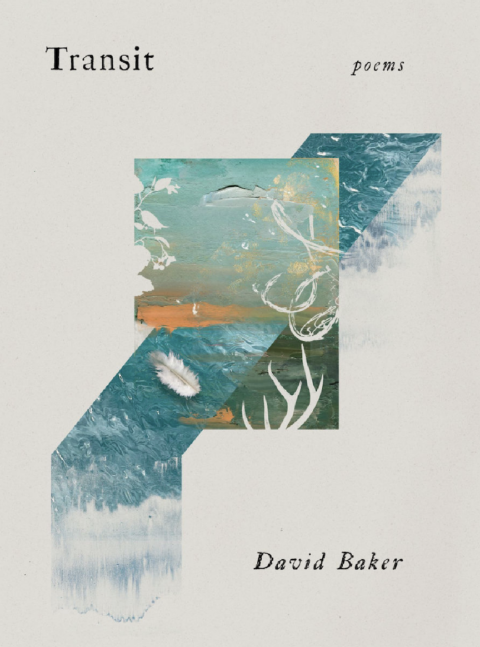
David Baker’s 12th collection, Transit, achieves something inconspicuously extraordinary as a follow up to his equally brilliant Whale Fall. The new release carries forward from Baker’s previous offerings a recognizable balance between precision of craft and a gentle openness of sensibility, patient enough to gather apparent opposites into dialogue. But even this balance, integral to the master poet, must find itself anew in each work, and, fittingly, Transit does present an interesting departure. Whereas Whale Fall is structured around the titular centerpiece, a longer meditation weaving together layers of styles and subjects, the title Transit operates as a circle of metaphors and implications whose center is everywhere and whose circumference is nowhere. So many varieties of transit take place; between modes of consciousness, different forms and self-states of writing and reading, awareness of experience, mortality, and textual legacy. Moreover, Baker brings many practices of transit into his work: self-reflection, reading, walking and meditation, imaginative and scientific interaction with the natural world, and the directed openness necessary for composing poetry. It’s difficult to draw a straight line from these makings to their unquantifiable realizations, yet unexpected and transformational connections between process and perspective — and between speaker, reader, and subject — take place within these pages.
 “The Bay” exemplifies Baker’s ability to modulate thinking and feeling responses in the reader, the transit from one to the other an intuitive tutelage in the complexities of loss and enduring presence: “Our friend is dying. He writes, / he says, more often. Yet more sparely. // Now to see what wasn’t seen before” (italics original). The lines themselves embody a paradox; in their solidification of a present-tense now past, we witness with each reading as a memory becomes a remembrance. The reader has room to stop and feel, in the unstated spaces around these lines, the friend’s stoical determination to maintain his meditative-poetic practice while — by — facing eventuality, as well as the speaker’s compassion and adherence to the same practice.
This communication across time and mortality implies a kind of esoteric faith that bonds the writer and friend with the reader in the implicit understanding that their shared practices will continue, that humanity needs poetry as one of its ways of preserving broader and deeper context for our lives. Therefore, the poem consecrates this moment of this friendship in these lines beyond their experiential conjunctions, within a context that also makes room for a reader’s continuation. The poem’s myth requires human participation to be lived. The speaker evokes the transcendent aspect of the myth gazing at the night sky, “How slow the constellations spin. / Invincible heroes.” This macrocosm invokes a related, common feeling also pertinent to the opening scene: Those who help us learn to participate in something that contains us, do seem invincible as their examples help us to feel that the work is possible, this despite many of our textual mentors having passed on before we meet them.
The speaker then uses the apprehension of a Freudian slip as a poetic turn, another instance of experience becoming form before our eyes: “Did I say invincible? I mean invisible.” To connect the two meanings, we must make a transit in processing and think through these implications regarding the “invisible” structures of our lives represented by the constellations, the complex dynamics of heroism, and how these archetypes connect with the human friends facing impending death and loss. In the process, we meet death again, but not only as an end to personal life, but, interdependently, as an aspect of greater, continual life which can contain fear, love, and inherited wisdom and practices in which we recreate and revise for those to come. The reader’s leap in processing corresponds indirectly with the speaker’s slip of tongue and the conjunction of awareness that results, and yet each is inextricable from the other. The gift of the poem is that, the more we think about these intricate connections; the more we feel interconnected; the more we feel awe within their vastness, the more we can understand how they contain and claim us.
“Six Meditations on a Poem” also perambulates the interconnections between writer, reader, environment, and literary ancestor. Although the form is quite different, interplay between foreground and context remains an important feature:
Let’s say ‘Now You Are’ can be simply a poem about walking and springs — the week or two when milkweed silks fill the air, whether you’re in the city or the country, whether there is a wind or stillness. Let’s imagine Anne Bradstreet alongside me on this walk, and we talk a bit, and she adds a phrase or two between my stanzas. My ghost companion.
Including the reader in the woven engagements with landscape and literature gestures toward two concurrent transits: Bradstreet’s ghost moves from the speaker’s reading into this text, while the living writer becomes a textual ghost for the reader. The accessible diction and openly improvisational approach invite us into this complexity through a state that feels like equal parts play and mystery:
Her elegant, rhymed couplets may be a ghost inside my poem, and her habit of reading large, divine purposes into every single tiny natural thing plays across the background. I see all these floating cottonwood seeds as words, too, or Bradstreet’s angels, bits of a soul, glimpses of the many worlds.
And illuminate the air. Like a trembling
of waters where cottonwoods grow tall.
The cilia, the silk of them.
Nothing’s moving —
which may reveal a mind —
(italics original)
Each of the poem’s sections consists of a prose paragraph that segues into four lines of verse, and the formal “crossings-over” mirror these movements between Bradstreet, the cottonwoods’ imagery, and the “mind” revealed as both container and inner witness of these synapses. The form enacts the uncertainty at the heart of the poem, preparing for its connective leaps between psychology and metaphysics: “I think we live in many times at once. We live in many places at once. Our words are hardly ours, so much as the gifts and intimations of all their previous uses.” The gaps between our lives are also the inchoate spaces where reading and writing poetry continue:
The meditative walk of my poem is looking for ways to find forms and voices of the plural, the ongoing, the here-and-now and just-beyond. Can a poem — fixed on the two-dimensional plane of a page — suggest a third or even further dimensions? Can a word or a phrase find its usages in more than a single sentence, in more than one person’s voice? What are those magical silky seeds but answers of “yes” to the questions? They are ghosts, gifts, whispers, defying gravity, place, and time.
This speculative yet considered exploration, complete with movements into genuine questioning, its open and generous outlook, is also an excellent description of the book as a whole.
Yet, there is so much more. “Six Notes” begins with one of the collection’s recurrent methods of inviting the poetic mind to such undertakings, the walk in nature:
Come down to us. Come down with your song,
little wren. The world is in pieces.
We must not say so. In the dark hours,
in the nearest branches, I hear you thrum —
. . .
The deer come to die beside the creek.
Mud the color of walnut stain. Reek and
runoff from the new development, there,
beyond the woods. Rib and skull. No jawbone —
 This seamless movement from the invitation of the wren to the declaration of the shattered world feels at once so profound and so instinctual. The rational mind may scoff as the speaker appeals to a tiny bird, but then materialism operating without balancing perspectives is one reason the world suffers from such “reek and / runoff” to begin with. The pun highlighted by the line break seems to acknowledge such evasions of “forms and voices of the plural.” Rather, in the willingness to seek guidance in a small bird, the speaker has created the conditions for transit to “a third or even further dimensions.” One reason all of those talking animals in stories offer deep guidance is that we have to get out of our habitual thinking to consider animals’ perspectives in the first place. This listening is already wisdom.
More connectively fascinating is the way that the felt connection with the wren must precede and contextualize the walk itself, the space in which it takes place having itself been cultivated by a confluence of other walks, meditations, conversations with ghosts from the page about nature. The dashes punctuating the stanzas’ final lines are a subtle detail that indicates the psychic texture of this meditative space, connecting the pauses within the meditation with these pauses in life that allow for it. Accordingly, the dashes give the gaps between the poem’s unfolding thoughts and feelings a complex nature of their own, each implying both a known interruption and a felt awaiting.
Within this nexus, the speaker does voice what one seemingly cannot:
Sometimes we have to say so. I don’t know how.
A man, a boy, an anger with no tongue
took his automatic rifle to school today.
The report we hear, discharge, echo —
. . .
is the sound of sorrow, reloading.
No matter where we walk, we hear it call.
As if quoting the shooter “with no tongue,” no understanding is offered to explain the violence. As the poem reveals its impetus, it also becomes more apparent that — and why —t he speaker has been acting as a meeting place for the wren and the “we,” the plural coalescing in grief. We, the readers, must feel “sorrow, reloading” as its own reality; otherwise, we cannot remain open to “hear” the “call” of other voices on deeper levels of the psyche, the impossible wren, the silence that says what we cannot, the reader beyond the “two-dimensional plane of a page.” We find ourselves again as a scattered community not unlike that of “The Bay.” In leading us home, Baker quietly models one potential for a life with the world that creates poetry: opening to, seeing into, and making the soul’s afflictions as opportunities for reawakening to connective life.
A related, signature practice Baker carries forward in Transit deploys science and poetry in direct collaboration. Another walking poem, “After Long Illness,” presents one seamlessly inventive manifestation of this symbiosis:
The spring peepers
sang — Pseudacris
crucifer cru-
cifer— from moss
logs and willow
mulch, from cattails
low and high all
around these trees.
[italics original]
Imagining the frogs’ singing their Latinate names in four-syllable lines, the poet harmonizes natural music with scientific taxonomy within form. Moreover, the poem presents an observing identification with the frogs in the making of the musical reflection. The frogs’ name also compares the cross marking on their backs to Christ, a subtle evocation of consciousness living on within the awareness of mortality that is central to the poem’s subsequent unfolding:
There is no more
story to tell —
except I had
not died. And
one sound I heard,
along the small
wing of creek, I
still cannot name.
I seldom speak
of such things, though
I had come so
far to hear it.
Was it my soul?
What do I know?
The unnamable sound invokes the enigma of living in full consciousness of one’s own mortality. But how does one live in this dual consciousness without slipping into either self-deception or nihilism? Baker’s practice holds both the intuition of soul and his known lack of authoritative knowledge dialogically in mind — as if the soul were most alive in the questioning that allows it to move between seeing itself as impossible and mirrored in our experience, not unlike our own consciousness. After all, as humans continue to amass material knowledge and means of coercive power, it becomes ever more important to ask: If we knew everything or were all powerful, where could we hope to encounter mystery?
A brief mythopoetic passage of “Twilight Sleep” synchronizes many of the soul’s transits discussed above, and others you will without doubt find in your own reading:
So we lean together, over the ancient waters. Big Sky
like music. All the night, freckled with doves with stars —
Listening to songs to be sung on the other side. Of what?
We will stay a while, by the water, until we are water —
Again, we see the play with time in conjunction with the dual tenses of poetry itself, one for composition, the other reading, the veil of mortality between them. The songs themselves are both the contextualizing sky and the connective medium by which the crossing is understood, life itself and life as transit.
In this wave-particle understanding of literature, it looks a lot like the water in the final line, a fluid medium capable of fostering the interchange between feeling and thinking in reading that we saw in the beginning. Concurrently, the movements between witnessing and becoming water relate to the ways in which inner dialogue personifies into impossible connections with other beings, connections that make conversations among aspects of the soul possible in very real ways. Further, awareness of these inner processes allows cultural and transdisciplinary conversations to be taken into the soul, remade, and provisionally transformed. In ways our world needs now more than ever, we find in these many transits the miracle of lines that reciprocally connect many apparently separate points. One reader to another, I’d suggest picking up a copy, taking a few walks of your own.
[Published by W. W. Norton on January 13, 2026, 96 pages, $26.99 hardcover]