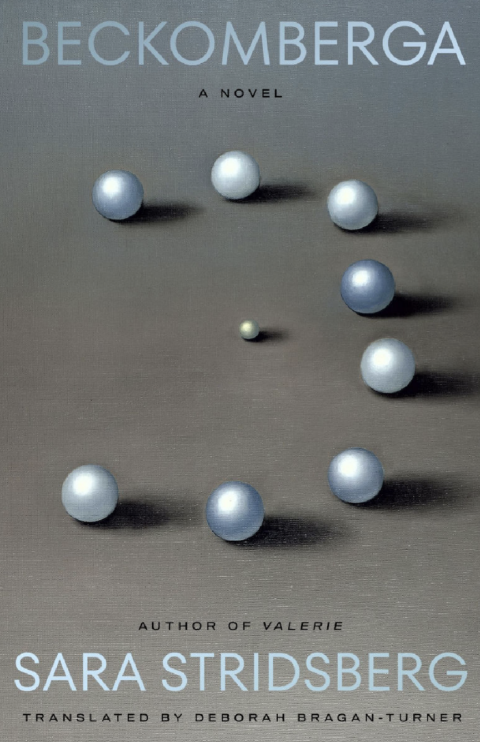
Sara Stridsberg’s bracing novel Beckomberga is narrated by a woman named Jackie and concerns the troubled life of Jim, a man suffering from alcoholism and depression. Jim has spent most of his adult life in Beckomberga, a psychiatric hospital in Stockholm that was open from 1932 to 1995. Her feelings toward Jim are a mix of lament and resentment: “I sometimes think Jim managed to avoid all impress of life after adolescence, of ageing,” she says. “He has always done what he felt like doing, followed all his whims and instincts: dishonesty, deception, drink and desertion. I do not believe he has ever loved someone.”
 Her concern with the disconnect between “normal” life and its disruption goes beyond the usual fictional conflicts — she’s looking for deeper schisms in our existence, between the sane and the mad, the living and the dead, despair over our fate and our acceptance of it.
It is clear, eventually, that Jim is Jackie’s father, but it’s not something she says directly, as if that fact were something that would need to be confessed instead of simply shared. His blunt, hurtful distance is her inheritance.
In that regard, Beckomberga is partly a novel about the distance that mental illness creates within families, even while we are tied to the people we are hurting. We know a few things things about Jim’s past — his mother’s suicide, for instance. And we know some things about Jackie — that she is a single mother, determined to raise her son alone. And though the divisions are apparent, so is the connection: Jackie is afraid she’ll be consumed by the same demons that have haunted him ever since she was 14. She tells Jim that one part of her hopes she goes mad: “Sometimes I wish it would happen, just so I don’t have to be afraid any longer.”
Which is to say that Beckomberga is a novel about mental illness that dodges the tropes associated with it — the urge to heal, and, at least, a glancing appreciation for how medical attention can help, if delivered properly. By contrast, Stridsberg is noncommittal, the novel’s structure diffused by design — it’s constructed out of brief chapters, interspersed with vignettes about the history of the hospital and a kind subplot involving Olaf, its last patient. These sections knit together only so far as they relate to the facility. There’s no direct relationship between Olaf and Jim, and Olaf’s closest connection is with his doctor.
In a similar fashion, the novel is also about the strained, tense relationship between the state and the mentally ill. Stridsberg is skeptical of any kind of treatment there beyond warehousing society’s unwanted, and she metaphorizes it as a zombielike creature, a disruption of nature: “During the summer of 1931 the skeleton of Beckomberga Hospital starts to emerge out of the earth.” She also notes Beckomberga emerged during a period where the occupancy of such facilities exploded, from 4,400 at the start of the 20th century to more than 33,000 at its midpoint.
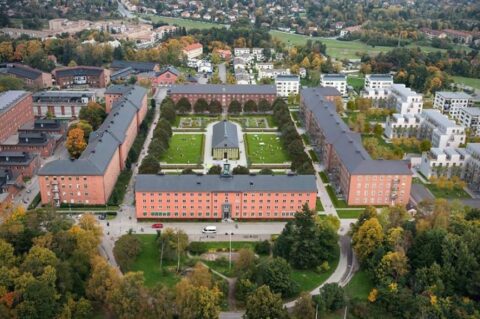 This was an achievement of a sort — evidence not of more mentally ill people but better awareness of them, but Stridsberg holds any praise for this at arm’s length: “It is easy to idealise the institution as the perfect place that will do everything we human beings cannot bring ourselves to do for one another,” she writes. “And yet it is terrifying too, because it represents the imperfect in us: failure, weakness, loneliness.”
Jackie grasps that Beckomberga can only do so much to treat Jim’s imperfections, and also comes to recognize how porous the wall is between the mentally ill and others. Jim is afforded regular opportunities to leave the campus and drink, and he suggests that medical supervision is lax. “Remember this, Jackie, if you ever end up in a mental hospital, you must always make sure you shack up with the ward nurse,” Jim says. “Because she’s the one who controls the medicine cupboard.” It’s a joke, and Jackie laughs at it, but the truth in it resonates.
This kind of melancholic perspective recalls all sorts of Scandinavian art, from Knut Hamsun’s Hunger to Edvard Munch to Ingmar Bergman to Karl Ove Knausgaard’s deliberately flat autofiction. And it pervades Stridsberg’s oeuvre: Her 2006 novel, Valerie (published in English translation in 2019), concerns the troubled life of feminist provocateur Valerie Solanas, author of the SCUM Manifesto and would-be assassin of Andy Warhol; 2018’s The Antarctica of Love (English, 2022) is about a murdered woman from her perspective in the afterlife. “I think I became a writer to stay sane,” she said in a 2019 interview. “Or maybe because you don’t have to be sane when you’re a writer.” (In the same interview, she notes that her father was a patient at Beckomberga, but that the novel isn’t autobiographical.) Her concern with the disconnect between “normal” life and its disruption goes beyond the usual fictional conflicts — she’s looking for deeper schisms in our existence, between the sane and the mad, the living and the dead, despair over our fate and our acceptance of it.
 Or, as Jim puts it to Jackie over the phone in a profoundly Stridsbergian line: “I’m fine. Life is a work of grief.” There’s little sense that Olaf, or Jim, or Jackie are improved for their experience with Beckomberga. But there is a measure of calm acceptance, a willingness to believe that Jim’s despair is a comfort, even a kind of preference. Riffing on an observatory near Beckomberga and the search for a “goldilocks planet,” she notes that Jim “existed in the magic Goldilocks Zone that love forms for alcohol.” She’s no longer lamenting, just understanding — it’s simply math.
Beckomberga is dedicated “to all those who passed through the hospital park at Beckomberga over the years 1932 to 1995.” It’s an interesting framing — Stridsberg includes not just the patients, but the family members and citizens who were affected by the collective decision to build such facilities. With the rise of psychiatric meds and criticism of institutions, hospitals like Beckomberga rapidly shuttered. Stridsberg notes the “enormous financial resources” they consumed, and considers the failure of the welfare state, but she doesn’t deliver a wholesale damnation of the experience. More to the point, she suggests we might spare ourselves some grief if we accept that our nature is to live with the sane and insane, loss and suicide. Beckomberga stands not as a place of healing but a monument to our folly that we ever thought we could live otherwise.
Published by Farrar, Straus & Giroux on January 27, 2026. 288 pages, softcover, $18.00]