Translator’s Note
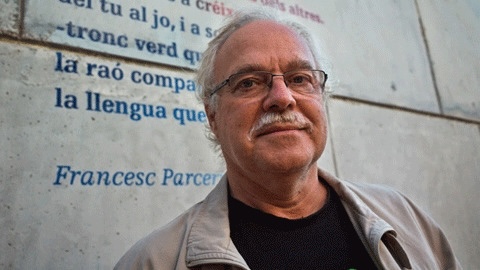 The Man With the Oar on His Shoulder, forthcoming from Stephen F. Austin State University Press in 2026, is a hearty paean to poet Francese Parcerisas, born in 1944, on the occasion of his 80th birthday. It is a celebration of his cosmopolitan genius as Catalonia’s foremost poet, memoirist, and unflagging translator into Catalan of esteemed world literature. These pages are also an emblem of a friendship that has endured over four decades, one that has fostered my ongoing apprenticeship as an engaged student of Catalan language and culture.
This new volume is meant to serve as a complement to our 2019 collaboration Still Life With Children: Selected Poems of Francesc Parcerisas, but with an emphasis this time on themes of risk, humility, joy and adventure as a dynamic counterpoint to the forever daunting phenomena of war, aging, physical decline, and Adam’s curse of inevitable mortality.
Parcerisas remains, as ever, a bard of everyday curiosity, sensuality, and relish, and a ready-to-roll troubadour of the eternal Mediterranean, while at the same time serving as an impassioned activist and defender of his beloved culture and beleaguered Catalan language (“… to go on adopting the stubborn will / of oars breaking the water, / to restore clarity to the dawn / we safeguard our language …”), callously banned from public use by Franco (“don’t bark, speak the language of the empire!”) in the repressive years following the Spanish Civil War.
— Cyrus Cassells
/ / / / /
Regarding Lot
It seems an injustice that Lot’s wife,
who craved to look back
on the suffering and fire
of the decimated cities,
was forced to feel the animus
that reduced her to salt.
We are all stone pillars
because of the things
we’ve endured. Likewise,
in the angel’s little world,
Lot’s eldest and youngest daughters
coax their dad into drunkenness
and cavort with him
on consecutive nights,
because the earth should never become
a barren wasteland.
Yesterday’s inept memories
keep galloping away: a neighing horse.
And what if Sodom never existed?
The ghetto’s subjugation,
the executioner’s white courtesy,
the tongue in the anus?
Everyone is an escaping Abraham,
at the crack of dawn,
surveying, in an immaculate shirt,
the smoking cities.
God promised us lands
and generations of descendants
and prophets to foster not feeling
one iota of blame — reminding us
enduring a divided world
is an out-and-out burden.
But I tell you, I revere
Lot’s wife even more —
a memorial fashioned of salt
in a communal grave,
without any costumes,
without the oblivion
of copulating with the rich
to secure black market items —
I admire her more
than the laughing girls
thrilled at the latest sales,
who deny three times
the fact that their father,
wooden suitcase in hand,
reached the station
where the downtrodden
immigrants negotiated their way
from the South.
◆ ◆ ◆ ◆ ◆
The Last Supper
Recalling The Last Supper is easier
than conjuring previous meals.
At Cana, everything pivots
around the stinginess of the host
or a clumsy sommelier;
the preponderance of loaves and fishes
we’re uncertain if they were consumed
uncooked or if somebody secured
wood to grill them.
Of the first dinner without you,
I remember a profusion of tears
and a yell like a wounded animal
the day I came to breakfast
and discovered my beloved wasn’t there,
didn’t even prepare the coffee.
But today’s supper will be
a vibrant wound to the memory:
we’re the same group of friends,
that usually meets,
the table is ordinary,
and so are the dishes.
But what’s most important
is the effort to salvage
what we’re resigned to lose.
Wine is on the menu,
and some of us plan to order
beer, a salad of legumes,
roast meat and fruit —
mandarins, sufficiently sweet —
to make us utterly aware
of the dispiriting fact
that the world and the invincible years
will surely separate us,
and that some of us
(we all grasp this)
are on the verge of undertaking
an onerous trek toward a dark orchard,
a Gethsemane full of olives.
◆ ◆ ◆ ◆ ◆
Simon the Cyrenian
In this backstreet of the species,
the Cyrenian ponders his wares and profits
— Syrian and Ethiopian dates,
peppers from Damascus,
produce acquired and shipped
from the marketplace at Jaifa … —
and bemoans the market cobbler
who put his son to work
in competition against him.
In a few years, if fate
doesn’t bungle things,
The Cyrenian may purchase,
as a benevolent gift for his brother,
that little share of land
glistening with sturdy olives.
He’s fed up with greedy Romans
constantly bugging him.
Now he’s got to haul the sacks
back inside, in front of the staircase.
The Roman soldiers haven’t a clue,
and sly kids will profit by swiping
handfuls of raisins and hazelnuts.
Hopefully, the crowd-dazzling Nazarene
won’t stop in front of the bodega.
Come on, lad,
keep pushing along that cross,
The Cyrenian coaxes,
lending the accused an avuncular
helping hand:
don’t know why you want
to be messing with all that trouble!
The marketman shoots
a watchful glance to ensure
nobody filches from his baskets,
as the garrulous crowd passes by,
and the bargaining women hover,
joshing about the shamelessly young wife
the merchant keeps at home.
The hard-nosed seller attempts to forget
the cross and the culprit
five stations above him,
while rubbing his hands on his apron,
ignoring shouts and insults
accumulating behind his back.
The one person who’s bound to make
an honest to God profit,
the Cyrenian calculates,
is Herod himself,
or the so-and-so Caesar, who hogs
the front page of the morning paper.
/ / / / /
A propòsit de Lot
Ens és injust que la dona de Lot,
que vol mirar enrere, per damunt el sofre i el foc
de les ciutats bombardejades, hagi de sentir
el fibló que la convertirà en sal.
Tots som columnes de pedra
per tot allò que ens ha tocat de viure.
Com ho devia ser el món petit de l’àngel
en què la filla gran i la petita embriaguen el pare
i jeuen amb ell en nits consecutives
perquè la terra no sigui del tot erma.
Sempre els maldestres records del passat
s’esventren com un cavall que renilla.
¿Que no va existir Sodoma, la submissió del ghetto,
la bondat blanca del botxí, la llengua endins de l’anus?
Tots som Abraham que va, de bon matí,
la camisa neta, a comprovar que les ciutats fumegen:
Déu ens ha promès terres i generacions de descendents
i els profetes fan per tal de no sentir cap culpa
— que n’és de fàcil tenir un món dividit.
Doncs jo m’estimo més ser la dona de Lot
— una memòria de sal a la fossa comuna,
sense disfresses, sense l’oblit d’haver copulat
entre pròspers rínxols d’estraperlo¾
que no pas les noies que ara riuen a les rebaixes
i tres cops neguen que el pare va arribar
amb una maleta de fusta a l’estació de França.
◆
L’últim sopar
És més fàcil recordar l’últim sopar
que els altres àpats. A Canà tot gira a l’entorn
de la gasiveria de l’amfitrió o d’un sommelier
inepte; i de la multitud de pans i peixos
no sabem si els van menjar crus
o qui va dur la llenya per fer-los a la brasa.
Del primer dinar al que tu vas faltar
recordo els plors i un xiscle d’animal ferit;
i el dia que em vaig llevar per esmorzar
i vaig descobrir que ella ja no hi era,
ni tan sols sé si vaig arribar a fer el cafè.
Però d’aquest sopar d’avui en tindré viva
una nafra a la memòria: som els de sempre,
la taula és vulgar, com ho són les menges,
ens importa més haver fet un darrer esforç
per salvar allò que ja ens hem resignat a perdre.
Hi havia vi i alguns hem demanat una cervesa,
una amanida de llegums i carn rostida,
i fruita — mandarines prou dolces —
per fer-nos pair allò que ens desespera:
el món i els anys inexpugnables
ens separen i alguns (ho sabem tots)
són a punt d’emprendre un viatge massa llarg
cap a un hort fosc ple d’oliveres.
◆
Simon El Cirineu
En aquest carreró de les espècies
el cireneu sol pensar en els profits
dàtils de Síria, llavors d’Etiòpia, pebre de Damasc,
l nòlit que reclama al mercader de Jaffa…—
en el sabater del mercat que posa el fill
fer-li competència. Si no se li torça res,
‘aquí uns anys podria comprar al germà
el tros amb les oliveres. Està cansat
i la cobdícia dels romans sempre l’emprenya.
Ara haurà de tornar a entrar els sacs que ha tret
ins al davant de les escales. Els soldats
no entenen res i la quitxalla aprofitarà
per pispar-li alguns grapats de panses o avellanes.
Només falta que el nazarè se li aturi
davant de la botiga. Apa, noi, empeny amunt
li diu mentre l’ajuda. No sé per què et fiques
in aquesta mena d’embolics. I desvia la mirada:
que ningú no toqués res de les cistelles,
que passi l’aldarull i tornin les dones
que li regategen el pes i el preu
que no paren de fer bromes
sobre la muller jove que té a casa.
Deixa la creu i el reu cinc parades més amunt,
es refrega les mans al davantal,
ent els crits i els insults que van quedant enrere.
L’únic que en traurà profit», pensa,
és Herodes, o qualsevol cèsar
que avui omple la primera plana del diari».