The opening iteration of “NOT” (the first of three movements in Sandra Doller’s new poetry collection NOT NOW NOW) ends in a hard stop. In fact, it is a hard stop in double: “I had to stop stop.” The poem stutters its way into being, blurring its own starts, its vowels, its consonants, its boundaries: “I was stoned […] out out […] zoom oom […] toughed […] tufted […] suffered a sayable […] Hop on pop ops.” The abiding image is of a majestic bird shaking itself into focus, checking its contours and components, spurting a few glitches before its song can begin. Arguably, though, Doller’s eighth book does not settle as such. It defies a one-note reading experience through its adaptive lyric, its ironic quips, its exuberant study of micro and macro realms.
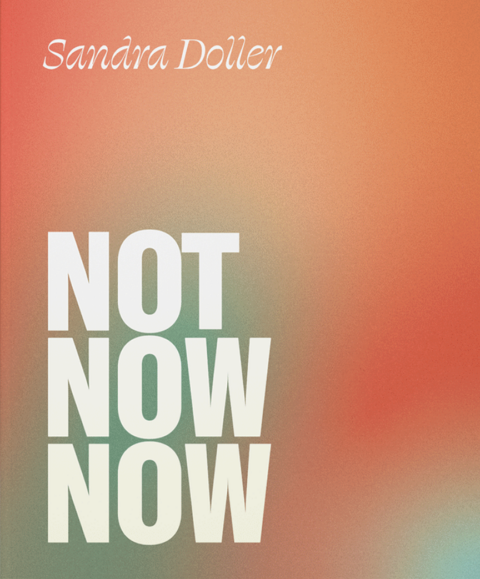 The reader ziplines through the untitled poems of “NOT,” “NOW,” and “NOW,” buffeted by the landscaped nuances; those of motherhood and self/humanhood, of an American diorama with its shootings and plagues, its Big Gulps and angels and thrill seekers and cartoon bandits and possums in the empty yard; of the everyday surreal, “the racket and the lexicon / the gangster and the grass / the pocky and the aeroplane / […] the plunger and the fist,” the “mullet badge of shame,” all “dancing down the hallway inside the leotard of [the] brain.” Doller refutes the kind of narrative drudgery that memorizing — the transmuting of remembered material — can often produce. Instead, we are charmed by skillful snapshots and acoustic shards, as if the “smithereens” of Bernadette Mayer’s Milkweed Smithereens (2022) were to proliferate into further playfulness. But it’s not all fun and games:
a snag of the nylon stopped me in track 2 and I switched it up to another, slower, roundabout, a sly lick of the knife, a shady touch off the side thumb, peel it off, it’s only skin, I said […].
Doller’s dexterous language moves us into, and through, multiple registers at once.
The multi-vocalic speaker of “NOT” adds that “[w]e are trying to record. / Fortunely.” What is predicted or predicated for us, the reader, then? We are drawn into a landscape of puns; a landscape that feels surreptitiously coded, visual and vivid: “Pray for mister / for I have thinned (13) […] Mudded crusty butte / Springs” […] “the big pink puffy bed and / pillows and the art of dark/nesses” […] Who said walk the line like that […] Let’s stay inside the game / shall we.” Another wryly-noted landscape is the one that NOT NOW NOW resides within, that of poetry and its form: “You and your dirty / I.” Furthermore:
like this line stacked to make
a thickness a thinking thing
is not a writer is a barista is
a theme here some kind of
rhyme you lacked in your
recipe and didn’t pack your
cups
Here, the threshold of meta-reflectiveness is approached; the reader is looped into the state-of-knowing, but also gently poked: How do you measure your own seriousness? How do you measure your engagement with the poem? How to “document [the] documents and messes”? We are reminded, to “[l]et the times you flinch / be the times you’re really in it.”
As retort, the speaker adds, “I’m here to write a government poem […] I channel some Chicago / individual who used / to like lines like these,” knowing that the legacy is but residual: “little leafettes […] to leaf through” by a daughter who, in the run of gorgeous images at the close of “NOT,” has “taken the house and upsized it with small pebbles / from shoes […] stickless mermaid sticker hair and tails and bandeau bikini tops.” The mother-daughter dynamic is acutely configured through NOT NOW NOW, turned “over and over like a desert covered coin.” The body has been stretched to expel; the two entities conjoin and overlap. Lines such as “I have a crafty kid which means she / wants to make things out of pieces whole” resonate in their implication. Who is made, and re-made? Does literature about motherhood really exist? Can it be known?
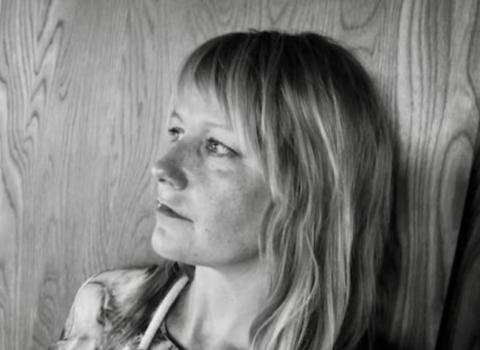 In “[Architecture is an idea that you live in],” the opening poem of “NOW” (#1), the question is “How many years did a woman live here before me?” The here could be the domestic space with its view of other roofs, lush patio and toy-filled living room. Here is also the region of American patriarchy, the “man’s man’s man’s man’s man’s man’s world” contorted by images of “lonely Marilyn,” the “face cream and heavy cream,” the silent rage threading through history. We are reminded that “[w]omen of the 1940s / write 20 books before / they die of throat cancer at 69,” just “cradle to graving / it.”
Time passes. The speaker rotates in and around a here, a moment, a poem, a state, a country. With reference to the conceptual artist Mary Kelly (whose Post-Partum Document recorded the minutiae of child-rearing over six years between 1973-79), it is noted that “[y]ou can write about your kid but not your times.” Doller’s work, however, feels delicately impacted within the recognizable present. Examples include the 2017 pink pussy hats as futile resistance, a reference to the Frozen franchise, the stasis of the Covid 19 pandemic as planes are grounded and un-grounded; the phrase “This is your last kitchen” lands brutally and eerily.
And yet, this here somehow unfurls forwards and back. A sequence about the film Written On The Wind (1956) – a welter of dysfunction with Southern Gothic traits- is tightly arranged in short-burst lines that give synopsis and interpretation: “How much devil can one girl hold in her and who is put to /shame.” Throughout the collection, there is a recurrent image of physically-suppressed speech, “[i]n the south where the / down mouth stops you by the gutter”; a mouth full of soap, scoured in case blasphemy should seep out. In this way, NOT NOW NOW insists that, for a woman, resistance is historically and infinitely punished: “[i]t’s like “staring into the abyss of mise-en-abime mirrors, or Sigourney Weaver in Alien, you will complode.” Women are mother[s] and daughter[s], forced to accumulate a mass of defenses, the “flak jacket, a wooden suit, a hiding dress with pockets […] a zipper up the back for easy release, and a twenty-two inch pile of steel, melty in the middle, for forming.” Our state[s] are shifting and malleable, in having “to come up with answers like the way one letter from the word “now” to “not” changes everything.” Complode is a Latin verb form that implies “to clap together” and so do the fragmented, recursive voice-selves in NOT NOW NOW combine to offer solidarity and a place for (our) reflection. They also hint at disintegration; Alien’s Ripley self-destructs into a furnace after learning she is impregnated with a queen xenomorph. This slippage (of identity, of meaning, of gesture) is ever present:
Not not
Not now
Now not
Now now
Not noow
New not
Noy noyt
Newt nein
Now no
Noo ny
Nee nun
Nee knee
Now now
No no
Not Now
Now
Placed in the third section of the collection, this sequence implies that in the stuttering-into-being there is also simultaneous degradation; that in imperative child-admonishing moments (Not now!) there is a soothing (Now now …); that babyspeak (Noon ny! / Nee nun!) can sound like an emergency vehicle’s siren; that there is both a Newtonian propulsion and a hard stop; that in a woman’s life there will be NO’s and NOT’s. Indeed:
I keep thinking
there will be
a female takeover but realize now
from here on in
it’s only kings
Reading NOT NOW NOW is to inhabit a system, a matryoshka-doll-rhythm of logic, whose layers click into sense. Its depths are as glittering as the surfaces. The reader can opt to revel in its decoration, or sit in its complexity, reading each poem, and each section, from different entry points. We can select our obsessions. For example, I was struck by the perspective shifts (of pp. 53-70) ricocheting from first- to third-person, to second-person, and back again: “[The screaming barnacle reeled her in]”; “[She picked up the wrong mug again, and carriage on like nobody]”; “[In an old box you keep a few things]”; “[There’s a story five ways not to tell it]”; “I take pictures of dangerous things].” Here, the text is de-naturing the self-aware poetic “I.” We are reminded that fashioning the self comes with pained awareness; that a distinctive personal[ity] does not need to have a characteristic address to the world; that we can be more than one thing. This elision is inherent in Doller’s wordplay: “Someday good you’ll get to be a fool again. Someday / fool you’ll taste a different kind of cobbler …” The faint shape of the word “soon” hovers behind “good” due to our expectation of the phrase “someday soon.” Once again, the imagery of baking and homemaking (cups, measuring, worth) is lightly – and yet deeply – invoked. How are you constructed? What serviceable things are left in the act of making? Who is making a fool (out) of you? Doller’s accumulation of puns and mis-hearings never cease to delight, but, as noted, they draw our attention to what is behind, what could be substituted, what can be blurred: “[W]e foil / ourselves like cartoon / bandits”; “Kissed by a striper / I mean slip it; “Fanny Howe says “I’m not a mother, I’m a man.” Compositionally, the final section, “NOW” (#2), unmarked by punctuation, departs from the tonally ornate long-running sentences of “NOW” (#1) and is constructed through tight, spare lyrics:
I have no exhaustion left
a trill a minute seeker
miles to go apres apres
du sun. Who sais so I
sai she can her mother
and I do
Beautifully austere, the echoes and references (Robert Frost!) skim across our minds.
Poetry, Doller reminds us, can be gracious to the reader. It also scrutinizes us. It enacts our dailiness and kicks up our existential concerns. Inventive and profound, NOT NOW NOW renders the inner and outer life in equal measure, defiantly ordering its own placing, as a text that can almost – now, nearly, or not yet? – be defined.
[Published by Rescue Press on October 21, 2025, 131pages, $20.00 paperback]