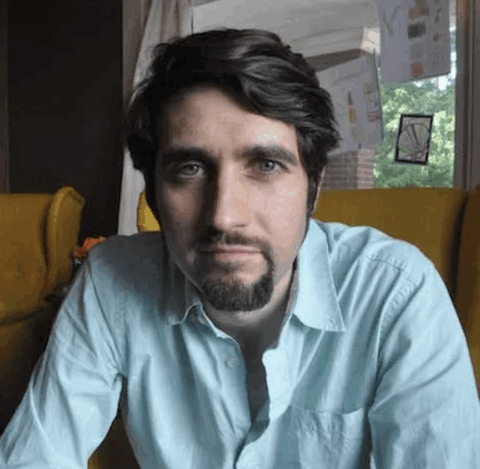
 Derek Mong’s new collection of poems, When the Earth Flies Into the Sun (Saturnalia, 2024), seems both timely and aslant, a book that reckons with many of our present catastrophes inside of sonic patterns that talk, idiosyncratically, to the poets of the past. I’ve known Mong since 2108, when I accepted one of the poems for At Length, the magazine I handed off to him and his partner a few years back. We’ve met in person only once, but we’ve spoken from time to time over those years, often in an attempt to make sense of our attempts to write something worthwhile in a poetry culture that we, like pretty much everyone in that culture, often struggle to understand. So it made sense to continue that conversation in the context of this book, which we did via email over the course of a couple months this summer. — Jonathan Farmer
◆ ◆ ◆
JF: I get frustrated with all the talk of poetry that seems to assume sound and subject necessarily align. That’s not the case with When the Earth Flies into the Sun. So much of the book is about responsibility, obligation, moral imagination, moral and ethical and practical failures. But the sound of it is most often exuberant. To the extent that you think about it when you’re writing or revising, what are you hoping to do with the sound of something like, for example, the first section of “Midnight Arrhythmia“?
DM: “Midnight Arrhythmia” — which is a self-elegy, lullaby, and letter to my son — does shoot for sonic exuberance as it opens. Or, barring that, old-fashioned sonic play. Thus the juxtaposition of the poem’s rather serious first line (“It’s practical, I’ve read, to picture death”) and the buoyant rhymes, or so I hope, that arrive hot on its heels — “owe,” “HMO,” “my love / expressed in shoveled snow.” Those rhymes gave me something to revel in, to roll my tongue around, as I imagined a heart condition killing me before my son grew up. In other words, I took pleasure in juking the language of insurance and estates. Increasingly, though, this is just how I think lyrically.
I’ve been reading this poem at events, and last December my old teacher, Linda Gregerson, heard something in it that I hadn’t. The rhymes, she said, functioned like ligatures. They were a kind of permission, she suggested, that I gave myself to shift scenes or execute a rhetorical turn. She was right, of course, though I hadn’t realized it when writing. This is classic Linda, by the way — she can identify a new strategy or flourish by ear. Another poet, Hailey Higdon, described my sonic play as “a glorious way of delivering the bad news.”
That “glorious” feels too generous, but she heard something that, if I returned to the dark corners of my composition and the impetus for my work, made a lot of sense: I use sonic play to navigate catastrophes large and small. And as my book’s title suggests, this is a collection of cataclysms and catastrophes. Of finding — as I’ve written elsewhere — the solace and sublimity that such events release. The title When the Earth Flies into the Sun is a subordinate clause that I complete in the book’s first line: “it will be morning every day.”
JF: This is also a book about art to some extent. In “A Poem for the Scoundrel Lucien Freud,” you seem to be wrestling with a fear that art might exist in opposition to responsibility, including the responsibility to be decent/good/not a self-indulgent monster. To what extent is that a live concern for you outside the poem? And do you have any sense of how that has shaped the way you write?
DM: While experiencing the events recorded in the Freud poem (early 2014), and in the years it took to complete its 160 lines (2014-2016), it was a very live concern. I was a young dad, and a struggling doctoral candidate, and a husband, and a poet. I never felt like I could fulfill all those roles satisfactorily, at least not with a preschool-age son. Every hour spent on a poem felt like one I’d stolen from him, my wife, or my graduate work.
That acute pressure has abated in the decade it took this one to appear in a book — my son’s 14 now, and wildly independent. But the trade-off or opposition that you identify — it still haunts me. If I sacrificed more, would the poems be significantly better? Would there be more of them? Could I push myself into some heretofore inaccessible echelon or inner circle of accomplishment? Could I matter?
It’s a selfish question, and a masculine one. So I remind myself that there are good, non-monstrous people writing great poems every day. That poetry isn’t a workout or a competition. That art vs. life isn’t a zero-sum game. Still, mortality presses down upon me. I write very slowly. And I continue to believe James Salter when he says that “life passes into pages if it passes into anything” (Burning the Days). This motivates me to work, but it also leaves me perpetually anxious.
I’ll tell you a story that might bring my anxiety into sharper relief. Last winter, I wrote an article for LitHub about ekphrasis. I described museums as my secular church; I mentioned the Freud poem. This led David Raskin, an art historian and poet, to contact me, and we spent a lovely hour together at his home institution, the Art Institute of Chicago, walking the galleries.
Something turned our conversation to artists’ biographies, how they treated their kids and their spouses, and he laughed, noting almost casually that nobody made it onto these walls without being a terrible person. I hope that’s not always true, but for the work we were looking at — Francis Bacon and Donald Judd and Picasso —it sure was.
JF: Masculinity — that’s a big part of this book, too. You teach at an all-male college. I teach boys — along with girls and nonbinary kids. Lots of people (including us!) have talked about all the ways boys and men are struggling, but none of us seem to be finding much that’s really useful to say. At this point — and in the book — how are you thinking about writing about — see? it’s already turning into a mess! — masculinity in ways that don’t feel reductive or trite?
DM: Yeah, it’s easy to forget — because we live in a patriarchy, because our President embodies the worst masculinity on offer — that boys are struggling. They account for 70% of high school Ds and Fs. Teenage girls become valedictorians by the same lopsided number. Boys are likelier to live at home, commit suicide, and develop addictions. And it saddens me that the humanities just don’t appeal to so many men. I see this at Wabash. I see it when I visit writing and lit classes elsewhere, which are 90% women. I have a friend who runs a summer writing camp for high schoolers, and this year she received just three male applicants in a pool of 150.
If I’m able to approach this topic afresh, I do so by drawing on my Wabash experiences. I take small, localized events — ones I observe or live — and extrapolate outward from the gender laboratory of a small liberal arts college for men. Sometimes that happens in poetry; “Ode to Aphaea” is about a #MeToo myth and a class trip to Greece. More often, though, it’s in prose, in essay-reviews or shorter pieces for Zócalo Public Square.
I’m about to teach our senior seminar on Emily Dickinson, perhaps the only all-male Dickinson class in the U.S. That’s an experience I wrote up a few years ago for the Boston Globe. My editor there, Kelly Horan, pushed me to cite specific projects, papers, and in-class comments that could illustrate what was, in the end, the insight I’ve gleaned from discussing feminism and the patriarchy with young guys: “the Truth must dazzle gradually / Or every man be blind.” Dickinson’s lines encapsulate a patient, open-minded pedagogy that reduces antagonism and helps this material take hold.
And often it does. “Many dudes like discussing gender,” I write in the essay. “It’s as if they were accidentally invited to a party with the cool kids.” I hope my own writing occasionally brings that party to the page. It’s too convenient to write about masculinity like a scold — with hand-wringing statistics (see above!) and stock lamentations. But one can get excited, perhaps even exuberant, to imagine — and write toward —masculinity’s future. Where therapy, dresses, and weeping at poems are welcome. Where vulnerability isn’t perceived as weakness.
JF: I’m eager for gender to take on all the forms (and formlessnesses) that people need to live meaningfully. But also, and as part of that, it seems like we need to make more room, in places like schools, for people to be stereotypically boyish without treating those traits as patriarchal or toxic or …
But I’m getting us away from your book. Your vision of the future is instructed by the past. That’s a big part of your book: looking into the past for ways to live, and worrying about whether you’re up to it. It’s never ponderous, and to the extent that it entails obligations, those obligations animate the poems. As heirs to all this art, what if anything do we owe to the various literary traditions we hope to add to in some way?
DM: I completely agree. Boys need room, in schools, camps, or their neighborhood streets, to be themselves. And they need it to last later into their lives than we might expect. Because they mature more slowly than their female peers. Because they ought to be allowed — like all adults-in-training, with their developing frontal lobes — to explore.
As for this next question: we owe our predecessors some quotient of openness and attention. For their cadences, which might sound foreign or old-fashioned. And for their politics, which we’ll perpetually find wanting, just as our own politics, 100 years hence, will be found wanting by whatever readers we retain. We owe them our gratitude, too, for the opportunity they offer us to challenge or change them, acquiescent in their graves, as we shape our language’s shared future. We owe them a willingness to grapple with their work — whether we deem it archaic, offensive, or sublime — as we position ourselves at new, slant angles to all the poetry that predates us.
So yes, you’re spot-on — the past is often on my mind. That’s partially born of my training as a literary scholar, someone shaped in meaningful ways by the writers of the American Renaissance, particularly Whitman and Dickinson. But, more recently, I’ve seen how my own language constitutes a past-in-the-making. My wife and I learn new words and phrases — riz, tuff, aura, jelly — from our son constantly. His vocabulary reminds us how rapidly English and its poetry changes.
This is all to say that I think of the poetic tradition like a Burkean Parlor, that metaphor, coined in 1941, for academic or intellectual debates. In it, Kenneth Burke imagines those debates as endless conversations that we enter mid-sentence. You must listen for a while before you start speaking. Once you do, others rise in support, or don’t. The conversation continues long after you’ve left.
Poetry’s like that too, but I guess we’re all singing. And someone threw the windows open. And our audience, small but steadfast, listens from folding chairs they’ve arrayed on the lawn.
JF: You’re an editor now, in addition to all your other jobs and roles. Can you name a few poets who aren’t getting as much attention as their poems deserve? Do you see any common threads among them? Any hints as to what we might be missing when we talk about poetry and poems right now?
DM: You’re eliding the fact that I owe my current editorship — I co-edit At Length with my wife, Anne Fisher; individually, I edit its poetry — to you and the 20 years you spent building that journal. I remain grateful for that opportunity and this chat. Poetry leads to conversations, in parlors large and small, and this one feels like an extension of our Zoom talks when you passed the At Length torch.
Unless they’re submissions, I read peripatetically, dipping into a poem’s “little gel pack of white space” — to quote Nicholson Baker’s The Anthologist — then moving on. Lots of books, lots of opportunities, until something takes hold. But I really enjoyed Sarah Green’s The Deletions; we published her long one, “The Afterlife,” not long ago. Natalie Shapero’s latest, Popular Longing, is very good too: quick turns and mordant humor that she aims like a blunderbuss at our social doom. Ben Doller has been on my shelves since I first met him as an undergrad. See his new one, “Thend,” on At Length.
Who else? Matthew Buckley Smith’s Midlife was a welcome refresher in the joys of formal poetry. Jonathan Weinert’s A Slow Green Sleep and Jacob Sunderlin’s This We in the Back of the House, both from my publisher, Saturnalia Books, were delights. I just blurbed Ayelet Amittay’s The Eating Knife, a personal retelling of Abraham and Isaac. And though she’s hardly under-appreciated, Deborah Landau’s one of my favorite mid-career poets. See her latest, Skeletons.
If there’s a through-line connecting these poets, it’s that they privilege the individual poem over the project. Their books tend to be shorter, without apparatuses or unwieldy frames. Some poems will, as is inevitable, be weaker than others, but none feel superfluous, a placeholder or bridge to another section. They attend to the line and, I think this is the case for all the poets cited above, the enjambment.
I don’t know if this hints at anything larger, save my own aesthetic, but it certainly indicates how I’d like to see poetry change. I encounter a lot of overly long and under-edited books, many of which are weighed down by prose poems. Some feel strident or even embrace sloganeering. These books sound like they began with a thesis, whereas the poets named above sound like they started with a question. There’s something they don’t understand. They write their poems to figure it out. And I read them because I love to eavesdrop.