Grady Chambers’ debut novel, Great Disasters, is narrated by a privileged young man who drinks too much and is socially and emotionally dim. Have I made a sale? This precis probably won’t do much in itself to persuade a reader to pick up the book, but it’s the cleanest way to describe what Chambers is up to: he’s underscoring his hero’s callowness on practically every page. At a kind of reunion that occurs late in the book, he suggests he’s above classism, but an observer calls him on it: “Where you go to school matters. I mean, look at all of you. I mean, come on — you all went to one of the best private high schools in Chicago.” The narrator, once again, is abashed and put in his place.
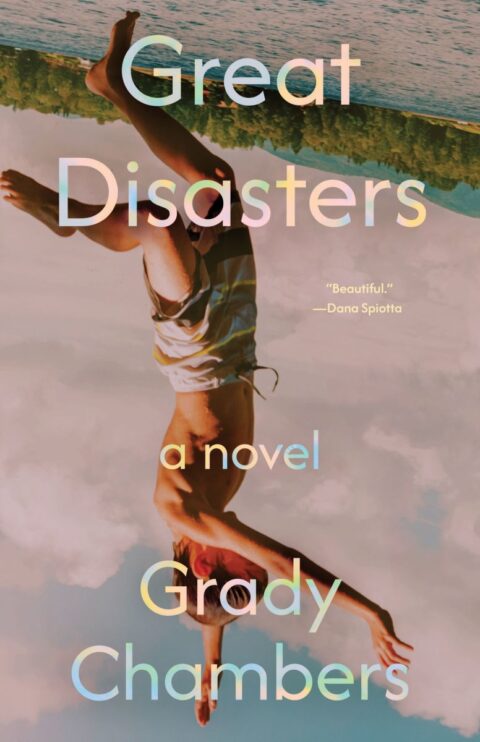 That narrator — we don’t learn his name until halfway through the book, it’s Graham — is a profile in passivity. “I’ve come to feel that I’m a person who receives their life rather than seeks it,” he explains early on, looking back at a crucial moment during his high school years. In that line, Chambers opens up two of the book’s interesting tensions. The first is about the consequences of passivity, how going along with whatever happens around you tends to lead to unpleasant, sometimes tragic outcomes. The second tension has to do with the fact that Graham writes that sentence in the present tense. Despite endless proof that his passivity hasn’t gotten him much, he persists in it. Can a novel sustain itself in an atmosphere of inaction? Can you admire a narrator who doesn’t escape it?
Answers, on the evidence of the novel: Yes, and kind of. If Graham is hard to admire, you can at least admire Chambers’ careful construction of his character, which emerges in a well-off Chicago neighborhood. Softness abides there. His parents and those of his peers were “the hippies of the sixties who had ended up with money, or who had had it all along.” He plays hockey, which seems hard to picture, given his inherent lack of hustle and aggression; there are no scenes of him on the rink, but one imagines him on defense, rarely if ever taking a shot. His whitebread neighborhood, usually the target of suburban satire, is here plainly and unironically bucolic:
“The sky was pure blue. Birds chirped from their perches on the different wires criss-crossing the alley behind the house. Our music played steadily from the kitchen, but there was music everywhere: up and down the street, neighbors had come out into their backyards. Fires were lit, people laughed, barbecue smoke drifted through the air, lawn chairs were dug out of garages, brushed off and spread open for the first time in months, the hum of cicadas rose and fell, screen doors slammed shut, children’s voices ricocheted in the dusk.”
Coddled as he is, the two main stressors in his life are also sources of pleasure. One is the news, which in the novel means 9/11 and the ensuing Middle Eastern wars. Being distant from the violence, he can observe it with bemused interest, even enthusiasm: “After the planes hit, life didn’t seem as boring as it had.” Second is drinking, which he and his friends do a lot of. In basements, at girlfriends’ houses, on a Michigan beach, Graham and his friends are literally stumbling into their futures, trying to figure out what they care about — or ignoring that figuring— in a blur of alcohol.
When you don’t make decisions for yourself, the world makes decisions for you — large and small, which Chambers’ novel expertly traces. The war gives Graham’s friend Ryan a means of escape from his besotted environment — he joins the marines and quits drinking — even while it condemns him to PTSD and military mismanagement. And letting alcohol make decisions means bad decisions get made — the novel pivots on a stupid, prankish gesture that ends up rupturing the friend group’s existence.
 Great Disasters is a confessional without explicitly coming off as one. Graham admits to the shallowness of his thinking, about people and about the early-oughts political moment. He attends an anti-war protest, but unfeelingly. He watches Errol Morris’ 2003 film about Robert MacNamara, The Fog of War, but doesn’t take the lesson — he sees it as a study of strategic confusion in Vietnam, not an indictment of a man using his intellect to excuse pointlessly sending young men to slaughter. In college, he pursues a thesis comparing Cold War and Iraq War propaganda, but his thinking is flimsy and half-hearted.
“To appease, to please — I thought that that was what would make a person love me: to reflect back what I thought they wanted, or who I thought they wanted me to be.” That’s Graham, thinking about his youth. But it’s also him in his 30-something present. When he catches up with a middle-school girlfriend, now sober, she has to explain to him the distinction between passive concern and active care. When she posted a cry for help online, she explains, “Ryan responded. He was the only one, actually, except for people responding with heart and hug emojis or whatever. I guess a few others said they were thinking of me. But he actually messaged me when he saw it. He was home on leave. He said he knew what I was going through … I think it was either that or I was going to die, so I did. I called him.”
Later, Ryan delivers his own confession to Graham, and concludes it this way: “Probably telling you ‘cause you’re basically a stranger, so what does it matter.” So here’s the virtue of passivity — it can, at least, make you a repository of somebody else’s stories. Although he’s stung by how little esteem he’s held in. A capacity to hear others’ stories is a start, but it’s not an identity.
Great Disasters moves roughly in chronological order, but Chambers bounces back and forth in time, as if to echo Graham’s slow process of understanding himself. And though the novel is full, Graham often runs into absences — blackouts, half-remembered conversations, antics he’s uncomfortable facing up to. (This isn’t a novel about recovery, but Graham behaves like he’s easing into AA’s fourth step, the “searching and fearless moral inventory.”) Some of the gaps are intentional — he lists a boy named Ricky as part of his friend group, then notes “you can mostly forget about Ricky,” just a side player in the teenage bacchanals.
Toward the end of the novel, when Graham explains to an old friend that he’s writing about those days, the friend scoffs: “It’s just what happened. It’s just something that happened.” But that’s the voice of somebody who was busy doing other things, acting. Graham, in the process of writing the novel, is only beginning to come into awareness that doing things, reckoning with what happened, has value. That feels a little pathetic as epiphanies go, delivered as the novel rounds the turn to the finish line. But spare some feeling for the novelist who can make passivity into something affecting and energetic, and for a protagonist little practiced in taking action. Here, at last, between covers, is his act.
[Published by Tin House on September 30, 2025; 224 pages, $17.99 paperback]