Like Celtics games, Jubilee videos, or first-person shooters, Mark Doten’s fiction makes hatred fun. Almost any contest does it, really. With Doten’s work — encompassing two novels and now a short story collection — the contest is to see what stands out more, the hatred of its characters or the hatred with which it’s written.
Whites, Doten’s debut collection of short fiction, collects haters — a grifter-cum-arsonist who SWATs himself, an alcoholic who kills a dog, a self-proclaimed “president of hell” who steals the souls of podcasters, a woman dubbed the “World’s Worst Karen,” and Elon Musk, among others. The stories run on antipathy and resentment, the kind that spurs online defenses and manifestos. Doten doles out punishments and judgments in return. Characters end up homeless, unable to speak, stripped of their parent or pet, detached from reality, jailed, or murdered.
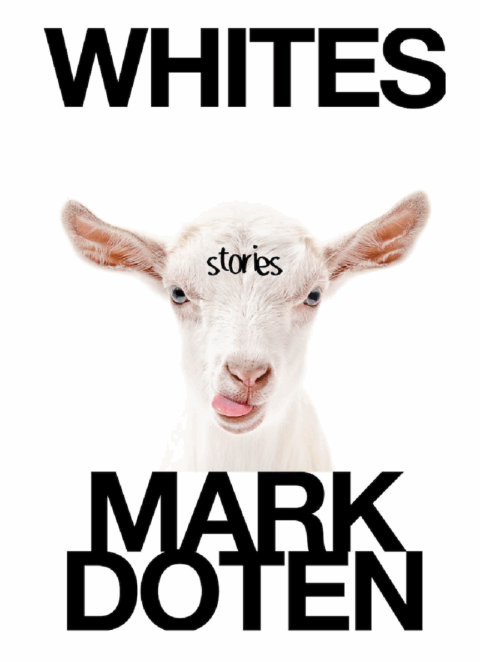 Darkness fuels the book’s satire, which is that of Terry Southern and not Percival Everett, unable to suppress contempt for its characters. It’s only with irony that Doten, parroting a Boomercon dialect in a series of epigraphic hashtags and slogans, claims these fictions “SPREAD LIGHT INTO DARKNESS!” Where Whites goes, there is no light. As soon as a character writes a sentence like “Readers, welcome,” he starts the next with, “Lol, but kill yourself.” What follows is a severe and splashy collection, peopled by caricatures and steeped in melodrama, bundled together by Doten’s skill as a mimic and his world-class facility with experimental narrative structures.
Doten, executive editor at Soho Press and an Ivy League prof, published their debut novel, The Infernal, in 2015. The novel remains Doten’s finest work and plays to their novelistic strengths. Its structure explodes with ideas, imitations of diary entries and redacted government documents, mixing the conspiratorial mythos with science fiction elements and slapstick. Along with Doten’s other major early work, a libretto for composer Ted Hearne’s oratorio The Source — which uses documents leaked by Chelsea Manning — the novel uses a kind of farcical docupoetics to broaden its scope. “[W]e as a species — or as a species in a country — see very little of each other,” Doten observes in the book, and their early work gets readers to see as much as possible.
The Infernal’s full plot is unsummarizable. I’ll spoil some of it. Jimmy Wales (the Wikipedia co-founder, but not the one who opposed a vaccine mandate) preserves in his body, for 1,000 years, the voices of important figures who destroyed the earth. He travels back in time with these recordings to warn the figures and prevent Earth’s destruction. The time travel, however, burns up Wales’ body (with “such severity that neither race nor gender [is] immediately apparent”) and damages the recordings, so no one listens to him. The book earned Doten a spot in Granta’s 2017 list of Best of Young American Novelists, the class with Joshua Cohen and Catherine Lacey.
In The Infernal, Doten describes themselves as a “bundler,” which continues to be the case in Whites. Doten in particular loves to package together lots of monologues and voices. “A Fence Is Not Walls” takes the form of a centrist senator enabling Trump’s immigration policies while claiming to oppose them. “I favor more of a fence-based approach,” the senator says, as opposed to Trump’s border wall, “which for the record I’m not in support of.” The title story, narrated by the smug president of a nonprofit, nails every rhythm of the professional-managerial class. Doten has an ear for the ticks and repetitions of speech — the passive verb that hides culpability, the sentence that ends in “right?” to induce approval, sentences that start with “So,” the project that’s “ready to move forward.”
These skills in mimicry are the foundation of Doten’s conception of character, first introduced in The Infernal. Because the book’s plot hinges on Jimmy Wales acting as a living Wikipedia, most of the characters are real people. (As such, the book begins with a particularly lengthy legal disclaimer.) This includes Barack Obama, Andrew Breitbart, Dick Cheney, Jack Nicholson, Osama Bin Laden, and even Jeff Gannon. This fondness for writing public figures continues throughout Doten’s work, and in Whites it extends to Trump and Elon Musk. Each of these characters arises not from a motivation so much as an impression. They’re voices.
In one sense, fiction that starts with known figures — e.g. Curtis Sittenfeld’s Rodham or David Foster Wallace’s “Lyndon” or Colm Tóibín’s The Magician — takes a shortcut. Readers can picture or hear the characters already, or at least start from something rather than nothing in their conceptions. Yet the best of such work, and the best of Doten’s work, uses the figures as a base layer to build on. The Infernal pushes Bin Laden and his devoted followers beyond their real lives and into a kind of Salafist Pinky and the Brain, cartoonish antisemites forever foiled in elaborate schemes against “the Jewboy.”
 Doten makes characters, in fact, the way Americans take in and take on pop cultural identities. The first story in Whites, “Even Elon on Human Meat,” can’t help but remind readers how much of the past few years we’ve given to absorbing Elon Musk. His voice and thoughts, his belated adoption of the MAGA fears over the “woke mind virus,” and his unerring radar for bad jokes have become a part of us. The story, a monologue Musk delivers “at the robot factory with the media here” after one of his rockets explodes, annoys us in the same way he does. That’s part of the impression. “The thing about a joke,” Musk says in the story, “is that if people don’t think it’s funny, that’s funny.”
Like many impressionists, Doten couldn’t resist doing a Trump. The arc of their second novel, 2019’s Trump Sky Alpha, is subtended by two extended Trump monologues. After the internet goes down for four days “during the chain of events that came to be known as 1/28,” Trump starts a nuclear war and kills most of the population. Trump escapes to float above the chaos in his “ultraluxury zeppelin,” from which he gives rambling YouTube addresses twice a week. One of those left alive is a journalist named Rachel, who has been assigned to write about not the end of the world, but rather the recent trends in internet humor.
Doten admits to writing Trump Sky Alpha more quickly than the previous novel, and in response to being “pretty stressed after the election.” Whereas The Infernal kept the cool distance of a time traveler with knowledge to impart, Trump Sky Alpha is too soon and heated, full of resentment for having to be funny. “[T]he world is exploding,” Rachel tells her editor. “And you want, what, Distracted Boyfriend memes?” The book’s anger is palpable. Such a line might as well be Doten talking to the reader.
It’s fitting, then, that Trump Sky Alpha is also the first of Doten’s books set in their home state of Minnesota. Rachel lives in what’s called the “Twin Cities Metro Containment Zone,” full of radiated survivors whose “eyes have all turned gold.” Whites likewise sets much of its action in Minnesota, mentioning Edina, Woodbury, and Bloomington, near where Doten grew up. The two books establish Doten in a lineage of particularly Minnesotan satirists. Sinclair Lewis, Garrison Keillor, and Charles Baxter all write in varying degrees the satirical equivalent of Minnesota nice, where humor barely disguises a real seething underneath. “[Y]ou’re laughing now,” a narrator declares late in Whites, “but there is a reckoning coming, there is a change that’s coming, fuck y’all.”
Anger first takes the ship’s controls in Trump Sky Alpha. “History’s fucked us,” Rachel says. “I owe precisely nothing to history.” A naked woman she’s slept with “is a mallet I use to hit myself.” Anger’s attendant melodrama, in fact, undercuts the humor. A villain named Birdcrash gives an unhinged monologue before drilling holes in Rachel’s skull and pouring acid into them. “More tape, more tape,” he says aloud. “Wrappy wrappy.” In the hospital, Rachel gasps to her editor, semiconscious, “Resist!”
A review in the Cleveland Review of Books sensed this and invoked György Lukács: “Satire animated by hate can function as a vehicle for revolution.” A year into Trump’s second term, it’s tough to see the satire on display in Trump Sky Alpha as having sparked a revolution, but the reviewer put his finger on the right emotion. What began in Doten’s work as righteous anger has pickled over time into a hatred for their characters, who in Whites meet fates of cathartic extremity. The pleasures of the previous books are present still, the structural ingenuity and the spot-on imitations. At certain points, reading Whites is like getting invited to Mark Doten’s birthday party and watching them hammer the piñata into the dirt long after everyone else has gotten their candy.
Take “Every Soul Ever,” a story centering a nursing home worker who “won’t get the jab.” In this protagonist, Doten creates a woman who calls one of the residents a “hag” and mocks people who “scream in pain.” When the hag dies, our protagonist says, “Good riddance!” Our protagonist doesn’t want to get vaccinated, so much so that she “lets herself get fired.” By the story’s third page, however, our protagonist reverses her stance, “claws her eyes out,” and tells people “the jab” caused it. She gets a man to agree to saw off her limbs and claims the jab did this too. She posts a video and sees it’s going “so so viral” (how she sees this is, how she clicks the mouse, etc., remains a mystery). The woman’s taken to the hospital, stops at the desk to call the receptionist a slur, and is seemingly euthanized.
Several characters meet violent ends. If we assume that Elon does kill the woman he steps on in “Even Elon on Human Meat,” five other of the collection’s 14 stories feature killings. Such violence intervenes between the reader and the characters, as if to forestall any accidental sympathy. In “Pray for Q,” a son confronts his mother at a diner, trying to break through her newfound QAnon beliefs. “Can we agree on a minimum sense of reality?” he asks. Before the reader can investigate what would compel a “sixty-five-year-old lesbian” to a 4chan board, the story jumps and switches POV. The mother has killed her son and put his body in the trunk, believing he’s been “switched out.” These people, the collection forces us to conclude, aren’t human. They’re monsters. They’re caricatures.
The longer stories in Whites lend themselves to exhibiting Doten’s structural ingenuity. “Banana Bunch Challenge” combines the confessions of a lolcow with the narrative of an accidental viral video. A self-proclaimed “gay man and a patriot” goes out in a spandex suit with a Kekistan flag to warn of whites being “exterminated by the brown hordes.” Perhaps in an allusion to a real news story in Pennsylvania, where a man beheaded his father and held the head up to the camera, the virgin patriot protagonist kills his father and attempts to shoot up the school nearby. The plot’s violence is de trop as in the other stories, but done with more self-consciousness and novelty. The story’s back half follows his two would-be victims from viral fame to being accused “crisis actors” to SWATting themselves for more fame, the life cycle of modern American grifters.
 The longest story, “I’m Wide Awake It’s Jumpman,” offers the collection’s most compelling character. The second-person voice brings life to a nonbinary sneakerhead podcast producer who goes to jail after storming the Capitol on January 6th. Doten leaves this protagonist room to explore ideas without having to dodge bullets. They articulate themselves through paradox, the language of someone who’s recognized the fallacy of a binary. They trace the history of their gender identity while claiming not to “believe in the self,” and prize independence while desiring connection. The producer wants their mother’s attention while asking themselves, “Why does she think that’s something she can have?” The story acts as a rebuttal to its collection mates, an “investigating for the investigation” that values curiosity above hatred. Its structure, nonsequential flashes that circle around the linear narrative, likewise presents a potential future for Doten’s fiction.
A subtler terror, however, is that the world of Whites is one in which fiction has no future. An alarming sense creeps through the collection of a form that’s made itself redundant. Six of the stories recapitulate a viral video, and two center a podcast. “A Fence Is Not Walls” reads exactly like the transcript of a politician speaking to reporters.” “J6ers” reads exactly like how Capitol rioters speak in interviews. “It’s German for The, Trump, The” reads exactly like scrolling Twitter when Trump got COVID. “I’ll Be Slayin While Woke Yt Twitter Burns” reads like a rewrite of the Rachel Dolezal saga. The question arises: why read these as fiction? Why not watch an actual viral video, actually scroll timelines, or read an actual interview transcript? The book struggles to answer, at times so concerned with verisimilitude that it forgets what fiction can do, so busy replicating that it forgets to add something.
Not just the forms of White’s stories but the characters themselves have ceded the ground of literacy. Monologues dictate the collection’s style for a reason — these characters don’t read. When the word “literature” appears in “Lord Wumpa,” it’s referring to brochures for a cookie manufacturer. The nonprofit president, the Tesla CEO, the president, the QAnon mom, the antivax nurse — they’ve given it up to scroll and comment. Only one character in Whites ever mentions a book: the murderous “gay white supremacist” in “Banana Bunch Challenge.” “[W]e must protect our art,” he says, the “we” referring to “the white race.” He twists Moby Dick to support his “will to power,” wringing from it support for his antisemitism. “Because either we win,” he tells his readers in a manifesto, “or they do.” This he writes before shooting himself in the head after slipping on a banana peel. And what tools, then, are left to those who oppose him? Posts.
[Published by Graywolf Press on August 19, 2025, 160 pages, $17.00US paperback]