on Absence, a novel by Issa Quincy
Now in my mid-40s, I have hit the age where nostalgic traps seem impossible to avoid. Movies from my childhood are remade at an astonishing clip, as are cartoons and television programs. Online, I swap memes of silly 80s and 90s toys with cousins, friends, and my spouse; I trawl the internet, hunting for half-remembered songs or old novel covers, and frankly, I am embarrassed by the hours I have lost on Wikipedia, reading through the various lineups of bands that my 18-year-old students have never heard of.
Most of this activity is designed to fool myself into thinking I can recapture elements of my vanished youth, of course, but I also value the storytelling aspect of nostalgia. When I visit my ailing father, I listen closely as he recalls his past, and as the number of aged loved ones in my life dwindles with each passing year, I have learned the vitality of slowing down to appreciate such reminiscence. Absence, the splendid debut novel by British writer Issa Quincy, revels in this same kind of unhurried listening, and as its protagonist bounces from country to country, from the near present to the past (and back again), it embraces the echoes and distress that accompany wistful conversations.
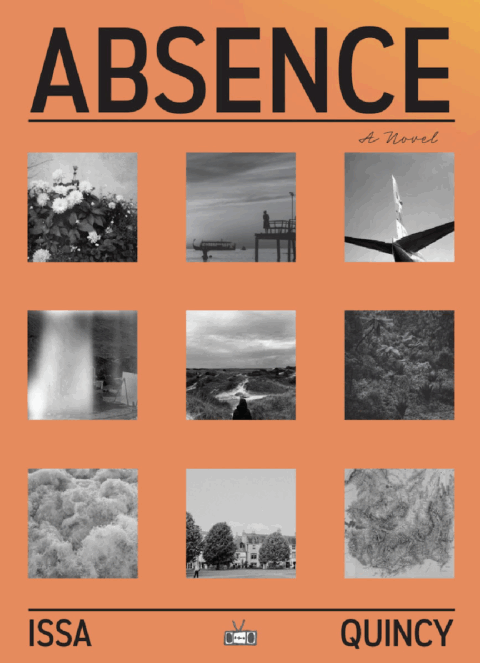 Quincy’s stylistic approach in Absence leans less on overarching plot and more on a series of stories threaded together by the title subject, all told to or experienced by a nameless male narrator, who opens the novel by mentioning a poem his dead mother read to him as a child. This poem returns at unexpected times in his life, and as the novel progresses, some of these reunions make their way onto the page. After his former English teacher commits suicide, for example, the narrator hears snippets of the poem read aloud by an acquaintance cleaning out the dead man’s home. Years later, the poem appears in an email sent to the narrator by his former roommate/landlord, and the poem surfaces once more in the novel’s final paragraphs. Throughout, the narrator never explicitly names the poem, but Quincy’s inclusion of a few quoted lines, as well as noting the author as “C.3.3.,” insinuates the poem in question is Oscar Wilde’s “The Ballad of Reading Gaol,” written partially while Wilde was imprisoned for homosexual acts and published in 1898. The poem’s most celebrated line — “Yet each man kills the thing he loves” — does not appear in Quincy’s text. Still, this feeling, together with the poem’s motifs of injustice, longing, and remorse, pepper Absence as the narrator seeks out stories from friends and family.
Beyond the reappearance of Wilde’s poem and its themes, Quincy includes additional repetitions that double as structural tentpoles. Characters frequently uproot their lives or are in the process of cleaning out homes. Death and vanishings haunt most stories. On a more concrete level, Quincy repeats character names, too. In an early chapter, the narrator recounts moving to Boston from England after finishing his schooling. While working at a restaurant, he befriends a bus driver, Patricia, who wears expensive perfume and speaks of an estranged son. Around this same time, the narrator crosses paths with a junkie twentysomething named Patrick. Despite their physical proximity, Patrick and Patricia never share a scene, yet their individual unrest impacts the narrator’s stay in the city, washing a dark patina over this time.
Fast forwarding several chapters and years, the narrator, now back in England, decides to learn more about his deceased godfather, Max, who committed suicide when the narrator was thirteen. He visits the home of a family contact, Margaret, and as she divulges Max’s troubled past, she mentions Max’s brother Patrick, who was born premature and died tragically young. Margaret also states that for a short period, Max coincidentally dated a man named Patrick, who encouraged his artistic inclinations. The double inclusion of Patrick here naturally calls back to Boston’s Patricia and Patrick. All four carry heavy loads and faced encounters with misfortune, yet more importantly, by constructing this narrative repetition, Quincy begins to suggest that, regardless of location or time, desire and pain are universal: the names do not even have to change. In fact, near the novel’s conclusion, the narrator’s father discloses a story that reinforces this idea, functioning as a metaphor for the narrator’s activities. In the tale, the father meets an old woman on a beach in Tunisia, who tells him about her family (in a lovely use of story-within-story-within-story). By the end of their exchange, the narrator’s father understands that she spends time on this beach nightly as a vigil to her missing brother, Hamed. The father explains that each year, the woman:
“… would come to Nabeul and stay at the Hôtel Club Riadh. And on each night of her stay, she would sit by the water and proceed to unstitch all the patches from the previous year to restitch a set of new colours and patterns into her brother’s old jacket. She would spend part of the year before sourcing new materials, attempting to create an entirely new piece of clothing each year . . . This process, continuous and shifting, she believed kept her in close conversation with Hamed.”
This repetition on the part of the elderly woman mirrors the motivations of the narrator, who spends each chapter finding a new speaker, listening to a new past. He alters locations, yet like the changing colors and patches on the jacket, the end product retains a basic, recognizable form. The narrator’s objective of recalling that which is lost, or engaging with others aiming to accomplish the same, establishes a pattern ripe for repetition, for setting up guidelines and filling in blanks, and by building a novel around this template, Quincy and his narrator propose a larger dialogue focusing on the power and limitation of memory.
 When seemingly unique traumas consistently fit into similar presentations, do they retain their explosiveness? If so, does one trauma weigh more than another? At one point, the narrator wonders if his “sense of home could in fact be found in the series of returns and recurrences that came sweepingly back” as he navigates roads and shorelines, yet he equally questions if secondhand recollection can be trusted as legitimate evidence. While learning about his godfather Max, the narrator slips into what he dubs a “naïve daze … perplexed and unknowing.” Unfitted to sift through embellishment and fact, he concludes “that the knowable would forever remain unknowable and the sayable would forever remain pale, ghostlike, evasive.” Though he may chase the past through recording the stories of others, there remains a barrier between recollection and reality.
In the end, perhaps that is the point of nostalgia, of settling in to hear a story from childhood, or of unearthing the lost song that helped soundtrack a specific moment — to get as close to the knowable as possible while acknowledging that any kind of memory is doomed to inaccuracy. At the novel’s onset, the narrator admits that the Wilde poem helps to remind him of “who [he] was before [he] disappeared.” The narrator sees himself as an absence, and this submits another reason for chasing nostalgia: to recall the things that make us feel alive. While Issa Quincy’s debut occasionally wobbles under the denseness of his loquacious speakers, overall he has crafted a confident, absorbing novel that digs into the past to help clarify the present. As the narrator notes, whether absence is triggered by a scent, or neurological damage, or the anonymity of sitting alone in a franchise coffee shop, the sensation is one every soul knows all too well.
[Published by Two Dollar Radio on July 15, 2025, 166 pages, $17.95 paperback]
♦ ♦ ♦ ♦ ♦
on The Hairdresser’s Son by Gerbrand Bakker, translated from the Dutch by David Colmer
Dutch author Gerbrand Bakker’s novel, The Hairdresser’s Son, first published in 2022 and now superbly translated for anglophone audiences by David Colmer, uses a real-life air disaster as an impetus to meditate on the kinds of solitude and loneliness felt all too often — yet rarely discussed — by generations of men. Bakker centers his novel on Simon, a 40-something hairdresser living in present day Amsterdam, as well as Simon’s father, Cornelis, who deserted his family in 1977 to abscond with another man and was presumed dead in a plane crash months before Simon’s birth. Simon now runs Chez Jean, a small salon handed down to him by his grandfather, Jan; against that elder’s wishes, he leaves the salon door’s sign turned to fermé most days. He opts to work with clients on an individual, pre-scheduled basis, rarely speaking and interjecting with a simple “hm” or “gosh” as he snips away. Outside of conversing with Jan during his monthly appointments, the single client Simon halfheartedly chats up is an unnamed male writer, who asks to observe Simon at work for his latest novel. Simon agrees, but otherwise, he lives an introverted life in the apartment above the salon, surrounded by framed posters of famous swimmers he once tried to emulate.
 Back in 1977, Cornelis and his companion — both hairdressers, too — book seats on a flight to the Canary Islands, only for their plane to be diverted to Los Rodeos Airport in Tenerife after a bomb explodes at their intended destination. The passengers deplane until the flight is cleared to return to the sky, and lifting off hours later, Cornelis’s aircraft collides with another, resulting in the real-life airport disaster that, with 583 fatalities, remains to this day the deadliest in aviation history.
Employing a narrative twist, Bakker reveals that Cornelis — trusting “a sinking feeling in his stomach” — refuses to reboard his plane in Tenerife and walks to the nearest town, eluding the disaster that kills his companion and entering an unfamiliar world without knowing a word of Spanish. Unsure of why he wants to continue escaping everything he knows back in Amsterdam, he is hired at a salon to placate any non-Spanish-speaking customers who pop in for a trim. When necessary, Cornelis converses via gestures with his new co-workers, foreshadowing his son, decades in the future, cutting hair in Amsterdam and barely muttering a response to his rambling clients.
 Father and son seemingly pass off their solitude as contentment, but as communication barriers exhibited by the duo repeat throughout Bakker’s novel, these obstructions reinforce the loneliness of the protagonists and serve as a metaphor for the ways men tamp down emotional expression and physical connection: if you cannot communicate, you cannot show your truest self. Though Cornelis — now going by Carlos — starts to reluctantly learn Spanish, Bakker writes that, “In the Netherlands he often didn’t feel like [talking]; here he was simply unable to hold a conversation.” Such thinking reinforces his isolation, helping him feel protected yet also deeply alone. Settled at his new job and living in the apartment above the salon — mirroring Simon’s later housing situation — Carlos rebuffs the overtures of several women, preferring brief affairs to long relationships. He befriends his co-workers while keeping them at arm’s length, adopting a dog for company, instead. And after over a decade on the island, Carlos encounters a different connection, one without conversation: he takes a fatherly shine to his co-worker’s intellectually disabled daughter, Gustava. She speaks by making the sound, “Aaiiii,” and Carlos shuttles her on adventures around the island.
A similar narrative echo emerges for Simon when his mother, Anja, asks him to fill in as a co-swimming supervisor for a group of teens with intellectual disabilities. This experience breaks Simon out of his cocoon, but his natural inhibition is nevertheless reinforced, since nearly all the teens are nonverbal, and those who do speak cannot hold a deep conversation. Anja talks with her son as they wade through the water, but much of their time is spent reprimanding and guiding their charges. The lone highlight for Simon comes in the form of Igor, a nonverbal teen in the program to whom he finds himself embarrassingly attracted.
Carlos connects without language by spending time with Gustava. Simon, on the other hand, feels sexual shame assisting Igor, and in both circumstances, Bakker illustrates how even when surrounded by others, men like Carlos and Simon refuse to reveal their natural selves. Father and son remain stuck inside their own heads, emotionally impenetrable.
Carlos’s timeline slowly catches up with Simon’s as chapters amass, and along the way, Bakker more deeply explores each man’s loneliness in manners that, if divulged much further, would spoil the novel’s final third and smart conclusion. Simon closes in on Igor in ways that creep toward pedophilia, and though Carlos completely erases Cornelis from his daily existence, he secretly attends a memorial unveiling for the air disaster’s 30th anniversary. He slumps in his seat at the event, worried someone might spot him, and later, he roams El Teide volcano to unwind. He admits he finds the volcano beautiful, but that it has lost its ability to inspire him. The admission leads to the following consideration:
“When you get older, things become normal. You should actually go in search of new things to give yourself a chance of feeling euphoria like that once again. But as you grow older and see the things around you as normal, settling into a new life, the possibility of turning back becomes more and more remote.”
 This feeling of resignation sums up the actions of Carlos and Simon, plaguing father and son as they toil, err, and sequester themselves again and again, self-sabotaging and clinging to facades as they barrel toward an unexpected climax and dénouement. When Simon meets the unnamed writer for drinks at a gay bar, the experience is completely new, yet this foreign location is similar to Simon’s salon in that they are the sole customers. Oscar, the bartender, perpetually hovers nearby, hoping to be included in their conversations, which eventually include Simon’s thoughts on his absent father. The physical emptiness of the space is striking, as is Oscar’s forlorn existence behind the bar, and though Simon sleeps with the writer once and has a one-night stand with a different man he meets at a pool, he never establishes a solid relationship with either, retreating to his remote existence. Soon, Simon’s ruminations on his father spark in him the desire to learn more about the man’s assumed death, which furnishes new opportunities for isolation. The longer he spends online, reading news reports or watching YouTube documentaries on the airport disaster, the less time he can spend in the physical world.
Despite its many attractions, The Hairdresser’s Son does have its blemishes. In particular, Bakker seeds glimmers of metafiction into late pages, a superfluous decision that calls into question which elements of the novel occurred to Simon and Carlos, and which were perhaps products of the unnamed writer character’s imagination. (As if aware of the polarizing effect of these additions, Bakker has Simon note to Jan, “… writers always milk something for all it’s worth.”) Thankfully, these metafictional hints are rare enough that they do not upend the novel’s determination to linger in narrative solitude and to chronicle the many ways men refuse to help themselves find happiness. With The Hairdresser’s Son, Gerbrand Bakker has written a book that spotlights male loneliness in a manner that is just now being addressed by general society. It is an uncomfortable journey, but one well worth investigating.
[Published by Archipelago Books on August 12, 2025, 289 pages, $22.00US/$29.00CAN paperback]