What’s A Murder for Miss Hortense about? The author herself responds in five words, a restriction suggested by an “NerdDaily” interviewer: “Community, Pardner, buried secrets & turmeric.”
While a cozy mystery with a Black detective is rare, one with a Black woman detective is a five-leaf clover. Miss Hortense as detective takes center stage in this debut novel by London-based playwright Mel Pennant. Setting: a suburb of Birmingham called Bigglesweigh where Miss Hortense’s past is entangled in the death of an unidentified man with a Bible quotation (as you guessed, not the sixth commandment) next to his body.
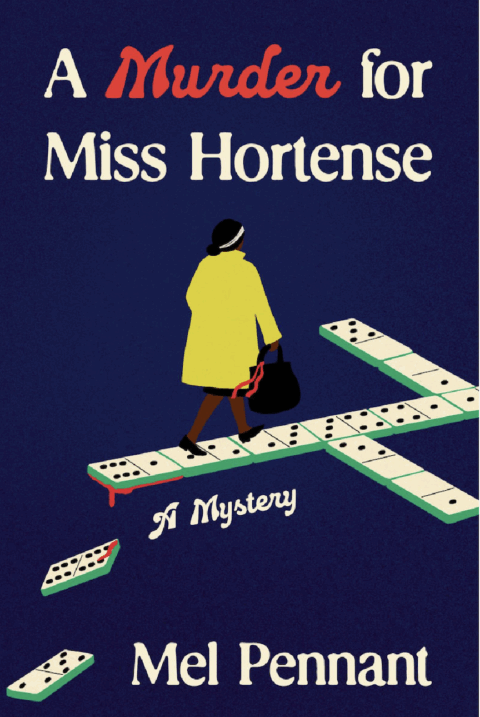 Hortense immigrated to the UK in 1960 from Jamaica, making her part of the Windrush Generation. She had a career as a nurse, and joined a Black investment group in her neighborhood. A Pardner, also called Box Hand or Sousou in the Caribbean community, is a mutual saving scheme in which a group of people pool their resources. The accumulated wealth is distributed on a regular basis among the contributing members. For reasons that unfold throughout the novel, Hortense’s churched colleagues in the Pardner forced her out 30 years before the novel begins, leaving some thinking the cause was stealing from the fund, resulting in Hortense’s alienation from her community and friends. Nonetheless, many locals continue to respect Hortense, to crave her cooking, and to seek her nursing knowledge. At 65, she’s still a force with which to be reckoned.
Since the local police often refused to pursue cases in Hortense’s community, “the Pardner members inadvertently also became unofficial sleuths in their own community.” Early on, Hortense developed a reputation as a keen and fearless investigator. The role thrust upon Hortense highlights a larger issue about how people in the UK, especially the police, treated the Windrush generation. Not the empire’s proudest moment. Back in Jamaica, Hortense “had confidence that if something wrong was done against her or any member of her family or community, justice would at least be seen to be done. But in England, for her people, it was another kettle of fish entirely. Because of that, it wasn’t often that you heard of her people going to the police for anything.”
If you’ve seen the South African/Scottish TV mystery series “Recipes for Love and Murder,” Hortense’s way with food will be familiar. The narrator includes, for example, a recipe for Bulla Cake. Cooking “calmed [Hortense’s] nerves and gave her space to think.” The food is salubrious for everyone who comes calling for Hortense’s help. One of her frequent guests went “in secret every Wednesday for a slice of Miss Hortense’s black cake generously soaked in rich ruby wine and white rum.” The recipe had been handed down through generations.
Away from her kitchen, Hortense uses food as a wedge into resistant spaces, such as when she shows up without an appointment for a quick wash and set at the Mane Attraction, but with “a freshly made tray of gizzadas, which Bola squealed at.”
As with the strangeness connected to policing Bigglesweigh, the food and the language of the Windrush Generation pose their own resistance to the breezy presupposition that immigrants should fully assimilate — a verb linked to digestion, to being digested — immediately. Who wants to be digested? Furthermore, the fact that most immigrants are not on equal footing, financially or legally, with the population at large quickly renders “fitting in” improbable.
 In what could have been a persistently sobering narrative, Pennant swirls in moments of humor. When the hypochondriac Blossom knocks on Hortense’s door late one night, the narrator makes plain Hortense’s reaction: “If it was anything to do with how she [Blossom] was dying, Miss Hortense would damn well help the Grim Reaper finish the job.” One of the fine things about Hortense is that one moment she can think of throttling her sidekick Blossom, and the next defend Blossom. A character named Fitz says, “From morning me never know a woman stupid like a she.” Hortense responds, “Blossom cares. There’s no crime in that.”
Pennant’s compositional power comes across fully in her presentation of Hortense as a character with multiple weaknesses and strengths, one of which is a commitment to justice. As the radius of the case widens, Hortense wants to make sense of the people around her, which also aids her in making sense of herself, particularly how she misunderstood the kind of suspect she had been pursuing for years, and how she ended up on the outs with the others in the Pardner. Furious at the violence in her community, Hortense understands that the past can be like a deadly undertow that requires you to swim parallel to the shore until you are, as the old film noir title has it, out of the past.
[Published by Pantheon Books on June 10, 2025, 342 pages, $28US/$37.99CAD, hardback]
- •. • • •
For readers of An Enemy in the Village, the 24th installment of Martin Walker’s Bruno series, Bruno is almost as famous as a cook as he is a police official. From the beginning almost two decades ago, Walker’s entry into the cozy mystery genre relied on an audience with specialized culinary tastes, one that perhaps contains more enthusiasts than any outsider would first imagine, until that outsider remembers the success Julia Child wielded in the U.S. with French cuisine when many Americans fancied TV dinners in aluminum foil trays. Walker’s first Bruno mystery, Bruno, Chief of Police, appeared shortly after the Paleo diet reached the public’s consciousness. Yet even Paleo fans don’t necessarily bind diet to the land one occupies, a crucial element of Bruno’s terroirifying worldview.
 How crucial? Don’t get Bruno started on the truffles he and his dog hunt up on Bruno’s land. Here’s one of many such samples from the novel: “Every autumn [Bruno] bought duck legs by the dozen, mixed some chopped bay leaves and thyme into sea salt, rubbed the result into the legs and then left the salted legs in a covered dish overnight. The next morning, in a deep pan, he would spoon in enough duck fat to cover all the legs he’d prepared and simmer them over low heat for two and a half hours.” At times, Walker’s novels read like cookbooks, literary spinoffs of a Francophone “Crime Scene Kitchen.” It’s not my cup of tea, but no one is drinking tea in a Bruno novel. Apparently, readers come for Bruno’s homemade vin de noix, and never plan to depart the fictional Dordogne intended for carnivores, hunters, connoisseurs of wines, cheese, and charcuterie boards, as well as champions of a rural form of “common sense.” If you’re familiar with The Savage, Noble Death of Babs Dionne, you’ll recognize in the Bruno series the passionate conservatism of non-urban French Catholicism.
As for the mystery, Walker wastes no time putting the corpse in play. In the first chapter, Bruno discovers a woman’s body, Monique’s, slumped over the steering wheel of a Peugeot 508. Mystery veterans know that suicide is almost always misread initially, especially if an inheritance is at stake. Surprisingly, Walker sustains the suicide scenario for almost the entire novel while we witness Bruno, à la The Last Temptation of Christ, suffer physical and verbal abuse, unconnected to the woman in the Peugeot, from various quarters, likely non-Peugeot owners, despite the accumulated good will from the people of his town, St. Denis, where on each market day morning, “Bruno probably kissed a hundred women and shook the hands of at least as many men” (from the first Bruno novel).
Bruno knows the people of his town. It’s what he calls “local knowledge,” a key element in his theory of how policing should happen.
In addition, Bruno teaches sports to the local children. During a radio interview, he says, “I think it really helps everybody in the valley that the children grow up knowing me as Bruno, and not as some anonymous authority figure with a gun and a uniform.” They also know him as a man with a basset hound and not a Doberman. In the first Bruno novel, the basset hound’s name was Gigi. The current dog is named Balzac. Such details make Bruno twee or scrumptious. My guess is that the series survives due to readers who think the latter.
 When it becomes clear that Monique’s suicide was anything but, Bruno summons his support group both to investigate and also to choreograph the culminating scene. No hint that this marks the end of the Bruno series. Rather this iteration of Bruno immerses him in contemporary political issues — the rise of the far-right (a topic that has been there since the series began) and various green parties, abortion, gender disparities in pay, immigration. In the midst of it all, Bruno practically claims neutrality: “I’m not very political, but I don’t like the hard left and can’t stand the hard right.” Walker justifies this with a robust relativism: “Words had many meanings, he [Bruno] had learned, and whatever might be wholly true today might evolve to allow for different circumstances tomorrow.”
One consequence of Bruno’s relativism is his willingness to play fast and loose with the spirit of the law, which he justifies via his commitment to his community. It leads to the interesting ambiguity in the novel’s title. Who is the enemy in the village? At one point, Yveline, who is helping Bruno with Monique’s case, says, “The problem is you, Bruno.” Difficulties higher up the food chain happen, in part, because, according to Yveline, “There is not much crime in St. Denis, nor up and down the valley now, thanks to you.” Bruno’s extensive personal contacts allow him to manipulate situations, resulting in favorable outcomes for those in his immediate milieu. The perpetrators and victims of crime outside Bruno’s orbit are not so fortunate in their dealings with the legal system.
Walker wants to be an ally of women, but seems constitutionally unable. First, the novel wouldn’t pass the Bechdel test. Second, Walker propagates a James Bond-era sexism, where every woman wants to befriend or to bed Bruno. Third, the narrator never describes males this way: “Laura was around thirty, Bruno guessed, maybe a little older, with a generous mouth and a high brow. Her skin had the healthy glow of someone who exercised frequently.” Unconsciously, Walker may have put some self-criticism in the mouth of Colette, Bruno’s administrative assistant: “I don’t think matters concerning women are your strong point.”
[Published by Alfred A. Knopf, July 1, 2025, 290 pages, $28US/$37.99CAD, hardback]