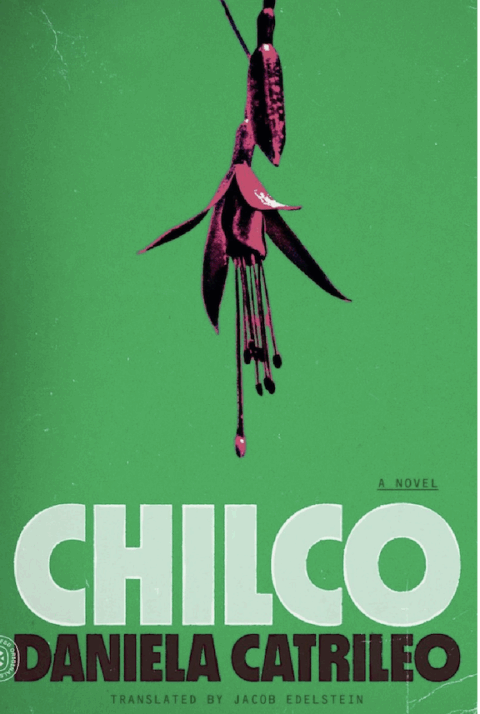
One doesn’t typically think of time as a concept that has been colonized, but in the Andes that is precisely the case. Prior to the arrival of European colonizers, indigenous Andean peoples, including my Quechua ancestors, thought of time not as the straight line or arrow often depicted in Western cultures but as a coil. Imagine the looping wire of an old rotary phone or the coils of a spring. That’s what time looks like. Instead of a linear progression of events marching inexorably forward with no way of reversing or redirecting, time dips, curves, and loops back on itself like a length of rope. The point where the timeline crosses back over itself, appearing to intersect, is the cataclysmic period known in Andean cosmology as a “pachacuti,” a moment of great upheaval in the world. For example, the expansion of the Chiefdom of Cusco into the Inca Empire — or the fall of that empire to the forces of colonization. In Daniela Catrileo’s novel Chilco, the time coil and pachacuti serve as the underlying shape of the narrative itself.
On the first page, the author indicates some unusual structural choices by offering what appears to be a piece of literary ephemera: an entry from the fictional Chilco Archive, providing an etymology/definition of the novel’s title, which derives from Mapudungun “chillko,” meaning “fuchsia” as a noun or “watery” and “to become watery” as an adjective and a verb, respectively. A second archive entry follows, describing the ecology of wild fuchsia, which grows in wetlands and other watery habitats, before readers are introduced to Marina, the first-person narrator. She has recently moved from Capital City to the island of Chilco with her dog Pachakuti and partner, Pascale, who grew up on Chilco and is now returning to the island to escape economic collapse and to reconnect with indigenous culture. Pascale identifies as Mapuche — specifically, as Mapuche Lafkenche, one of six territorial identities of the Mapuche peoples. To be Lafkenche is to have a deep connection with water and the ocean. For Pascale, the island’s tropical ecosystem and fish-focused economy offer a richness, a fecundity, that the gentrified and exploitative Capital City could never provide. For Marina, who grew up in Capital City and is Quechua, these damp and overgrown surroundings signify death and decay.
 After two short chapters introducing the island and Marina’s depression after moving to it, the narrative dips into the past, like the downward loop of the time coil. Readers will spend most of the novel in that dip. Catrileo navigates this time shift elegantly, using a combination of a chapter break and the narrator’s propensity to jump around and explore different subjects. “I always do better on a tangent,” Marina says. “I have an innate talent for diverting topics, to the point where people forget about the original idea.” In the context of the novel as a whole, that original idea is Marina’s sense of foreboding, which takes a backseat to the unfolding of her life in Capital City. We’re first introduced to her time renting an apartment with Pascale and a roommate, Laura, a techno musician and DJ who talks a big game about wanting to listen to the “urban vernacular” of the city and its people, but flees to New York City or someplace similar as soon as unrest erupts in Capital City. Sinkholes start opening up and swallowing houses. Buildings decay. Society fractures.
In a chapter titled “The Theory of Central Conflict,” the narrator outlines how businesses, government officials, and the mainstream media collude to pin the blame for the sinkholes on the working class protestors. This rhetoric enables them “to frame the popular movement as part of a terrorist operation, refusing to acknowledge its roots in widespread discontent” and also to obscure the true cause of the sinkholes: overdevelopment enabled by the policies of those very businesses and government officials. Such lies will be familiar to readers who have seen governments crack down on protesters, strip free speech rights, and attack its own citizens. Catrileo links the fascist and capitalist policies of Capital City to environmental degradation, emphasizing what activists and indigenous leaders have known for a long time: that racism, fascism, and capitalism are all inextricably linked. For the narrator, this is no great revelation. It’s simply a fact of life. She has to navigate the consequences of this truth as the city crumbles. “Like I said, life can’t be put on hold,” she says. “You’re tired, but you have to keep dancing, eating, loving.”
Marina and Pascale make a life for themselves in the decaying Capital City. Pascale gets a full-time job doing various kinds of repair work, and Marina continues working at the museum where they met, even as life grows more difficult and their relationship more strained. After one particularly tense fight (and passionate makeup session), the narrative dives even deeper into the past, to “the gentle times” when Marina first started working at the museum alongside Leila, who becomes a dear friend. One of Marina’s tasks is to hire a contractor to build sturdier shelving for the archives. Enter Pascale. Over the course of two months, Pascale renovates the A wing of the museum and grows close to Marina, who gradually falls for the contractor. In one moving scene, Pascale pauses to admire the skeleton of a blue whale (a species believed to have gone extinct in this near-future climate apocalypse). In running hands over the whale bones, Pascale unwittingly seduces Marina, who writes, “I felt fortunate then, to contemplate the presence of these two sea creatures.”
Only after that do readers learn the true origin of the Chilco Archive: it is a gift compiled by Marina and Leila in honor of Pascale’s last day on the job. Its eight short entries are dispersed throughout the novel and include a map, definitions, illustrations, music, and excerpts of historic texts—materials that Pascale may or may not have been familiar with already, but which provide the reader with additional context to understand this lightly fictionalized part of Chile. Within the novel, this archive serves many purposes, both structural and informational, but perhaps its most important role is emotional: it brings Pascale and Marina together. It also, in some respects, tears them apart, because the nostalgia it sparks in Pascale grows over the course of their relationship, until finally it becomes unbearable for Pascale to live anywhere else but Chilco. One day, Marina wakes to a letter from Pascale. “I feel like the territory is calling to me,” Pascale writes, “… like I can hear the heartbeat of its body, its pulse. And what moves inside me is its vibration.” Pascale does not (cannot) ask Marina to come to Chilco, but she does it anyway.
 And here we must return to that sense of foreboding, because there is a good reason why Pascale left Chilco as a youth: Pascale is what the reader understands to be transgender. Although that term never appears in the text, there are many clues throughout the novel (allusions to binding breasts and gravitating toward men’s clothes, the violence of a hate crime in which some aggressive straight men mistake Pascale for a gay man, making several false assumptions about Pascale’s gender and sexuality). One of the most remarkable aspects of the novel is the fact that it never genders Pascale or ascribes the character a pronoun. In the original Spanish, the author achieves this by utilizing the language’s built-in aversion to possessive pronouns like “his” and “hers,” which renders “his hand” as “the hand (or la mano).” In the English translation, adeptly undertaken by Jacob Edelstein, the effect is somewhat less seamless but still easy for readers to gloss over until one of the other clues emerges. When the narrative loops back to the present, the source of that foreboding becomes clear: the pervasive and oppressive anti-trans sentiments that follow Pascale and Marina around, making Marina in particular feel othered and unwelcome.
Where Pascale seems willing to overlook this bigotry from the other Chilqueños, Marina becomes so unsettled that she can barely function. She works remotely, alone in the rented house while Pascale is at work with family, fishing and doing odd jobs. One Friday, Marina goes out on a long walk with Pachakuti and gets caught in a storm. In her efforts to get dry, she stumbles into the home of a young man who turns out to be a bigot. He misgenders Pascale repeatedly, mocks Marina and her mixed Quechua heritage, and smokes menacingly under the rifle mounted on the wall. Disturbed by this encounter, Marina runs from the house. She hears a gunshot, then the sun sets, then she returns to the village to find people gathering and lighting candles outside Pascale’s father’s house as in vigil. It is implied that Pascale has died. But how? The novel never explicitly states what happened. That combination of bigot, gunshot, and vigil implies a hate crime, but the shot comes right after Marina leaves, so for this to be murder Pascale would have already needed to be in the house (or on the way). And how would the people standing vigil have known about it before Marina returned? It’s unclear. All the reader knows at this point is: Pascale is dead.
At first glance, the novel would appear to be participating in the “bury your gays” trope, the killing off of queer characters, sometimes to maintain the fiction of heterosexuality (as in The Talented Mr. Ripley) and sometimes as cosmic retribution for their queerness (as in The Fox, both the book and the 1967 film). Sometimes referred to as “dead lesbian syndrome” because of the preponderance of lesbians getting killed in film and television, the trope is widely known and often points to bigotry and bias on the part of the writer or creator, who may or may not be conscious of the bias. I admit my initial reaction to the sudden death was disappointment. Up until then, the sensitive handling of Pascale’s transition and the intense focus on queer love and progressive values rather than bigotry had led me to believe I was in — for lack of a better term — a safe space, one where I could rest assured that the trans character wouldn’t be abruptly murdered for no better reason than the author thought it was original. It took me a solid half hour to turn the page and find out what happened next.
What follows is open to interpretation. In the days after Pascale’s death, Marina falls into a deep depression and is roused only by the unexpected arrival of her family from the mainland, who have come to check up on her. Shortly after their arrival, they hear a commotion outside. A crowd has formed to celebrate the return of the blue whale. Three of them are seen swimming off the coast. Contextual clues sprinkled through the novel, including the wording of Pascale’s letter (“like I can hear the heartbeat of its body, its pulse. And what moves inside me is its vibration”) and the way Marina refers to Pascale and the blue whale as “two sea creatures” (emphasis mine), point toward an alternative but no less valid interpretation of Pascale’s death: that it wasn’t brutal murder but was, instead, a different kind of transformation, one where an indigenous trans person becomes a majestic sea creature. This would solve the logistical questions about the gunshot and make sense of the moment when Marina arrives at the vigil and someone tells her, “It’s okay,” an inappropriate statement in the context of murder but a sensitive and caring one in the context of a transformation, especially one with ritualistic undertones. In Mapuche mythology, there is a story of a fisherman slowly turning to stone and becoming a manifestation of the sea god Lafkenfucha, so there is precedent for a Mapuche Lafkenche person to undergo such holy transformations. The author may be trying to create a new trans mythology and center queerness and indigeneity in the work of reversing climate disaster. It’s a powerful idea, if indeed it is the author’s intent.
 This question of intent remains a thorny one, especially given the politics of this moment, when what few trans protections exist are being rolled back in several countries. It’s important to note that Catrileo is writing from a Chilean context — not an American or British one. In Chile, a primarily conservative and Catholic country, legal name and gender changes have been available through the court since 1974, but legal protections for gender identity weren’t implemented until 2012, and gay marriage was not legal until 2022. In some respects, Chile is more progressive on queer and trans rights than the United States is today — but that does not necessarily mean a trans person will be welcomed or feel safe everywhere. Chilco is proof of that, as is the hate crime that Pascale survives in Capital City. Without detailing this legal history or centering violent acts, the novel makes it clear that Pascale could be targeted at any time.
Reading Chilco, I was reminded of another Latin American novel that explores the events leading up to a trans person’s death: Hurricane Season by Fernanda Melchor. The book opens on the discovery of the rotting corpse of the Witch (later revealed to be a transgender woman), then jumps back in time to examine how internalized homophobia, machismo, greed, and drug use led the transwoman’s lovers to murder her. Though the novel is not narrated from a trans character’s perspective, it is in part about the precarity of existing as a trans person in Latin America. Where Hurricane Season presents that precarity through the eyes of (often judgmental) straight people, Chilco centers queer experience, focusing on desire and connections while pushing violence and hatred to the margins. Why, then, allude to the possibility of murder? Why not say so plainly, like in Hurricane Season, in order to comment on anti-trans violence? The novel has no issue making its politics clear elsewhere, as with the protests. One could read the avoidance of naming the hate crime in combination with the complete absence of the word “trans” as a kind of erasure.
I think Chilco is doing something else entirely. Recall that when the time coil loops back on itself, there is a “pachacuti,” a period of great upheaval or change in society. The return of the blue whale marks the end of one era and the beginning of another. Or, in other words, the point at which capitalism fails so utterly that something else, something indigenous, reemerges to take its place. In this reading, Pascale’s transformation into the blue whale is a wondrous and momentous occasion ushering in a new way of living and being in relation to the Earth. This assumes that the transformation is voluntary and not intended to be taken as a sacrifice (violent or otherwise), but, given the author’s own Mapuche ancestry and centering of indigenous principles, I find it hard to believe she would be advocating that trans, indigenous, and other marginalized peoples sacrifice themselves for the sake of the planet. Instead, the novel ends on a note of wonder, as the narrator marvels at the whales “swimming in circles, unafraid of extinction.” I choose to believe Pascale has this transformative power, but other readers might interpret the ending differently. As Marina says, “We’re drawn to that which mirrors our own way of interpreting the extraordinary.”
[Published by Farrar, Straus & Giroux on July 15, 2025, 256 pages, $18.00 paperback]